
Xi’an · In-depth place guide
陕西历史博物馆本馆
An ancient capital, in small things.
A tiger that authorised armies. A camel carrying a concert. A cup carved from a single piece of agate. Read the region through the things people made.
Choose a thread through the collection. Let the objects do the talking.
The main museum at Xiaozhai brings the region’s long history into a single collection visit. Its core exhibition moves through seven periods, with particular attention to Zhou, Qin, Han and Tang. This is where an apparently modest vessel, seal or pottery figure can make an imperial capital feel more intelligible.[7]
Start with one question: how was power exercised, how did people live, or what connected Chang’an with the wider world? Our closer looks are a collection-reading companion, not a promise that every photographed object will be in its usual case. Current labels and gallery notices settle what you can see on the day.
Plan your visit
Before you book.
- Which museum?
- The main museum at 91 Xiaozhai East Road. The Qin-Han branch is a separate journey.
- Time to allow
- Our suggestion: an unhurried half-day. Add a paid mural visit only if it is a priority.
- Before travelling
- A successful official order and the original passport used for the main-museum booking.
- Best approach
- Choose a few objects and one historical thread; leave time to read and sit.
A dated opening exception matters here.
From 15 March to 14 November 2026, the main museum opens on Mondays and the Qin-Han branch on Tuesdays. Main-museum hours in that notice are 08:30–19:00, last check 18:00. Do not extend this exception beyond 14 November without a new notice.[3]
Choose the ticket for your visit
Choose the main museum deliberately. A free general reservation, a paid exhibition order and admission to the Qin-Han branch are different arrangements.
Published arrangements checked 29 October 2026. Paid-exhibition availability, concessions and the actual order take precedence over an old guide.[2]
Main museum · general visit
- Admission / order
- Free, with an official reservation unless a published exemption applies.
- What to check
- Match the main museum, visit date, session and travel document.
Tang Mural Treasures
- Admission / order
- Separately paid exhibition. Confirm the current price in the official booking flow.
- What to check
- An advance online order can establish main-museum entry without a duplicate free reservation.
Hellenistic gold · temporary
- Admission / order
- Published adult price CNY 100; 14 June–29 November 2026, Room 7.
- What to check
- Date-limited. Do not put this exhibition into a visit after its announced end.
Qin-Han branch
- Admission / order
- The current guide permits entry with an original valid identity document, without reservation.
- What to check
- Different location and collections; foreign passports are checked by staff.
| Visit / product | Admission / order | What to check |
|---|---|---|
| Main museum · general visit | Free, with an official reservation unless a published exemption applies. | Match the main museum, visit date, session and travel document. |
| Tang Mural Treasures | Separately paid exhibition. Confirm the current price in the official booking flow. | An advance online order can establish main-museum entry without a duplicate free reservation. |
| Hellenistic gold · temporary | Published adult price CNY 100; 14 June–29 November 2026, Room 7. | Date-limited. Do not put this exhibition into a visit after its announced end. |
| Qin-Han branch | The current guide permits entry with an original valid identity document, without reservation. | Different location and collections; foreign passports are checked by staff. |
The older English page lists winter hours 09:00–17:30 and a 16:00 ticket-office cutoff. Confirm the coming winter’s last check and closing-day notice.[6]
An old 2024 mural discount ended on 31 October 2024; that notice restored an adult reference price ofCNY 270 afterwards. We have not verified a current paid checkout and do not reuse the expiredCNY 150 promotion.[28]
The June 2026 gold-exhibition notice confirms that advance online gold or mural purchases do not require a duplicate free main-museum booking. Buying an add-on after entering is a different route: it does not get an unbooked visitor through the gate.[5]
Buying with a foreign passport
Use 陕西历史博物馆 on WeChat. Main reservations release five days ahead at 17:00 China time. Prefilling is not a confirmed order.[2]
Bring the booked original passport and successful order to the South Gate in your reserved session.[2]
Cancel before your session’s last check. The general policy imposes a 180-day reservation restriction after a no-show.[2]
Advance paid gold-exhibition tickets are treated as used when their order admits you through the main museum’s South Gate; refund eligibility changes at that point. Read the particular paid product’s conditions before purchasing.[5]
For passport or name-field difficulties, call +86 29 85253806 during working hours. The museum’s June reply says its public lines are not 24-hour services.[27]
Find your bearings
One main museum. Several ways to read it.
The core Ancient Civilization of Shaanxi display is organised in three galleries and seven historical stages. Use its chronology as a framework, then slow down at a handful of cases. You do not need to absorb every period equally.[7]
The Hejia Village hoard is identified with Room 4. Tang Mural Treasures is in the east building’s basement; the 2026 programme also pairs its ticket with the Han Xiu tomb-mural conservation display in the west basement. Follow current signs between buildings and floors.[11][4][23]
A collection entry marked “displayed” is useful research, but not a live case-location system. Two official records for the dancing-horse flask even show opposing display statuses. Keep the collection insight; confirm the original’s presence locally.[18][19]
Power and public life
People and the Tang capital
Craft, exchange and fragile images
Open the museum’s floor plans and visitor services ↗
The region was a political centre. Ritual bronzes link objects with rank, ceremony and written accounts of transactions and conflict.[8][22][21]
The Du County tiger tally is catalogued to the Warring States period. It makes military authorisation tangible; do not assume every Qin-labelled object dates to the short unified empire.[14]
The Han collection combines an imperial capital, tomb material and objects of work and everyday life. A small seal can be as revealing as a spectacular model.[9]
Chang’an’s city planning, craft, music and long-distance connections form different strands of the Tang galleries. Read “Silk Road” through particular materials and forms.[10]
The Hejia Village Tang hoard was excavated in Xi’an in October. Its fine objects offer a concentrated study of material, technique and use.[11]
A closer reading
What to look for.
Twelve closer looks. Read the Chinese object names on labels; photographs are dated collection views, not an inventory of today’s display.
Core exhibition
陕西古代文明
Start with the chronology, then choose
The museum’s core display divides the story into prehistory, Zhou, Qin, Han, the Wei–Jin and Northern–Southern dynasties, Sui–Tang and later periods. The sequence helps distinguish different capitals and political worlds rather than collapsing them all into one timeless “ancient China”.[7]
A useful first pass is simply to locate your chosen period and one object you want to understand. After that, read more slowly. This guide’s theme groups are editorial choices, not prescribed museum routes.
Our looking suggestionFind the date range, excavated location and material on one label before reading the longer interpretation.
Zhou collection
多友鼎 · 五祀卫鼎
Bronze vessels can be documents
The Duoyou ding has a deep rounded body, restrained decoration and a long inscription recording conflict and reward. Its surface is only part of the story: the writing makes the vessel historical evidence.[21]
Another example, the Wusi Wei ding, records a land transaction and its official procedures in 207 characters. These two cases make a useful comparison: commemoration of military action versus negotiation and administration. Read the displayed interpretation; a top-down photograph of lettering is not the same as being able to look inside a case.[22]
Our looking suggestionCompare handles, legs and body before looking at a transcription of the inscription.
Qin collection
杜虎符
A small tiger, a system of authority
The museum identifies this bronze tally with Du County and the Warring States period. It was made as one half of a matched token: the ruler retained one half and the local official held the other. Fitting them together authorised the dispatch of a force of more than fifty soldiers, according to the catalogue.[14]
Its compact animal shape is appealing, but the useful question is institutional: how did a distant order become something an official could check? This is a different scale of evidence from the massed army outside the city.
The accompanying coin-mould photograph has a Qin-dynasty label. It is included here as a second small object of administration and production, not as Han material.
Our looking suggestionLook for the tiger’s outline and written characters; ask what part of the command system survives here.
Han collection
皇后之玺
An empress’s seal, with a careful attribution
Only a few centimetres across, this Western Han jade seal carries four characters meaning “Empress’s Seal”. The museum records its discovery near Xianyang in 1968 and describes an animal-form knob.[15]
The catalogue proposes that it may have belonged to Empress Lü Zhi because of its findspot near Changling. That is an attribution, not a securely documented personal ownership statement. Its scale and inscription are powerful enough without turning a possibility into certainty.[15]
Our looking suggestionFind 皇后之玺 in the label or magnified inscription. A photographed seal impression may be clearer than the carved underside.
Han collection
汉代生活与生产
Leave room for ordinary materials
The Han display also concerns farming, manufacturing, trade and everyday life. Pottery buildings, agricultural tools, coins and jade objects broaden the story beyond imperial names. Tomb objects are evidence selected for a burial; they should not be treated as a neutral photograph of everyone’s daily life.[9]
Compare a small animal-shaped jade with a monumental political object, or a tomb model with evidence of practical work. These are looking prompts. The archival photographs here do not establish that the same objects remain in the same cases.
Our looking suggestionChoose one object of daily use, then another that concentrates individual craft.
Tang collection
三彩载乐骆驼俑
A whole musical scene on a camel
The museum describes eight human figures: seven seated male musicians around a standing female singer. The camel supports an imagined travelling stage, with a platform and brightly glazed surface. This Shaanxi example is different from the five-performer camel in the National Museum of China.[17]
Treat the ensemble as a carefully constructed artistic scene, not literal evidence that a full band routinely travelled this way. Watch how heads, instruments and the standing figure turn a small model into an animated composition.
Our looking suggestionCount figures, follow the direction of the players, and separate the singer’s stance from the seated ring.
Tang gallery theme
长安与丝路
A capital open to different forms
The Tang interpretation connects Chang’an’s planned streets and palace districts with craft, music, sport and long-distance exchange. Imported forms and locally made objects coexist in this story; resemblance alone does not prove where a particular object was made.[10]
The photographed octagonal cup gives another way into music and design: follow the separate decorated faces, then compare its metal surface with the glazed camel. This is a material-and-composition exercise, not a claim that one object explains every community of the Tang capital.
Our looking suggestionMove between one architectural idea, one figure and one vessel; notice how their evidence differs.
Room 4 · current signs govern
大唐遗宝——何家村窖藏
Read a hoard as a group
The Hejia Village discovery brought together a rich group of Tang objects in 1970. Room 4’s exhibition is the place to compare them: vessels, materials and techniques make more sense in relation to one another than as an isolated list of famous treasures.[11]
Start with one object’s function, then compare its outline or decoration with a neighbour. The operator’s recorded panorama is also useful preparation. Its photographed cases record a particular display; they cannot confirm where originals will be during your visit.
Our looking suggestionAsk which objects are containers, which are fittings, and what details turn a practical form into a luxury object.
Hejia Village collection
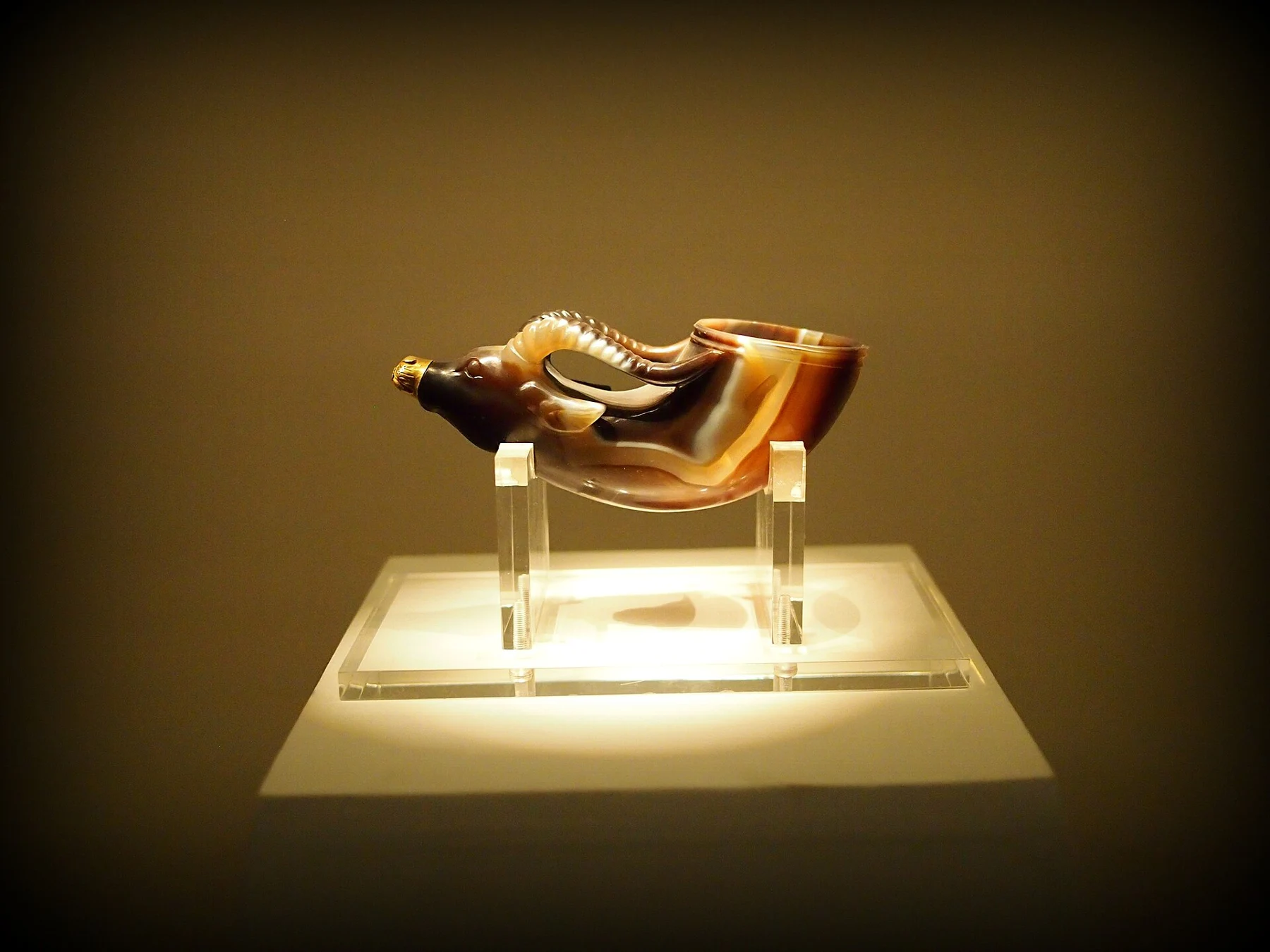
镶金兽首玛瑙杯
A cup shaped by its own stone
Carved from banded agate, this cup curves towards an animal head with a gold fitting at the mouth. The museum explains that removing the gold stopper lets liquid flow through: the shape is a rhyton, rather than a conventional open drinking bowl.[13]
Its place of manufacture remains debated in the museum’s interpretation. The form connects it with drinking vessels familiar in Central and West Asia; that relationship is stronger evidence than a confident but unsupported “made in Persia” label.[13]
Our looking suggestionFollow the stone’s natural bands and the way the horns reconnect with the body.
Tang collection
银香囊
Look inside the silver sphere
The English catalogue’s silver perfume fumigator consists of two openwork hemispheres. Concentric rings inside support the inner container so that it can stay level as the outer sphere moves. This is engineering as well as ornament.[16]
A static photograph cannot demonstrate the moving mechanism. Use the label, a model or a museum explanation if available; do not mistake a modern souvenir’s working demonstration for handling the ancient original.
Our looking suggestionFind the seam between the halves and distinguish the suspension, openwork shell and internal support.
Hejia Village collection · display unconfirmed
鎏金舞马衔杯纹皮囊式银壶
A silver vessel that remembers a skin bag
The museum’s interpretive record explains the flattened skin-bag form, small lid and chain, and the horse holding a cup in relief. The metalwork translates a portable container into a luxury object and links its imagery with Tang court entertainment.[19]
Official records conflict: one interpretive entry says displayed, while the collection-data entry says not displayed. Use this archival photograph to understand the form; ask staff about the actual original before making it the sole reason for visiting.[18][19]
Our looking suggestionTrace the lid, connecting chain and raised horse. The highlighted decoration is different from the silver body.
East basement · paid
唐代壁画珍品馆
A separate visit to fragile painted worlds
Tang tomb murals preserve images of architecture, attendants, envoys, hunting, music and sport. The museum explains that these fragile works require controlled conditions; its collection total is not a count of pictures all displayed at once.[12]
Choose this extra if painting and Tang visual culture interest you enough to read slowly. The accompanying photograph is explicitly a reproduction of Palace Maids, taken at the museum in 2006. It is not a photograph of an original currently in the paid gallery. The mural and Han Xiu conservation exhibitions are linked in the 2026 published programme.[12][4]
Our looking suggestionLook at placement, gesture, clothing and surviving colour. Respect the current room’s photography and lighting instructions.
Choose what matters
Make the visit yours.
Visitors who want a rounded collection visit.
From public power to Tang craft.
- Keep
- Selected core galleries and the Hejia Village theme.
- The trade-off
- You will still need to choose; this is not every case plus every special exhibition.
Start with the core story
Use the chronological sequence for context; compare two earlier periods.
Give Tang objects proper attention
Read the camel and a small group of metal or stone objects.
Pause, then choose Room 4
Check current inclusions and concentrate on material and function.
Keep the rest of the day light. A timed reservation is an entry session, not a promise of an empty gallery.
All outlines are editorial estimates, not field-tested routes. Follow current admission rules and venue directions.
Arrival, energy and interpretation
Get the details right.
Arrive at the right gate
Save 陕西历史博物馆本馆,西安市雁塔区小寨东路91号. For the main museum, Xiaozhai 小寨 is on Lines 2/3; Dayanta 大雁塔 is on Lines 3/4. Both require a street walk. Follow current South Gate directions.[1]
Qin-Han is on Lanchi Third Road in Qinhan New City, Xixian New Area, near Line 14’s Qingong 秦宫 station.[2]
Our suggestion is to leave luggage at your accommodation and allow a comfortable margin for the walk, security and document check. No door-to-door journey time, station exit or queue duration has been verified here.
English interpretation
The 22 June 2026 fee chart lists an English Ancient Civilization tour atCNY 600 for 90 minutes, up to 10 people; English Hejia Village interpretation isCNY 200 for 40 minutes. These are published tour charges, not an included entry ticket or confirmed guide availability.[23]
The same chart lists English mural / Han Xiu interpretation atCNY 300 for 60 minutes. Ask the service desk about availability, meeting arrangements and which admission products you need.[23]
Access and a manageable route
The museum’s accessibility page lists South Gate access, lifts, accessible toilets, Braille labels and free wheelchair/stroller provision at visitor services. These are listed facilities; availability and a complete step-free route through the desired rooms have not been tested.[24]
If using a powered mobility aid or travelling with a service dog, contact the museum in advance: its published prohibited-item list has specific restrictions and a separate assistance arrangement for guide-dog users. Do not infer ordinary access from a generic accessibility symbol.[25]
Bags, photography and comfort
The English visitor page lists charged deposit boxes and prohibits flash photography, eating and drinking in exhibition halls. Check current locker capacity and charges; we have not tested them. Individual exhibitions may have stricter image rules.[6]
The prohibited-item list includes tripods and lighting equipment, lighters and sunscreen sprays. Keep this an ordinary-light visit and read the full list if carrying specialist equipment.[25]
Children and exemptions
Children aged 6 or under, or up to 1.4m, can accompany a booked adult without reservation, maximum two per adult. Confirm passport-family categories.[2]
The museum’s senior and disability exemptions refer to specified documents. We do not turn a Chinese ID-card scanning instruction into a blanket passport-holder entitlement. A reduced-price paid exhibition has its own verification rules.[26]
CCTV-3 · National Treasure · episode 20171224
Three objects, told through film.
CCTV-3 · National Treasure · Episode broadcast 24 December 2017
National Treasure: objects from Shaanxi History Museum
A Chinese-language cultural programme about the silver incense container, Du tiger tally and Prince Yide’s mural. Interpretation and performed historical scenes are distinct from documentary evidence. This archival programme does not establish current displays or access.
Watch the original museum episode on CCTVOpens the publisher’s own player in a new tab. Chinese source; English subtitles and regional playback are not confirmed. The cover is a credited reference photograph, not a film still.
- The original 2017 Chinese-language programme discusses the silver incense container, Du tiger tally and Prince Yide’s mural. It combines interpretation and performed historical stories; staged scenes are not documentary evidence of the past.
- Use it for cultural context, not current cases or visitor arrangements. English subtitles, regional playback and a complete viewing have not been verified.
Official digital resources
Walk around the Hejia Village exhibition online.
The museum’s Room 4 page links a recorded interactive panorama. We opened the actual viewer, selected 美食美器 and scene 12, then dragged the view at desktop and narrow 390 px widths. It is a recorded exhibition, not live video.[11][30]
Treasures of the Great Tang · Hejia Village
Open the scene strip at the bottom if needed. 美食美器 means “food and fine vessels”; choose thumbnail 12, then drag to look around the room. Chinese category names, the map and numbered scenes help navigation. Only this tested selection and pointer drag are confirmed.[30]
Open the museum’s Hejia Village panoramaThe viewer reports that its visitor counter is unavailable, but the tested room and panorama still loaded. We did not verify all 44 scenes, English coverage, complete narration, every hotspot or real-device touch gestures.[30]
The mural page also links an older Flash-labelled panorama. It is not presented here as a verified working modern tour; a contemporary browser does not establish that an obsolete viewer works.[12]
Before you ask.
Is this the Terracotta Army museum?
No. The army and Lishan Garden form an out-of-town museum visit. This guide concerns the main Shaanxi History Museum at Xiaozhai. Keep them as separate principal outings.
Can I turn up at the main museum with only my passport?
The main museum accepts passports for reservations; an original passport alone is not general walk-in admission.[2]
Is Monday always closed?
No. The dated 2026 exception covers 15 March–14 November. For a later trip, check the new operating notice before choosing the day.[3]
What if the free reservation is unavailable?
Recheck the official channel or choose another confirmed activity. A separately paid exhibition is a deliberate cultural purchase with its own conditions, not a promise of stock or a reason to trust an unofficial seller.
Are all the famous treasures guaranteed?
No. Old photos, catalogue entries, loans and even conflicting database statuses cannot establish every current display. Choose a theme broad enough to enjoy the collection that is actually open.
Should we do every gallery and the murals?
Only if your interest and energy support it. Our half-day outline is selective; the painting-focused option trades some core-gallery coverage for slower looking.
Dates, sources and photographs
Follow the evidence.
Desk research checked 29 October 2026 against museum notices, visitor policies, collection interpretation and original film sources. Visit outlines and looking prompts are editorial suggestions; no booking, payment, guide hire or on-site inspection was performed. Every published photograph was checked for visible subject and licence; historical views and reproductions are labelled.
Reviewed 2026-10-29. This date records our source review, not a live availability check.
Open 31 source references
- Main museum official portal
Official visitor information · Reviewed 2026-10-29
- Current Chinese visitor and reservation policy
Official visitor information · Reviewed 2026-10-29
- Dated 2026 extended opening notice
Official visitor information · Reviewed 2026-10-29
- 2026 September/October holiday programme · expired hours
Official visitor information · Reviewed 2026-10-29
- Hellenistic gold exhibition · dates and admission conditions
Official visitor information · Reviewed 2026-10-29
- Older English visitor information · conflicts disclosed
Official visitor information · Reviewed 2026-10-29
- Ancient Civilization of Shaanxi · core exhibition
Official visitor information · Reviewed 2026-10-29
- Zhou collection interpretation
Official visitor information · Reviewed 2026-10-29
- Han collection interpretation
Official visitor information · Reviewed 2026-10-29
- Sui–Tang collection interpretation
Official visitor information · Reviewed 2026-10-29
- Hejia Village exhibition and linked panorama
Official visitor information · Reviewed 2026-10-29
- Tang Mural Treasures · collection and location
Official visitor information · Reviewed 2026-10-29
- Museum interpretation · agate cup
Official visitor information · Reviewed 2026-10-29
- English catalogue · Du County tiger tally
Official visitor information · Reviewed 2026-10-29
- English catalogue · empress jade seal
Official visitor information · Reviewed 2026-10-29
- English catalogue · silver perfume fumigator
Official visitor information · Reviewed 2026-10-29
- Museum interpretation · eight-figure musical camel
Official visitor information · Reviewed 2026-10-29
- Dancing-horse flask · collection-data status
Official visitor information · Reviewed 2026-10-29
- Dancing-horse flask · interpretive entry and opposing status
Official visitor information · Reviewed 2026-10-29
- Gold bowl · collection-data status
Official visitor information · Reviewed 2026-10-29
- Duoyou ding · inscription and history
Official visitor information · Reviewed 2026-10-29
- Wusi Wei ding · land-transaction inscription
Official visitor information · Reviewed 2026-10-29
- Main museum guide-fee chart ·22 June 2026
Official visitor information · Reviewed 2026-10-29
- Museum accessibility facilities ·22 August 2024
Official visitor information · Reviewed 2026-10-29
- Published prohibited-item list
Official visitor information · Reviewed 2026-10-29
- Museum replies · September 2026 document and ticket questions
Official visitor information · Reviewed 2026-10-29
- Museum replies · June 2026 phone and mural questions
Official visitor information · Reviewed 2026-10-29
- Expired 2024 mural promotion and restored reference tariff
Official visitor information · Reviewed 2026-10-29
- CCTV · National Treasure ·24 December 2017
Official visitor information · Reviewed 2026-10-29
- Museum-hosted Hejia Village recorded panorama · actual scene tested
Official visitor information · Reviewed 2026-10-29
- 2025 temporary renovation display · historical notice
Official visitor information · Reviewed 2026-10-29
Photograph authors, dates and licences (17 photographs)
源義信 · 2023-10-10 09:53:35 · CC BY-SA 4.0
Resized and converted to WebP. Image-file proportions retained; hero and preview layouts may crop the display. Original licence retained.
源義信 · 2023-10-10 13:21:37 · CC BY-SA 4.0
Resized and converted to WebP. Image-file proportions retained; hero and preview layouts may crop the display. Original licence retained.
Nishino Asuka · 2022-09-22 · CC BY-SA 4.0
Resized and converted to WebP. Image-file proportions retained; hero and preview layouts may crop the display. Original licence retained.
Deadkid dk · 2010-12-19 · CC BY-SA 3.0
Resized and converted to WebP. Image-file proportions retained; hero and preview layouts may crop the display. Original licence retained.
Deadkid dk · Date not recorded by source · CC BY-SA 3.0
Resized and converted to WebP. Image-file proportions retained; hero and preview layouts may crop the display. Original licence retained.
Gary Todd from Xinzheng, China · 2009-01-01 00:00 · CC0
Resized and converted to WebP. Image-file proportions retained; hero and preview layouts may crop the display. Original licence retained.
幽灵巴尼 · 2013-11-16 11:09:56 · CC BY-SA 3.0
Resized and converted to WebP. Image-file proportions retained; hero and preview layouts may crop the display. Original licence retained.
Gary Todd from Xinzheng, China · 2019-03-23 16:28 · CC0
Resized and converted to WebP. Image-file proportions retained; hero and preview layouts may crop the display. Original licence retained.
Deadkid dk · 2010-12-18 · CC BY-SA 3.0
Resized and converted to WebP. Image-file proportions retained; hero and preview layouts may crop the display. Original licence retained.
Original uploader was Mountain at zh.wikipedia · 3 August 2004 (original upload date) · CC BY-SA 3.0
Resized and converted to WebP. Image-file proportions retained; hero and preview layouts may crop the display. Original licence retained.
momo from Hong Kong · 2013-04-18 11:37 · CC BY 2.0
Resized and converted to WebP. Image-file proportions retained; hero and preview layouts may crop the display. Original licence retained.
Gary Todd from Xinzheng, China · 2011-03-12 16:15 · CC0
Resized and converted to WebP. Image-file proportions retained; hero and preview layouts may crop the display. Original licence retained.
Gary Todd from Xinzheng, China · 2011-03-12 16:14 · CC0
Resized and converted to WebP. Image-file proportions retained; hero and preview layouts may crop the display. Original licence retained.
G41rn8 · 2006 · CC BY-SA 4.0
Resized and converted to WebP. Image-file proportions retained; hero and preview layouts may crop the display. Original licence retained.
Byrnzie500 · 2009-08-26 12:09:14 · CC BY-SA 2.0
Resized and converted to WebP. Image-file proportions retained; hero and preview layouts may crop the display. Original licence retained.
Gary Lee Todd, Ph.D. · 2000-01-01 00:02:04 · CC0
Resized and converted to WebP. Image-file proportions retained; hero and preview layouts may crop the display. Original licence retained.
Gary Lee Todd, Ph.D. · 2000-01-01 00:01:58 · CC0
Resized and converted to WebP. Image-file proportions retained; hero and preview layouts may crop the display. Original licence retained.
How conflicting descriptions were handled
Specific 15 March–14 November 2026 opening provisions supersede the older English weekly closures within that window only. The March 15–April 30 renovation capacity was temporary, not a present daily allocation. The September/October holiday’s 07:30–20:30 opening is also expired.[3][6][4]
The 2025 renovation article describes a temporary substitute exhibition and planned works. The 2026 holiday programme identifies the core Rooms 1–3 and Room 4 as open; old closure text is not carried forward as a current shutdown. Individual current-case availability still requires confirmation.[31][4]
Current Chinese official-only main booking and no-reservation Qin-Han entry supersede older English reseller/branch instructions.[2][6]
Mural pricing is left to the live official product. The 2024 CNY 150 promotion expired; a later notice’s reference tariff and 2026 student answer do not establish a completed adult passport checkout.[28][27]
A detailed interpretive entry for the dancing-horse flask says displayed; a data entry says not displayed. Gold-bowl data also says not displayed. We do not turn catalogue status or archival photography into a guarantee of an original in a named current case.[18][19][20]
The named Palace Maids image is a reproduction at the museum, not the original. Search results for similar murals at Qianling or a reproduction at Guimet were excluded from the place photographs.
What still needs direct confirmation
- Current paid adult passport checkout, remaining reservations and successful foreign-card payment.
- New closure/last-check notices after 14 November 2026, and temporary exhibitions after their end dates.
- Every original object’s present display, loans, room location and photography restrictions.
- English guide availability, locker charges/capacity and an end-to-end step-free route.
- All panorama scenes, touch gestures on a real phone, complete narration and English coverage.
Film verification: Original episode title, date and description read at the publisher. External source link only; no rehosted video or unverified playback claim.
In this guide