
Beijing · In-depth place guide
北海公园
Slow down beside the water at Beihai
An island stupa, glazed dragons and small gardens within an imperial landscape.
Choose the island, a northern garden, or an unhurried lakeshore visit—with the right ticket for each.
Beihai is an imperial garden in central Beijing, with an island, substantial water, historic courtyards and a northern shore of smaller architectural settings. The city’s account traces its development through the Jin, Yuan, Ming and Qing periods. Its layers matter more than an unsupported claim that every building has survived untouched for centuries.[1]
The White Dagoba is the recognisable landmark, but it is not the whole visit. A closer look at a glazed screen, a pond garden or a stone-calligraphy setting can make the place more rewarding than simply circling the water. Our suggestion is to choose an island-focused or northern-shore-focused visit first.
Keep Beihai Park in Beijing distinct from the city of Beihai in Guangxi, and keep its White Dagoba distinct from Beijing’s separate Miaoying Temple / White Stupa Temple. The Chinese name 北海公园 is the useful anchor for a map or taxi. A view of a white stupa elsewhere does not identify the same attraction.
Plan your visit
Before you book.
- Park hours
- April–October: opens 06:00, last entry 20:30, closes 21:00. November–March: opens 06:30, last entry 19:30, closes 20:00.[1]
- Courtyards and scenic sites
- The detailed guide lists April–October 08:00–18:00, last entry 17:30; November–March 08:30–17:00, last entry 16:30. A September 2026 notice confirms Monday closures for named temple and courtyard areas; check current exceptions and the specific site.[4][5]
- Suggested time
- Our estimate is about two hours for a selective island/shore visit, or a half-day for a broader choice with pauses. These are editorial estimates, not measured or accessibility-tested routes.
- Foreign visitors
- The municipal May 2025 answer confirms both online and on-site ticket channels, including staffed purchase without an advance booking. Bring valid identity documents and choose a gate for your intended visit.[2]
- Boats
- Treat a boat as an optional separate service. Confirm the actual route and last departure; our visit outlines do not depend on a ferry operating.
September 2026: Liuli Pavilion courtyard opens
A municipal report dated 30 September 2026 announces the opening of the Western Heaven complex’s third courtyard, with its glazed pavilion and historical interpretation. It states that park admission covers the complex. Check today’s courtyard hours and closures before planning this extension.[21]
Choose the ticket for your visit
The basic park ticket and the combined ticket have different coverage. The municipal service reply describes the combined peak-season product as including Qiongdao and Tuancheng (the Round City). Before buying, check which paid area you want, whether it is open and what the current product includes.[2]
Published full-price adult tickets · CNY[1]
April–October
- Park admission
- CNY 10
- Combined ticket
- CNY 20
November–March
- Park admission
- CNY 5
- Combined ticket
- CNY 15
| Season | Park admission | Combined ticket |
|---|---|---|
| April–October | CNY 10 | CNY 20 |
| November–March | CNY 5 | CNY 15 |
The prices above are published full-price adult amounts. The current listing also gives concession prices, but eligibility depends on the relevant policy and documents. A ticket benefit for one visitor is not evidence that a boat, event or every extra programme is included.[1]
If you mainly want the lakeshore and a selected open garden, decide deliberately whether the combined product adds something you intend to use. If the island temple or Round City is central to the visit, check that specific admission before setting off.
A May 2025 municipal answer confirms eligible child free entry in the case it addresses. For a particular child, ask about the age/height and document conditions at purchase, rather than extending an adult price or a family anecdote to every visitor.[2]
Buying with a foreign passport
Use the municipal Visiting Beijing Parks (畅游公园) channels or buy through the park’s staffed gate windows. The newer municipal answer explicitly permits visitors without a prior ticket to purchase on site. We do not repeat the older page that tells foreign visitors they must telephone at least a day ahead.[2]
That answer identifies five gate areas: South Gate and Southwest Gate on Wenjin Street; the park’s North Gate and Jingxin Studio’s North Gate on Di’anmen West Street; and East Gate on Zhishan Street. Choose for the area you want to visit, not an assumption that one general park address means a single entrance.[2]
The official municipal online tutorial accepts passports or Foreign Permanent Resident IDs and describes QR-code entry with the matching valid document. This is a published process, not a completed test with your particular foreign phone number or card. If online purchase fails, ask about the staffed option rather than substituting another person’s identity.[3]
The park enquiry number in the March 2026 listing is +86 10 64037972. Use it to confirm your intended courtyard, access needs, current ticket product or a temporary closure before travelling.[1]
Find your bearings
One lake, several kinds of visit.
The municipal guide divides the main park into Jade Islet / Qiongdao, the eastern shore and the northern shore. The Round City is an associated, relatively independent garden near the southern entrance. An island climb and a northern pond-garden visit are different physical and interpretive choices.[6][7]
Use the lake as a visual connection without assuming that the most direct line across it is a route you can take. A ferry may connect particular points when operating, but its presence in an old itinerary does not establish a current service. Pick a finishing gate and a return that still work without it.
Southern / island emphasis
Northern shore emphasis
A slower connection
Municipal park guide ↗
A closer reading
What to look for.
The island, northern shore and Round City are different emphases. Use these explanations to make a coherent selection rather than treat every name as a required circuit.
A compact southern garden choice
团城 · 承光殿
Round City & Chengguang Hall
Tuancheng is a relatively independent elevated garden near Beihai’s southern entrance, not another name for Qiongdao. The parks authority describes it as part of the wider imperial landscape, with ancient trees and the Dushan Jade Sea vessel among its notable features. Its separation matters when selecting a ticket and a route.[7]
A small enclosed setting provides a useful contrast to the broad lake. Look at the hall, terrace and trees as a composition. Do not equate a compact area on a map with a surveyed step-free approach: it is raised above the surrounding road level.[7]
The Chengguang Hall photograph below is dated January 2024. It illustrates the setting, not the exact rooms, objects or routes available on your day. If this is your main interest, confirm the current entrance and combined-ticket conditions first.
Our looking suggestionNotice how an enclosed, elevated garden feels different from the open shoreline.
Read the landmark before the climb
永安桥 · 琼岛
Yong’an Bridge & the island approach
Yong’an Bridge connects the southern approach with the island setting. The municipal feature identifies the bridge and White Dagoba hill together as a recognisable Beihai composition. This is an architectural sequence over water, not simply the first place to take a selfie.[8]
Look at the way the bridge sets up the view toward the island, then compare the same relationship after changing position. Our suggestion is to leave room for people crossing rather than making the centre of the bridge a fixed photo position.
Decide whether you want the temple-and-hill visit or a lower-level view of the island. The background landmark can be appreciated from the shore without implying the same access or effort as ascending to its upper area.
Our looking suggestionBegin with the relationship of bridge, hill and water; the landmark makes more sense in its setting.
The island’s religious and architectural focus
永安寺 · 白塔
Yong’an Temple & the White Dagoba
The White Dagoba stands on Qionghua Island and belongs to Yong’an Temple’s setting. The parks authority dates its foundation to 1651 and describes its Tibetan-style form. It is a different architectural subject from the timber halls, bridges and garden pavilions around the lake.[10]
The temple is a hillside complex. Read the sequence of buildings and terraces rather than expecting a single freestanding monument. Its separate admission and shorter opening conditions must be checked alongside your park ticket.[9][4]
The September 2026 notice names Yong’an Temple among the areas resuming Monday closures, except statutory holidays. That does not mean the whole park is shut on Monday, nor that a later park closing keeps the temple open. Follow the specific courtyard’s current directions.[5]
Our looking suggestionCompare the stupa’s silhouette across the lake with the closer temple setting, and choose the climb only if it suits your group.
A different way to read the garden
阅古楼 · 快雪堂
Yuegu Tower and the stone-calligraphy story
Yuegu Tower stands on the western side of the White Dagoba hill. The parks authority describes its unusual near-oval plan and its embedded calligraphy stones, associated with the Sanxitang model-calligraphy collection. The setting asks you to look at walls as carriers of writing, not only as architectural boundaries.[16]
The CCTV film linked below is specifically about calligraphy stones at Yuegu Tower and Kuaixue Hall. These are distinct settings in the broader park, not interchangeable English names for one building. The programme provides context, not proof that every room or stone can be visited today.[19]
You do not need to read classical calligraphy fluently to notice line, scale, arrangement and how stone preserves a model of writing. Check the open area and interpretation before making this the core of your visit. The English viewing notes below identify the subjects without claiming English subtitles.
Our looking suggestionLook at the relationship of an inscription to its architectural setting. The original programme can add context before or after the visit.
A northern-shore highlight
九龙壁
Nine-Dragon Wall
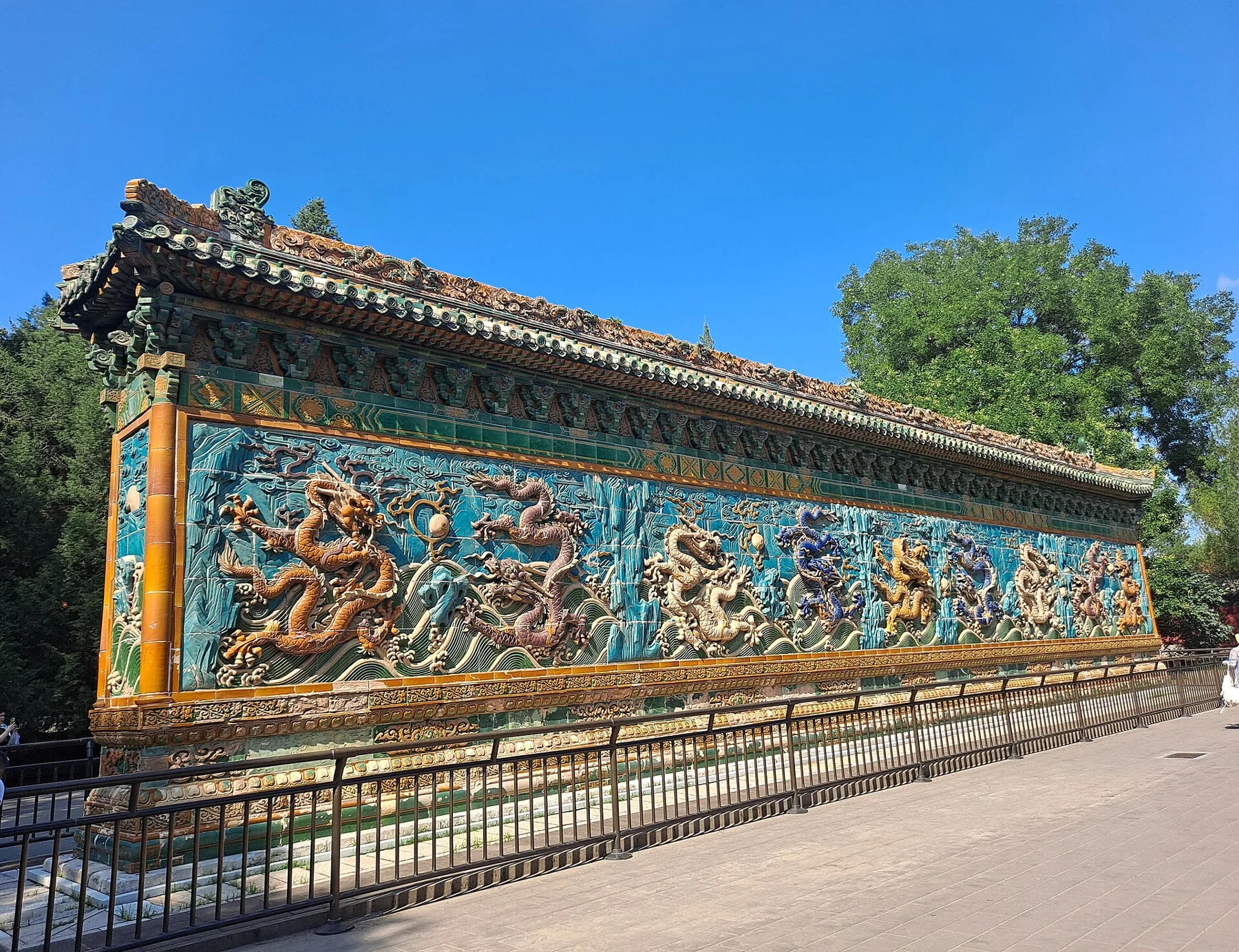
Beihai’s Nine-Dragon Wall is a glazed screen with dragon reliefs on both sides. The dedicated municipal feature dates it to 1756; another official explanation identifies nine principal dragons on each face. Keep it distinct from the different Nine-Dragon Screen inside the Forbidden City.[11][12]
Read it at two distances. A wider view shows the screen’s length and roof line; a closer view shows coloured glaze, clouds, waves and changing dragon forms. Avoid assuming that “Nine-Dragon Wall” means there are only nine dragon motifs in the entire decorated structure.
Move around only where the current visitor route permits. A photograph of one face should not be relabelled as the wall at another destination, and a close detail is not evidence of current access to the reverse side.
Our looking suggestionCompare one dragon’s movement with the whole screen. Let colour and relief be part of the story.
A garden within the garden
静心斋
Jingxin Studio / Tranquil Heart Studio
Jingxin Studio lies on the northern side and brings a smaller pond, rocks, corridors and rooms into a concentrated garden setting. The parks authority describes a Qianlong-period garden influenced by southern garden design and later phases of use, repair and reopening. The current appearance is part of that conservation history.[13]
Choose it for a change of scale: distant hill and open water give way to framed near views. Look at how rocks and architecture divide and reveal the pond. A small garden can support a slower visit; it need not become another quick checkpoint.
The September 2026 closure notice names Jingxin among the separate areas with Monday closures. Nighttime cultural programmes have also been advertised here in earlier summers, but a dated performance notice does not establish a current evening programme or inclusion in basic admission.[5][18]
Our looking suggestionLet one framed pond view settle, then compare it from another permitted position.
A deeper northern-shore choice
西天梵境 · 琉璃阁院落
Western Heaven Temple & Liuli Pavilion courtyard
Western Heaven Temple, also called Daxitian, is a separate northern-shore complex near Jingxin Studio. Its glazed archway frames a different ceremonial approach from the island’s Yong’an Temple. The historical photograph here shows Daci Zhenru Hall in the older part of this complex, not the White Dagoba temple.[20]
On 30 September 2026, the Beijing government reported that the Liuli Pavilion courtyard—the third courtyard of this complex—opened to the public after conservation and service works. Its report identifies a 1759 glazed pavilion, Buddhist reliefs and a historical exhibition. Basic park admission was stated to cover the Western Heaven complex; check the current entrance and courtyard timetable before relying on it.[21]
This is a reason to question an older guide that stops at the familiar foreground buildings. At the same time, the 2011 photograph below is not an image of the newly opened courtyard. Keep the date, the specific building and the current visitor route separate.
Our looking suggestionCompare the wooden hall and glazed architectural elements. Use the current visitor directions for the third courtyard rather than guessing a connection from this historical photograph.
The northern lakeshore
五龙亭
Five-Dragon Pavilions
The Five-Dragon Pavilions form a linked lakeside group. The parks authority dates their origin to 1602 and explains their use for imperial fishing and moon-viewing; later repairs changed and restored elements of the connecting bridges and balustrades. They are a setting for looking out over water rather than another uphill landmark.[15]
Read the pavilions together, then use one as a frame for the island or shoreline. Their relationship to water creates a different pause from the contained pond at Jingxin Studio.
Do not infer a recurring concert from the existence of a stage or a summer-event photograph. A 2024 programme had specified days and months and weather conditions. Confirm any current event independently, and let the architecture itself justify the visit.[18]
Our looking suggestionLook from the shore at the connected group before choosing a closer view.
The connection can be the subject
湖岸慢行
Choose your stretch of lakeshore
The park’s water and island are not empty space between buildings. Its current municipal overview identifies water as a substantial part of the imperial garden. A selected shoreline view can make a complete, lower-intensity visit without every separate courtyard.[1]
Choose one useful connection and a finishing gate. Our outlines do not demand a full lake circuit, and a ferry shown in a historical photo is not an assured shortcut. Confirm any boat’s actual boarding point, destination, fare and last operation on the day.
Keep a little unplanned time for a view, a rest or ordinary park life. Ask before close portraits, leave pathways clear and avoid feeding wildlife. A quieter pace should remain an option, not a promise of quiet conditions.
Our looking suggestionChoose a view across water and notice what changes after a small shift in position.
Choose what matters
Make the visit yours.
Our outline for a broader first visit
Island and one northern subject
- Keep
- A selective island view or visit, plus one northern emphasis such as dragons, Jingxin or the pavilions.
- The trade-off
- Different closures and more outdoor distance; choose rather than collect.
Plan around enclosures
Do the time-sensitive courtyard you most want while it is open.
Give the island its context
Read the bridge, water and stupa together rather than only going to the highest point.
Choose one northern emphasis
Take time with a glazed screen, a smaller garden or the pavilion group.
Keep the return independent of boats
Use a current map for open walking paths and the gate you intend to leave.
A half-day is a flexible selection, not a complete circuit or an accessibility assessment.
All outlines are editorial estimates, not field-tested routes. Follow current admission rules and venue directions.
Arrival, energy and interpretation
Get the details right.
Arrive at the right gate
For a northern-shore visit, the municipal transport page identifies Beihaibei station on Line 6. Match it to the gate and garden you actually want; the station name does not place you beside every island building.[17]
The May 2025 service reply gives five gate areas and their streets. South and Southwest Gates are on Wenjin Street; the North Gate and Jingxin North Gate are on Di’anmen West Street; East Gate is on Zhishan Street. Confirm the exact pin and stopping point for any car journey.[2]
Useful Chinese names are 北海公园南门, 北海公园北门, 北海公园东门 and 静心斋. The article’s address-copy tool is a general park identifier, not a guaranteed entrance, crossing or accessible route. Use current signs for the street-level approach.
Courtyards, Monday and changing notices
The September 2026 notice names Yong’an Temple, Yilan Hall, Painted Boat Studio, Jingxin Studio, Western Heaven Temple, Chanfu Temple and the Ten-Thousand-Buddha Tower relic site as resuming Monday closure, except statutory holidays. It is a courtyard list, not a closure of the entire park.[5]
Shorter winter hours also matter. Use the detailed hours page and confirm a specific room or enclosure before relying on a late arrival. A long park opening is not a long exhibition opening.[4]
Boats and seasonal performances
If you want a boat, ask about the specific current service, not simply “a Beihai boat ticket”. Boarding points, route boats, rental boats, weather conditions and last operations can differ. No boat service is essential to our outlines.
Earlier summer notices describe folk music and the “Yin · Jingxin” programme on specified evenings, with cancellations in unsuitable weather. Those 2024 notices are historical context here, not a timetable for your current trip.[18]
Steps, families and practical help
An island climb, the elevated Round City and a shore walk are different mobility choices. No continuous step-free itinerary has been surveyed here. Ask the park about the precise gate, terrace, courtyard and exit if assistance or access is essential.
Leave time for water, food and rest. We have not verified every facility location, English exhibition label or individual restaurant. Use the park’s official enquiry channel for something your group cannot improvise on arrival.[1]
CCTV-10 · Travel Along the Books
See the setting in motion.
CCTV-10 · Travel Along the Books · Cultural programme · broadcast 2023-04-21
Discovering Beihai: stone calligraphy in the imperial garden
The original episode 发现北海 introduces stone-calligraphy settings at Yuegu Tower and Kuaixue Hall. English viewing notes accompany our guide; the Chinese-source programme is cultural context, not current access information.
Watch the original episode on CCTVOpens the publisher’s own player in a new tab. Chinese source; English subtitles and regional playback are not confirmed. The cover is a credited reference photograph, not a film still.
- Official episode: 跟着书本去旅行 · 20230421 · 发现北海. The source page identifies Yuegu Tower and Kuaixue Hall as the principal stone-calligraphy settings.
- Look for writing preserved in stone, the architectural setting of the collections, and the distinction between the two locations.
- This is a Chinese-source cultural programme. English subtitles and regional player availability are unconfirmed; present room access must be checked independently.
Before you ask.
Do foreign visitors need to telephone a day in advance?
The newer municipal May 2025 answer explicitly allows on-site purchase without an advance booking. The older telephone-only page is retained only as a disclosed conflict, not our current advice.[2][6]
Is the combined ticket the same as ordinary park admission?
No. The municipal reply describes the combined product as covering Qiongdao and Tuancheng in addition to the park visit. Check the current product and closures before choosing it.[2]
Is the whole park closed on Monday?
The cited 2026 notice concerns named temple and courtyard areas. Do not turn it into a whole-park Monday closure or assume every paid enclosure remains open.[5]
Is this the same White Stupa as Miaoying Temple?
No. This guide concerns the White Dagoba of Yong’an Temple on Beihai’s Qionghua Island. Use 北海公园白塔 to distinguish the location.[10]
Is this Nine-Dragon Wall the one in the Forbidden City?
No. Beihai has its own screen, with principal dragon reliefs on both faces. Check the park and Chinese name on any map or ticket.[11][12]
Must I climb to the White Dagoba?
No. A shore view and selected garden can make a coherent visit. The hill visit adds a different perspective and effort; no step-free equivalent to every terrace is promised.
Can a boat be my guaranteed way back?
We do not base an outing on an unconfirmed ferry. Verify the exact service and keep an independent return plan.
Are night performances included and held every week?
No current weekly programme is established here. The cited 2024 notice had specified summer evenings and weather conditions; it must not be copied forward as a permanent schedule.[18]
Will the documentary show rooms I can enter now?
Not necessarily. The programme provides cultural context; it does not establish present access, exhibits or opening. Follow the venue’s current instructions.[19]
Dates, sources and photographs
Follow the evidence.
Desk research using the latest municipal visitor listing, a specific foreign-visitor purchase answer, dated 2026 closure notices, parks authority building histories and an original CCTV programme page. Individual venue and park scopes are kept separate. Photograph subjects, dates and licences were reviewed; visit outlines are editorial estimates rather than timed or accessibility-tested routes.
Reviewed 2026-10-29. This date records our source review, not a live availability check.
Open 21 source references
- Beijing government · current Beihai visitor listing
Official visitor information · Published 2026-03-20 · Reviewed 2026-10-29
- Beijing government · on-site tickets without a Chinese SIM
Specific municipal answer; displayed date · Published 2025-05-29 · Reviewed 2026-10-29
- Beijing government · foreign-visitor municipal park ticket tutorial
Official visitor information · Reviewed 2026-10-29
- Beijing government · Beihai seasonal park and courtyard hours
Official visitor information · Published 2023-01-11 · Reviewed 2026-10-29
- Beijing government · September 2026 courtyard Monday closures
Dated operational update; seasonal details checked separately · Published 2026-09-04 · Reviewed 2026-10-29
- Beijing government · Beihai tour overview
Historical features and area grouping; old phone restriction superseded · Reviewed 2026-10-29
- Beijing parks authority · Round City
Official garden description · Chinese · Published 2022-01-11 · Reviewed 2026-10-29
- Beijing government · Yong’an Bridge
Official feature description · Published 2023-01-11 · Reviewed 2026-10-29
- Beijing government · Yong’an Temple
Official feature description · Published 2023-01-11 · Reviewed 2026-10-29
- Beijing parks authority · White Dagoba of Yong’an Temple
Official architectural history · Chinese · Published 2019-11-21 · Reviewed 2026-10-29
- Beijing government · Nine-Dragon Wall
Dedicated feature history · Published 2023-01-11 · Reviewed 2026-10-29
- Beijing government · dragon motifs in municipal parks
Glazed screen faces and reliefs · Published 2024-01-26 · Reviewed 2026-10-29
- Beijing parks authority · Jingxin Studio
Official garden and conservation history · Chinese · Published 2021-11-29 · Reviewed 2026-10-29
- Beijing parks authority · Jingxin opening history
Exact founding-year difference disclosed · Chinese · Published 2016-04-19 · Reviewed 2026-10-29
- Beijing parks authority · Five-Dragon Pavilions
Official architectural history · Chinese · Published 2022-04-27 · Reviewed 2026-10-29
- Beijing parks authority · Yuegu Tower
Official stone-calligraphy setting · Chinese · Published 2022-04-03 · Reviewed 2026-10-29
- Beijing government · Beihai transport reference
Official visitor information · Published 2023-01-11 · Reviewed 2026-10-29
- Beijing government · 2024 summer nighttime cultural programme
Dated historical programme; not a current schedule · Published 2024-07-08 · Reviewed 2026-10-29
- CCTV-10 · Discovering Beihai, Travel Along the Books
Original broadcaster episode on stone calligraphy · Published 2023-04-21 · Reviewed 2026-10-29
- Beijing parks authority · Western Heaven Temple / Daxitian
Official spatial and architectural description · Chinese · Published 2018-08-16 · Reviewed 2026-10-29
- Beijing government · Liuli Pavilion courtyard opens
Recent opening report and admission scope · Chinese · Published 2026-09-30 · Reviewed 2026-10-29
Photograph authors, dates and licences (10 photographs)
EditQ · 2023-08-12 · CC BY-SA 4.0
Resized and converted to WebP. Image-file proportions retained; hero and preview layouts may crop the display. Original licence retained.
Ermell · 2011-01-04 10:58:54 · CC BY-SA 4.0
Resized and converted to WebP. Image-file proportions retained; hero and preview layouts may crop the display. Original licence retained.
Ermell · 2011-01-04 11:59:21 · CC BY-SA 4.0
Resized and converted to WebP. Image-file proportions retained; hero and preview layouts may crop the display. Original licence retained.
EditQ · 2023-08-12 · CC BY-SA 4.0
Resized and converted to WebP. Image-file proportions retained; hero and preview layouts may crop the display. Original licence retained.
Shizhao · 2006-01 · CC BY-SA 3.0
Resized and converted to WebP. Image-file proportions retained; hero and preview layouts may crop the display. Original licence retained.
Patrick20242023 · 2024-01-03 · CC BY-SA 4.0
Resized and converted to WebP. Image-file proportions retained; hero and preview layouts may crop the display. Original licence retained.
Francesco Bini · 2024-11-11 10:12:30 · CC BY-SA 4.0
Resized and converted to WebP. Image-file proportions retained; hero and preview layouts may crop the display. Original licence retained.
ScareCriterion12 · 2023-03-18 12:59:05 · CC BY-SA 4.0
Resized and converted to WebP. Image-file proportions retained; hero and preview layouts may crop the display. Original licence retained.
ScareCriterion12 · 2023-03-18 12:59:22 · CC BY-SA 4.0
Resized and converted to WebP. Image-file proportions retained; hero and preview layouts may crop the display. Original licence retained.
そらみみ · 2016-08-22 12:18:12 · CC BY-SA 4.0
Resized and converted to WebP. Image-file proportions retained; hero and preview layouts may crop the display. Original licence retained.
How conflicting descriptions were handled
The older English tour page requires foreign visitors to telephone before arrival; the May 2025 municipal service answer explicitly allows on-site purchase without advance booking. The newer specific answer is used.[6][2]
The dedicated Nine-Dragon Wall feature gives 1756 and the current guide uses that date. A broad magazine passage elsewhere labels it Ming; we do not repeat that generic attribution over the specific feature history.[11]
Two parks-authority histories give different exact founding years for Jingxin Studio. The prose uses the Qianlong period rather than silently choosing an unsupported precision.[13][14]
The September 2026 closure notice supplies the recent Monday pattern, while the detailed guide supplies seasonal winter hours. Neither is extended into a promise about a temporary room or special event.[5][4]
The May 2025 reply uses CNY 20 for the combined peak-season ticket despite an awkward English label. The March 2026 listing separately identifies basic and combined products and both seasons.[2][1]
A candidate photograph labelled only as a Beihai temple shows the Daci Zhenru Hall name on its plaque. It is placed with the Western Heaven complex, not mislabelled as Yong’an Temple or the newly opened Liuli Pavilion courtyard.[20][21]
What still needs direct confirmation
- Current ticket inventory, temporary closures, concessions and exact current combined-product conditions.
- Successful online purchase with an individual foreign phone number/card; staff-assisted capacity on a particular date.
- Current boat products, fares, weather restrictions and departure/return arrangements.
- Courtyard exhibitions, interpretation languages and current nighttime performance availability.
- A fully surveyed step-free route and facilities for every intended gate, terrace and hall.
- Regional CCTV playback or subtitle availability; a source link is not a playback guarantee.
Film verification: The episode identity, date and subject were checked on CCTV’s own programme page. The site links to that original player without downloading, rehosting or bypassing its playback controls.
In this guide