
Beijing · In-depth place guide 01
故宫博物院
The Palace Museum
A day inside the Forbidden City
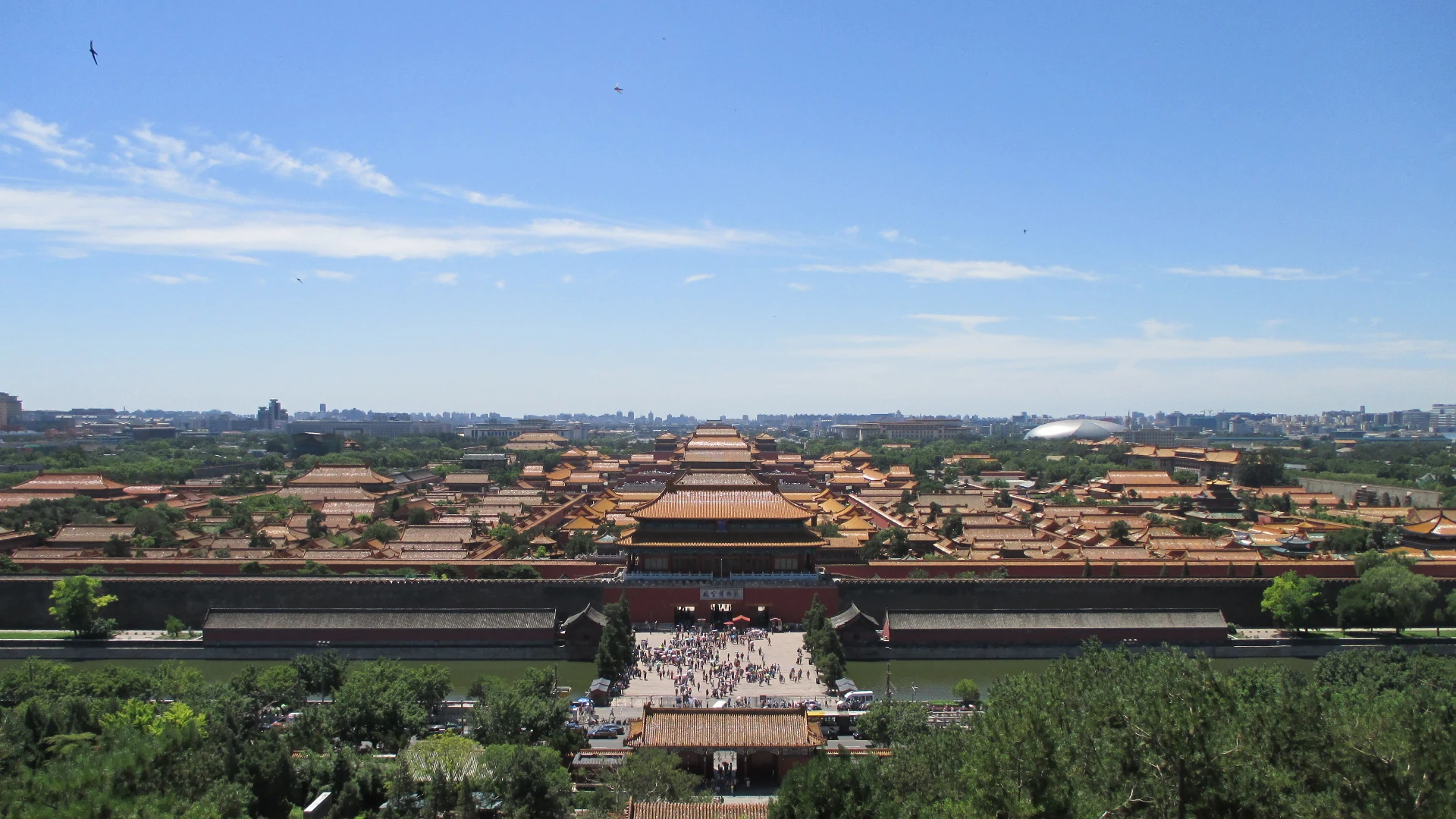
Ceremonial courts, imperial interiors and collection galleries. Make sense of what you see, then choose the visit that fits your day.
A rewarding first visit has two threads: the buildings that staged imperial power, and the objects that furnished court life. Choose a principal thread, then add the other where your time and energy allow. Trying to collect every palace name can leave the place harder to understand.
This guide is for independent visitors who want more than a photograph of the main courtyard. It combines museum research with our suggested ways to arrange a visit. We have not walked these routes as a field test, and the time budgets are editorial estimates, not measured walking times.
Plan the foundations
Before you book.
- Best for
- Imperial architecture, court history and craftsmanship.
- Our starting point
- About 4–5 hours for the central sequence and one gallery; an editorial estimate.
- Hours
- Apr–Oct 08:30–17:00, last entry 16:00; Nov–Mar 08:30–16:30, last entry 15:30. Closed Mondays except applicable national holidays, and closed on Chinese New Year’s Eve. Check temporary notices.[1]
- Adult admission
- Main ticket: CNY 60 Apr–Oct, CNY 40 Nov–Mar. Treasure Gallery and Clock Gallery: CNY 10 each.[1]
Taihemen restoration affects the classic approach
A notice dated 31 July 2026 announces the closure of the Gate of Supreme Harmony from 3 August for restoration, without an end date. This concerns the gate, not a stated closure of the entire Palace Museum or Hall of Supreme Harmony. Check current directions for the passage around it.[19]
Booking from overseas
Start at the museum’s official international booking link. Its notice accepts passports for visitors from outside mainland China and lists ticket release seven days before the visit at 20:00 China time. Bring the original document used for the reservation.[3]
Choose the date and session, enter each visitor’s matching document details, and check whether your chosen gallery or exhibition needs another reservation. Save the confirmed order where you can retrieve it offline. These are preparation steps; we have not completed a foreign-passport registration or international-card payment.
The current visitor rules say morning-session admission ends at 12:00 and afternoon-session admission begins at 11:00. A ticket does not give unrestricted arrival at any hour. Dates, sessions, ticket types and named visitors cannot simply be changed after issue.[2]
For an unused booking, the international portal describes cancellation through the original channel before midnight on the previous day without a missed-visit count. A visit-day cancellation before 20:00 counts toward the missed-visit rules; used tickets are non-refundable. Read the conditions in your actual order before acting.[3]
If your date is unavailable, keep another Beijing day flexible or choose another visit. A higher-priced guide package is not evidence of a confirmed ticket in your name. Ask what has actually been reserved, what document is used and what happens if admission is not secured.
Understand the place
A palace with
different worlds.
The Forbidden City is the historic palace complex; the Palace Museum is the institution established there in 1925. Its southern Outer Court contains the three great ceremonial halls. Farther north, the Inner Court combines residences, government activity and religious spaces, ending at the Imperial Garden. The central axis is a useful organising idea, but it is only part of the museum.[5]
Use the diagram to understand relationships, then use the museum’s current map for actual paths. The Treasury lies in the northeast; the Clock Gallery is in the eastern side of the main complex. A side visit takes you away from the central sequence, so choose it before you become tired.[16][17]
The Meridian Gate was completed as part of the Ming palace. Later repairs and rebuilding shaped the complex seen today.[7]
The Palace Museum was established within the former imperial palace.[5]
Beijing’s palace was inscribed on the World Heritage List. The heritage property also includes the imperial palace in Shenyang.[6]
A closer reading
What to
look for.
Follow the central sequence first, then compare the optional side visits. The numbered list is a reading order, not a guarantee of an uninterrupted walking route.
South · arrival
午门 · Wumen
Meridian Gate
The gate’s projecting wings wrap around the approach, making arrival feel like entry into a succession of enclosed courts. Historically, its different doorways expressed rank: the central passage was normally reserved for the emperor, with specified ceremonial exceptions. The structure is part of the palace’s political language, before you have reached a throne hall.[7]
Our looking suggestionBefore joining the entrance flow, take in the whole U-shaped frontage. Then follow today’s marked admission lane; the historic use of a doorway is not a present-day visitor instruction.
Outer Court · ceremonial centre
太和殿 · Taihedian
Hall of Supreme Harmony
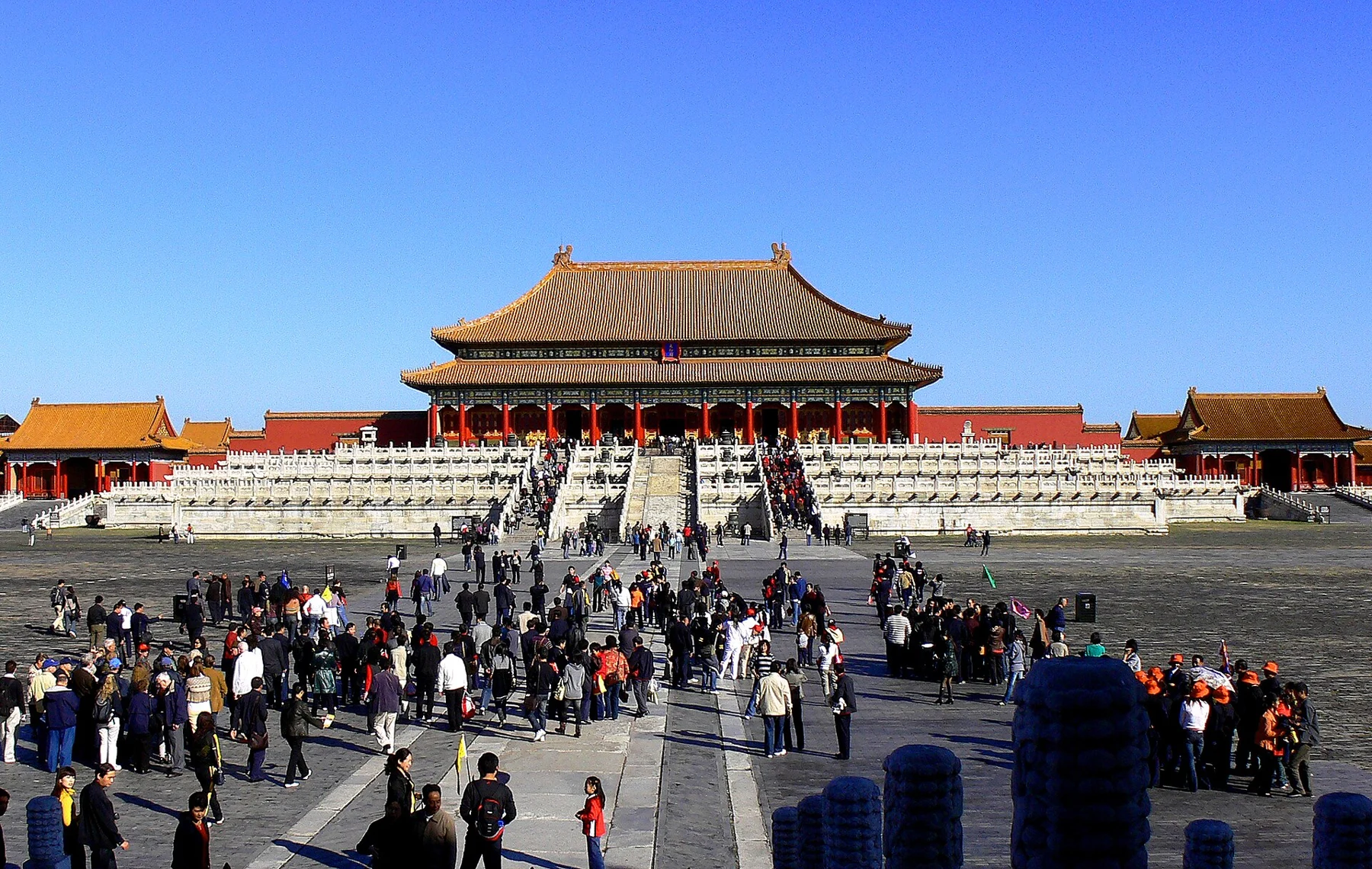
This was the setting for the grandest state ceremonies, including imperial accessions. The largest hall, a three-tiered marble terrace and a broad courtyard work together to make a single ruler appear distant and elevated. It is more useful to understand that ceremonial scale than to imagine this as an ordinary daily office.[8]
Look up at a roof corner: the museum identifies ten small animal figures as a distinctive mark of the hall’s status. Down at terrace level, the carved dragon-head waterspouts had a practical drainage role. The terrace also carries a sundial and a standard measure, objects through which time and measurement joined the language of rule.[9]
Our looking suggestionCompare the distant roofline with the detail beside you. Use the allowed viewing position; do not expect permission to walk into the throne room.
Outer Court · between the great halls
中和殿 · Zhonghedian
Hall of Central Harmony
The compact, square hall between its larger neighbours had a preparatory role. Before major ceremonies, the emperor received officials here; before sacrifices, he inspected ritual texts and agricultural implements. Its smaller scale makes the transition legible: preparation and ritual organisation sit between the more public displays of power.[10]
Our looking suggestionNotice the square plan and the roof silhouette before continuing north. Compare it with the broad façade you have just left; the three halls were not interchangeable rooms.
Outer Court · northern hall
保和殿 · Baohedian
Hall of Preserving Harmony
The last of the three great halls changed function over time. In the Ming period it was used for changing into ceremonial dress. Under the Qing it hosted important banquets, and from 1789 it became the venue for the palace examination. That final examination connected this architectural stage with the recruitment of imperial officials.[11]
Our looking suggestionGive this hall a different question from Taihedian: who was admitted to these events, and what did being received here signify? The museum film below helps distinguish the hall’s successive uses.
Inner Court · central axis
乾清宫 · Qianqinggong
Palace of Heavenly Purity
Originally an emperor’s residence and workplace, this palace lost its residential role when the Yongzheng emperor moved to the Hall of Mental Cultivation. It continued to host government business and major occasions. The present building dates to 1798, a reminder that a palace founded in the Ming period contains many later reconstructions.[12]
The panel above the throne reads Zhengda guangming, rendered by the museum as “Upright and Pure in Mind”. The museum connects the space behind it with the Qing practice of secretly recording the designated heir. The inscription is therefore part of a political story, rather than simply a decorative sign.[12]
Our looking suggestionIf the permitted view allows, identify the panel. Read the local display information before treating any interior arrangement as unchanged from a single reign.
Inner Court · between Qianqinggong and Kunninggong
交泰殿 · Jiaotaidian
Hall of Union
This small hall was a setting for the empress’s birthday congratulations and housed the twenty-five imperial seals of the Qing. The museum’s architectural record also describes a water clock and a mechanical clock in its interior. Here, ceremonial authority, the empress’s role and the regulation of palace time meet in a much smaller space.[13]
Our looking suggestionCompare this square hall with Zhonghedian in the Outer Court. Look for differences as well as repetition; a similar position in a sequence does not mean the same use.
Inner Court · north of the Hall of Union
坤宁宫 · Kunninggong
Palace of Earthly Tranquility
Although built for the emperor’s principal consort, this was not simply the Qing empress’s everyday home. The building was adapted to Manchu traditions and combined sacrificial functions with an imperial bridal chamber. The museum points to an off-centre entrance and heated brick kang platforms as features of that adaptation.[14]
Our looking suggestionFrom the permitted view, look for how the entrance departs from the central symmetry you have become used to. This is a good place to ask how Qing use changed a Ming palace.
Far north · before the northern exit
御花园 · Yuhuayuan
The Imperial Garden
The garden behind Kunninggong offers another kind of looking: pavilions, trees, rockwork and patterned paving replace the vast ceremonial courts. Its design is still ordered around the central Hall of Imperial Peace, but the smaller buildings vary in shape. The paired Wanchun and Qianqiu pavilions combine round upper forms with square lower plans.[15]
Look down as well as up. The museum describes coloured pebble mosaics forming figures, flowers, scenes and stories along the paths. These make a useful final observation exercise after the palace halls: the detail is underfoot rather than on a distant throne.[15]
Our looking suggestionChoose a short passage of paving and one pavilion to examine carefully. Use open paths and keep moving where instructed; a garden label does not guarantee a quiet or uncrowded rest area.
Northeast · separate admission
珍宝馆 · 宁寿宫区
Treasure Gallery & the Tranquil Longevity sector
This is a substantial side visit, not one cabinet beside the main axis. The northeast complex was planned as a retirement setting for the Qianlong emperor, with ceremonial halls, residential spaces, theatre, garden and religious buildings. It creates another palace world inside the larger one.[16]
The gallery’s collection-based displays include precious materials such as jade, gold, silver and pearls. Look for the work behind the luxury: how material, carving and assembly create an object intended for court display or use. The official gallery account describes different installations and renovations; it is not a guarantee that a particular famous object is on view today.[16]
Our looking suggestionChoose this addition if craftsmanship and court objects are a priority. The photograph shows the Nine-Dragon Screen associated with this sector; check current access and the exact gallery ticket scope before relying on a particular stop.
East · separate admission
钟表馆 · 奉先殿区
Gallery of Clocks
The museum describes a display bringing together clocks from Qing workshops, Guangzhou and overseas makers, including England, France and Switzerland. Timekeeping is only one part of their appeal: decorative cases and mechanical figures also speak to technical skill and court collecting.[17]
The 2019 gallery account locates the display in buildings south of the Hall for Ancestral Worship. That is more precise than assuming the old main hall is the clock exhibition. It names a writing-figure clock among the installation’s objects, but neither that account nor a historical photograph confirms its current display or a live demonstration.[17]
Our looking suggestionFor a clock you can actually see, compare its dial, case and any moving figures. Look for its maker or place of manufacture on the label. No performance time is promised here.
West of Qianqinggong · optional addition
养心殿 · Yangxindian
Hall of Mental Cultivation
This is the place to connect the central palace story with later Qing imperial work and residence. A museum notice announced reopening on 26 December 2025 after a long conservation project. It describes restored period displays, including the Sanxi tang study arranged with reference to the Qianlong period.[18]
Our looking suggestionConsider this instead of a second collection gallery if imperial interiors interest you more. Reopening is a dated event, not a promise that every room is accessible on your visit date; check the current local route.
Explore with the museum
Look around.
Notice a little more.
Pair the Palace Museum’s official virtual visit with a few things to look for. Choose a subject here, then open the museum’s site and find the corresponding scene.
 Open official virtual visit ↗
Reference photograph, not an interactive tour preview. Photo dates & credits
Your viewing notes
Hall of Supreme Harmony
- Compare the raised terrace with the width of the ceremonial courtyard.
- Look towards the roof corners for the small decorative figures.
- Then read the hall’s role in imperial ceremonies.
Opens the official tour homepage in a new tab. Scene selection, loading and language controls are provided by the museum. Digital views do not confirm today’s access or what is on display.
Look at objects
Open the Palace Museum’s Digital Cabinet of Curiosities. Follow its own controls to explore the available objects.
Official museum resource · opens a new tabPAINTING STUDIESLook into a painting
Open the museum’s painting resource for close study and its own annotations. Online availability does not establish current gallery display.
Official museum resource · opens a new tabChoose with intention
Make time
for what matters.
Most first-time visitors who want architecture and objects.
The axis plus one collection
- Keep
- The main palace sequence and either the Treasure Gallery or Clock Gallery.
- The trade-off
- Choose one extra gallery. Give up a few secondary stops rather than rushing both.
Make the side-visit decision before arrival
Compare the two collection sections above and obtain the appropriate additional ticket. Decide which central stops matter most to you.
Use the current map for the detour
After the principal Outer Court halls, orient the gallery visit from the on-site map and open connections. This outline does not certify a turn-by-turn path through the eastern courts.
Return to the main story
Keep time for the central Inner Court and garden if they remain priorities. Take a break before the last section; remove an optional stop when tired.
The estimate includes a modest pause, but not guaranteed queue time or an independent meal booking. Add security and the approach separately.
All three outlines are editorial estimates, not field-tested routes. Admission arrangements, opening hours and local diversions determine what is possible.
The practical visit
Arrive, explore,
find your way out.
Getting to the right gate
Use 午门(故宫南门参观入口) as your destination reference. The Chinese visitor guide describes approaches from Donghuamen or Xihuamen along the east or west moat roads; those gates are approach points, not alternative public admission gates. Line 1 stations Tian’anmen East and Tian’anmen West are also listed near the southern approach.[4]
For a palace-only visit, the regulations direct visitors via the east or west moat roads. A visit combined with a Tian’anmen Square reservation uses a different approach through that area’s security. Match the approach to what you have actually reserved.[2]
Choose a metro exit or taxi drop-off from current local directions, then allow for the remaining walk and security. We have not field-checked a station-exit route, a taxi stopping point or an accessible approach. Avoid aiming for the northern postal address: the museum’s visitor entrance is on the south.
Luggage: plan your collection exit
The current rules place deposit at the visitor service centre west of Duanmen Square, with collection outside Shenwumen or Donghuamen. The stated service covers suitcases and large packages of 20 inches or more, with exclusions including valuables, electronics and food. Keep the collection receipt and confirm the collection point before leaving an item.[2]
Our suggestion: leave routine luggage at your accommodation when practical. Do not assume a small camera bag, laptop or unusual item qualifies for museum storage. Check the published seasonal collection hours and return in good time.
Audio, guides and understanding what you see
The museum’s services page lists audio-guide hire at Wumen and Qianqingmen, with returns at Shenwumen and Donghuamen. It also lists visitor-service support and equipment. Parts of that page retain older information, so confirm the current desk, language, fee, deposit and return arrangement before renting.[21]
A guide is useful when you want questions answered and objects interpreted. Before paying, agree the language, duration, group size and whether gallery tickets are included. Independent visitors can use the building explanations here with the museum’s map; do not confuse hiring interpretation with obtaining admission.
Water, meals, toilets and rest
The official service map marks toilets, a nursery, food and drink, first aid, accessibility and stroller services. Use that live map or ask a service desk for a facility along your chosen route. This guide does not verify the operating hours, menus or availability of individual outlets.[1]
Plan a pause before you need one. Carry essentials appropriate to the day and current admission rules. If you have an allergy, ask the individual food business about ingredients and handling; neither a museum food marker nor this article establishes dietary safety.
Children and mobility needs
The published under-18 free-admission wording applies to Chinese citizens, including Hong Kong and Macao residents, and foreigners with permanent residence. It should not be read as blanket free admission for every overseas child. The Chinese guide also requires adult accompaniment below age 14, with up to three such children per adult.[4]
For a wheelchair or stroller, ask the museum for a current suitable route and equipment terms. The official map identifies accessibility services, but we have not assessed the continuous step-free path, slopes, surfaces or current detours. A shortened route should be agreed around the person’s needs, not an assumed ability to cover the central axis.
Photographs with a purpose
In exhibition halls, the rules prohibit flash, selfie sticks and support-type photographic equipment. Follow gallery-specific restrictions.[2]
Use a wide view to explain a building’s place in the courtyard, then make one closer observation: a roof corner, a terrace detail or a readable panel. Leave people room to pass. The photos in this guide are dated reference views, not evidence of today’s scaffolding, crowds or permitted access.
From the museum
See the story
in motion.
The Palace Museum · official external video · Chinese captions & signed presentation · no English subtitles verified
Baohedian: a hall with changing roles
Streamed from the host used by the museum’s original page, only after you choose to load it. No video file is hosted by this site. The cover photograph shows Taihedian, not a film still.
- Watch how the hall is placed within the three-hall sequence.
- Connect the ceremonial architecture with changing court uses.
- Compare the filmed view with the museum’s current route; it is cultural background, not a live visitor report.
Before you ask.
Are the Forbidden City and the Palace Museum two visits?
They name the historic palace complex and the museum institution within it. Choose your architecture and collection priorities within the same overall visit. The northeast Treasury and the Clock Gallery need separate admission choices.[5][1]
Do I need to reserve Tian’anmen Square as well?
Plan these as distinct reservations. Use the palace-only or combined-visit approach described above; a palace booking does not establish admission to every attraction in the Tian’anmen area.
Can I walk inside every throne hall?
No such access is promised. Period-hall descriptions explain a building’s history, not an entitlement to enter its interior. Use the viewing line, local signage and current route.
Will the writing clock perform during my visit?
No demonstration schedule is established here. The photograph records a past display; check the current gallery and any announcement for the date you intend to visit.
Can I finish with Jingshan?
It is a separate outing after the northern exit. Choose it if the weather and your remaining energy suit another climb. Check the Jingshan guide for its own ticket and visitor information.
What if the weather or closures change my plan?
Treat the shorter route as your fallback and keep side visits optional. Follow staff directions in severe weather. If you cannot use an issued ticket, act through the original booking channel and check its current refund conditions.
Sources, dates & photographs
Follow
the evidence.
Researched from museum and heritage sources. Suggested timings and sequences are editorial; no on-site route test or completed foreign-passport booking is claimed.
Research began 2026-10-28; article reviewed 2026-10-29. References support the details beside them. Unreferenced visit choices are editorial guidance.
Open 23 museum, heritage and official resource references
- Hours, admission and service map
Visitor information · Checked 2026-10-28
- Visitor regulations: entry, access and luggage
Visitor regulations · Checked 2026-10-28
- Official international booking portal
Booking instructions · Checked 2026-10-28
- Chinese visitor guide and transport approaches
Visitor information · Checked 2026-10-28
- History and layout of the Palace Museum
Museum reference · Checked 2026-10-28
- UNESCO: Imperial Palaces in Beijing and Shenyang
Heritage record · Checked 2026-10-28
- Meridian Gate: architecture and historic use
Museum reference · Checked 2026-10-28
- Hall of Supreme Harmony
Museum reference · Checked 2026-10-28
- Hall of Supreme Harmony: architectural details
Museum reference · Checked 2026-10-28
- Hall of Central Harmony
Museum reference · Checked 2026-10-28
- Hall of Preserving Harmony
Museum reference · Checked 2026-10-28
- Palace of Heavenly Purity
Museum reference · Checked 2026-10-28
- Hall of Union
Museum reference · Checked 2026-10-28
- Palace of Earthly Tranquility
Museum reference · Checked 2026-10-28
- Imperial Garden: layout, pavilions and paving
Museum reference · Checked 2026-10-28
- Treasure Gallery and Tranquil Longevity sector
Museum reference · Checked 2026-10-28
- Gallery of Clocks: collection and 2019 relocation
Gallery reference · 2019 installation described · Checked 2026-10-28
- Hall of Mental Cultivation reopening notice
Dated notice · 2025-12-23 · Checked 2026-10-28
- Gate of Supreme Harmony restoration
Dated notice · 2026-07-31 · Checked 2026-10-28
- Ceramics Gallery: time-limited closure
Dated notice · 2026-06-15 · Checked 2026-10-28
- Museum visitor services
Service reference; some older details · Checked 2026-10-28
- Hall of Preserving Harmony: museum film (Mandarin)
Museum film · Checked 2026-10-28
- Official Panoramic Palace Museum
Virtual visit · Checked 2026-10-28
Photograph dates, authors and licences (6 article photographs)
Morio · 9 August 2015, Beijing, China · CC BY-SA 4.0
Resized and converted to WebP; article preserves image proportions. Original attribution and share-alike licence retained.
Gisling · 2008-10 · CC BY 3.0
Resized and converted to WebP; article preserves image proportions. Original attribution and share-alike licence retained.
Dennis G. Jarvis · 2006-11-22 11:11 · CC BY-SA 2.0
Resized and converted to WebP; article preserves image proportions. Original attribution and share-alike licence retained.
N509FZ · 2022-02-18 13:27:46 · CC BY-SA 4.0
Resized and converted to WebP; article preserves image proportions. Original attribution and share-alike licence retained.
Netopyr-e · 2007-09 · CC BY-SA 3.0
Resized and converted to WebP; article preserves image proportions. Original attribution and share-alike licence retained.
Mummyyx · 2011-07-31 13:31:50 · CC BY-SA 3.0
Resized and converted to WebP; article preserves image proportions. Original attribution and share-alike licence retained.
Reading dated notices
The Ceramics Gallery notice specifies 16 June–17 July 2026, with reopening scheduled for 18 July. That summer notice alone does not establish an October closure or confirm today’s access.[20]
What still needs direct confirmation
- Foreign-passport account creation, verification messages and overseas-card payment have not been tested end to end.
- A reopening date for Taihemen was not established from the reviewed notice; no unrestricted path through the gate is promised.
- Current English audio-guide fees, deposits, accessible detours and specific dining outlets still require direct confirmation.
- Temporary exhibitions and individual objects can change; a collection reference or old photo is not a display guarantee.
In this guide