
Chengdu · In-depth place guide
成都杜甫草堂博物馆
A place for poetry.
Bamboo beside water. A small room for writing. A poem that begins with a leaking roof and reaches out to other people. Come with a little context, then take your time.
Begin with the person behind the place.
Du Fu reached Chengdu in winter 759 after fleeing the upheaval of the An Lushan rebellion. He built his cottage the following spring. His residence here totalled three years and nine months, across the years before his departure in 765.[9]
You can approach this museum through something very small: a room, a bird, a window or the wish for a secure roof. Read a little of the poet’s work, then look at how later people chose to remember him. You do not need a background in Chinese literature to begin.
Our suggestion is two to three hours for a selective first visit, longer if you want to read closely. This is an editorial allowance. Choose a handful of subjects below and leave space to stop in the garden.
Plan your visit
Make room for a slower visit.
- Published ordinary hours
- 09:00–18:00; ticket sales stop at 17:00.[2]
- Standard admission
- CNY 50 per person per entry.[3]
- Language help
- Free Chinese and English audio is listed through the museum’s WeChat account.[6]
- A useful first selection
- The poet’s story, the memorial axis, the reconstructed cottage and one garden or archaeological detail.
Ask about foreign children’s admission
The Chinese policy limits the under-18 exemption to Chinese nationals; its English summary omits that condition. Confirm the actual passport category with the ticket office.[3]
Sales stop is not a separate last-entry rule
Holiday or summer extension is subject to an actual notice: 08:30–18:30, sales ending 17:30.[2]
Modern rooms, a longer history
The house is a reconstruction informed by poetry and earlier plans. Read it as an interpretation of domestic life.[25]
Choose the right document and ticket.
Budget for standard admission until the museum confirms any concession for your actual documents.
Published admission and document questions
Standard single entry
- Published position
- CNY 50.
- What to confirm
- The date and the passport/document used.
Eligible full-time students
- Published position
- CNY 25; undergraduate level and below, with valid identity and student proof.
- What to confirm
- Whether your overseas proof is accepted.
Foreign children
- Published position
- Current Chinese and translated wording differ.
- What to confirm
- Ask for the rule for your child’s passport and age.
Visitors aged 60+
- Published position
- Published exemptions name Chinese, Hong Kong/Macao/Taiwan and foreign permanent-resident documents.
- What to confirm
- An ordinary foreign passport alone is not a listed exemption.
| Visitor or product | Published position | What to confirm |
|---|---|---|
| Standard single entry | CNY 50. | The date and the passport/document used. |
| Eligible full-time students | CNY 25; undergraduate level and below, with valid identity and student proof. | Whether your overseas proof is accepted. |
| Foreign children | Current Chinese and translated wording differ. | Ask for the rule for your child’s passport and age. |
| Visitors aged 60+ | Published exemptions name Chinese, Hong Kong/Macao/Taiwan and foreign permanent-resident documents. | An ordinary foreign passport alone is not a listed exemption. |
The annual product is CNY 100 and uses original-ID entry conditions. Confirm eligibility before choosing it. Ticket-office enquiries: +86 28 68921800.[3]
The visitor rules require a new ticket after leaving the paid area. Plan equipment return, bags and your final exit before you leave.[5]
Book for the passport you will carry.
The general museum page offers real-name booking up to 14 days ahead through its WeChat service account. It describes original Chinese-ID admission and a window exchange without that original.[4]
The museum home page has a separate “foreign visitor ticketing” link to Trip.com. This is an operator-linked option; we have not tested its passport form, checkout or admission scan.[1]
Bring the original passport used for your booking and the order details, and ask which window or gate applies. The February 2026 holiday notice described passport purchases at a service window; it is a dated procedure.[10]
Read the actual seller’s cancellation and exchange conditions before purchase. Do not assume the document process from another Chengdu museum applies here.
Find your bearings
A home remembered, a poet still being read.
The central memorial sequence reflects later rebuilding, notably the arrangements of 1500 and 1811. Gate, Daxie Hall, Poem History Hall, Brushwood Gate and Gongbu Shrine give you a useful set of names.[19]
Start from the entrance you actually use. The groups below are a way to choose what interests you; consult the museum map for positions and present routes. Reading every hall is optional.
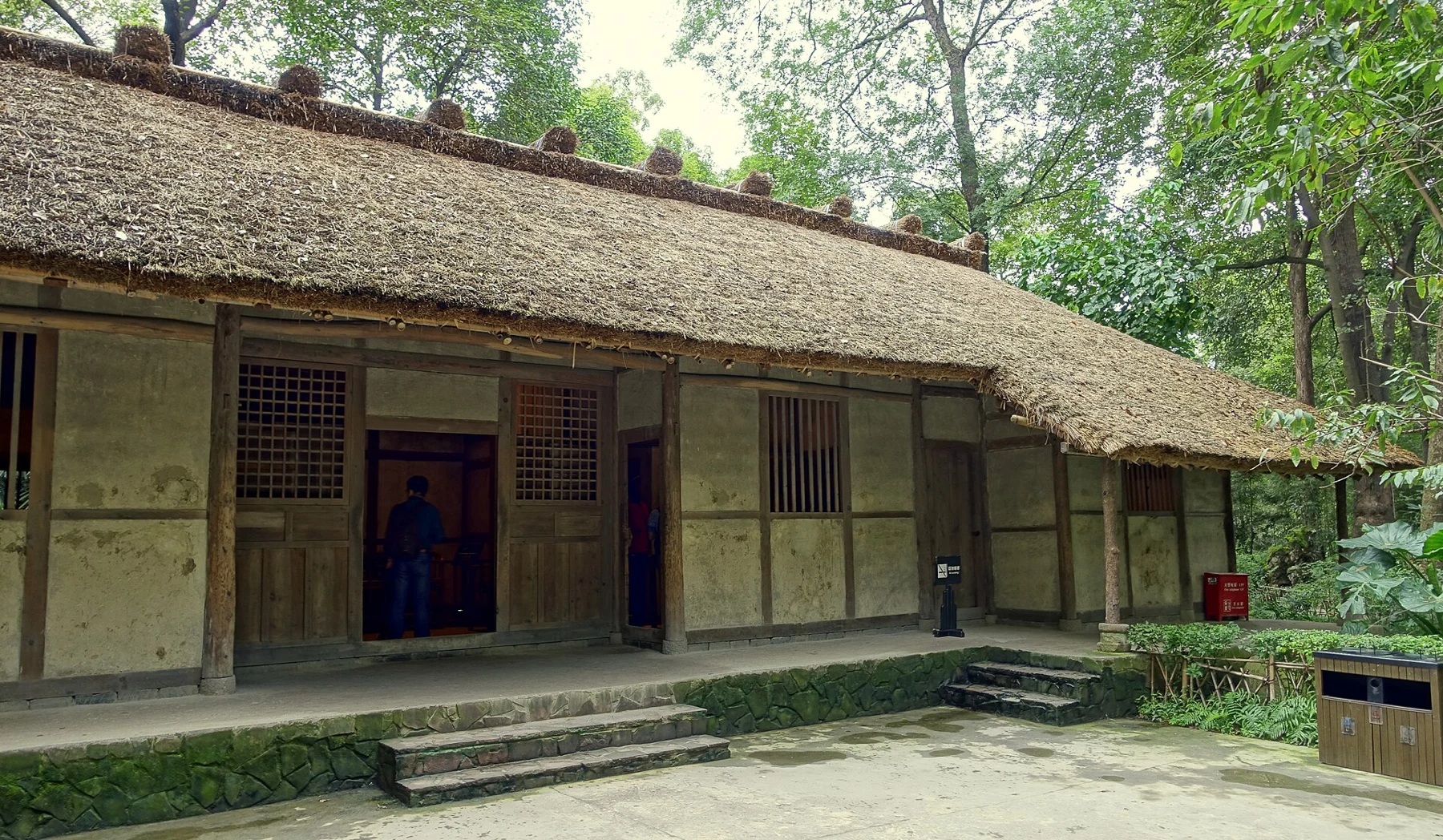
Compare the materials in the photographs: thatch and white walls around a domestic setting, a formal plaque in a memorial building, porcelain pieces used as lettering, and pottery behind glass. Each asks a different kind of question.
The poet & memorial
A home, a poem, a garden
Archaeology & continued reading
Open the museum’s original map ↗
Arrival in Chengdu, then the building of a cottage the following spring.[9]
Later rebuilding shaped the memorial sequence described by the museum.[19]
An earlier porcelain-lettered screen was made; its damaged characters were later replaced.[28]
Excavation exposed remains now interpreted in the Tang-period site display.[26]
Daya Hall, the rebuilt tower and the academy mark different stages in the continuing cultural complex.[29][30][31]
The museum reported completion of the latest roof work in late January.[11]
A closer reading
What to look for.
Choose a few subjects that interest you. The building names are useful anchors; poems, rooms, materials and garden details offer different ways to begin.
A first point of context
先认识杜甫
Meet Du Fu
Du Fu lived from 712 to 770. The memorial’s Daxie account introduces his life through displacement, family and public concern.[20]
Try a simple question as you explore: what would make this place feel like home to someone who had spent years moving? Let the small domestic scenes sit alongside the grandeur of later commemoration.
Our looking suggestionChoose one human concern to keep in mind: family, shelter, friendship or the wish to write.
Later generations’ remembrance
纪念建筑中轴
Read the memorial sequence
The five named buildings along the memorial axis form a later commemorative composition. The gate’s 草堂 characters were copied from the Shaoling stele inscription.[19]
A Chinese building name can be a useful visual anchor even when you cannot read the entire inscription. Save a few names below and compare the scale, threshold and atmosphere of each space.
Our looking suggestionLook for a change from a garden passage to a more formal memorial setting.
A sculptor’s reading of a life
大廨
Daxie Hall
Daxie takes its name from an official hall, but this later memorial building is not evidence that Du Fu ran such an office here. Qian Shaowu’s sculpture evokes the poet’s late life in Hunan, kneeling in a boat.[20]
Ask how the posture communicates a life story. A modern sculptor can give a visitor an emotional starting point without giving us a contemporary likeness.
Our looking suggestionRead the artist and subject label; keep this sculpture distinct from the bronze in Poem History Hall.
When writing becomes testimony
诗史堂
Poem History Hall
The hall’s name points to the idea of poetry as history. Its Du Fu bronze is by Liu Kaiqu, a different sculptural interpretation from the figure in Daxie.[21]
Think about what a poem can preserve that a timetable of events cannot: a household’s anxiety, a weather detail, the sound of birds or one person’s view from a room.
Our looking suggestionCompare the label, age suggested by the figure and mood, rather than assuming every Du Fu statue is the same work.
A modest name inside a formal memorial
柴门
Brushwood Gate
The current 柴门 plaque is by Pan Tianshou. The name was adopted in the 1960s from Du Fu’s poem 《野老》. Embedded inscriptions chiefly record later visitors.[22]
The contrast is worth noticing: a name suggesting a humble entrance sits within a place reshaped by centuries of admiration. You are reading both the poet’s imagined domestic world and the history of his readers.
Our looking suggestionFind the short plaque first; leave a long inscribed text for later if you prefer.
Why a poet has an official title
工部祠
Gongbu Shrine
“Du Gongbu” comes from an honorary Ministry of Works position. The plaque is by Ye Shengtao. Inside, Du Fu is commemorated with the later Song poets Lu You and Huang Tingjian.[23]
The museum dates the painted-clay Du Fu and Lu You figures to 1811, and Huang Tingjian to 1884.[23]
In the 2015 interior photograph, warm colours, layered panels and inscribed stones surround a painted portrait. Read each kind of representation on its own label.
Our looking suggestionMatch each figure to a current label before assigning a name.
Portraits as acts of remembrance
杜甫画像与石刻
A face made centuries later
The photographed displays include a vertical inscribed portrait and a stone image. They invite a closer look at the face, clothes, writing and surrounding frame.
The stone portrait’s photographed label names He Yudu and the Ming date 1602. This is a much later image of a Tang poet.
Treat each as a particular representation: read the date and maker on its own label. A convincing face can feel immediate while still belonging to a later age. The pictures here record the displays in 2015 and 2023.
Our looking suggestionLook at one feature of the face, then one feature of the inscription.
A different way to look at a garden
少陵草堂图
A historical plan on display
This April 2023 photograph records a framed plan whose label dates it to 1793 and says its maker is unknown. Buildings, trees, water and written names share the composition.
A historical plan can tell a story through emphasis and composition. Use the present museum map for your visit, and read an older image for what its maker chose to show.
Our looking suggestionCompare one building cluster with a patch of open water; this is a looking exercise, not a modern navigation plan.
The name, and a later shelter
少陵草堂碑亭
Shaoling Thatched Cottage pavilion
Yunli wrote the stele inscription in 1734. “Shaoling” is an alias associated with Du Fu. The protected building dates from 1811 and later became the six-sided thatched pavilion.[24]
This October 2024 view shows the stele under its own shelter. It is distinct from the reconstructed residential house. The shared thatch makes that distinction useful to learn before visiting.
Our looking suggestionFind the vertical inscription inside the pavilion.
Imagine a household, with care
茅屋景区
The reconstructed home
The house draws on Du Fu’s poetry and a Ming-period layout. Its construction uses a timber frame, bamboo-and-mud walls and a thatched roof.[25]
The museum reported completion of a re-thatching campaign in late January 2026, using dried wild thatch, local bamboo and traditional craft.[11]
The 2015 residential exterior matches the museum’s own reference building: a long thatched roof, timber-framed walls and a low stone platform. A separate detail shows a stone table and seats beside it.
Our looking suggestionNotice where rain would leave the roof and how the walls meet the timber frame.
Read a room as an interpretation
客厅与书房
A living room and a study
The museum describes a central living room, bedrooms and kitchen to the east, and a study and children’s room to the west.[25]
Our 2015 photographs show bamboo seating in a room labelled “Living Room” and a separate study display. The furnished scenes illustrate domestic life; no claim is made that this furniture belonged to Du Fu.
Imagine the difference between writing alone and keeping a household going. You can engage with that question without treating a modern display as an untouched home.
Our looking suggestionCompare the bamboo seating with the simple working surface in the study.
A closer look inside the reconstruction
灶台与屋架
Keeping a household going
The 2015 photographs show a cooking area with covered round openings in a built stove, a suspended vessel, a work table and a cupboard. A second view looks upward into the timber and thatch.
Pause on the practical side of a writer’s home: cooking, keeping rain out and finding light to work by. These are furnished reconstructions; the photograph does not make the stove, table or suspended vessel the poet’s own possessions.
Our looking suggestionLook from the cooking surface to the roof above. Where do you see a structure, a working surface and an opening for light?
One poem to know before you go
茅屋为秋风所破歌
A leaking roof, a wider wish
In the storm poem, damage to a cottage and rain indoors lead to a wish for secure shelter for other people. This is the cultural theme introduced by CCTV’s 2021 episode.[18]
Read the reconstructed house with that change of scale in mind: the concern begins in a small room, then extends far beyond its walls. This paragraph is our plain-English reading, not a borrowed literary translation.
Our looking suggestionAsk what changes when a private misfortune becomes a concern for strangers.
An invitation to read
绝句四首·其三
Four lines, four changes of view
The museum’s Liu Yong calligraphy record includes the following classical text. The English lines below are our own plain-English gloss, not a quotation from a published translation.[12]
两个黄鹂鸣翠柳,一行白鹭上青天。
Two orioles sing in green willows; a line of white egrets rises into a blue sky.
窗含西岭千秋雪,门泊东吴万里船。
A window frames the western ridges’ enduring snow; by the door lie boats connected with distant Eastern Wu.
Read from near to far: birds and willow, sky, mountains and boats. A poem can make a small room feel connected to a much larger world. It does not promise a snowy mountain view from today’s reconstructed cottage.
The accompanying archival photograph shows fragments labelled Tang-period inkstones from the museum’s 2001 excavation. It is a related writing-material subject, not an illustration of Du Fu’s personal tools.
Our looking suggestionChoose one pairing—green and blue, near and far, room and world—and carry it into the garden.
A name drawn from verse
红墙花径
The red-wall Flower Path
The current red-walled passage links the memorial and former temple areas. Xiao Longyou wrote its plaque; Guo Moruo wrote the couplet. The name evokes Du Fu’s welcoming-a-guest poem.[27]
Follow one visual line at a time: wall, roof edge, paving and foliage. A path can be enjoyable through its framing as much as through where it leads.
Our looking suggestionRead the short 花径 name; consult the current map before treating a passage as an exit.
Look closer at a familiar photograph
草堂影壁
Characters made from porcelain
The blue-and-white 草堂 lettering is assembled from broken porcelain. Zhou Shanpei made an earlier version in 1908; after damage, his brother Zhou Zhujun made the present characters.[28]
The 2010 photograph is useful at two distances. From further back, you read a name. Closer in, the lettering becomes pieces, shapes and small patches of blue.
Our looking suggestionTrace one stroke with your eyes and notice where separate fragments join.
A garden interlude
竹影与水岸
A little time among bamboo
The photograph brings a dense stand of bamboo stems close enough to see the repeated joints and the spaces between them.
Pick a comfortable permitted place to pause. Look at one repeated shape, then listen for a moment. You do not need to identify every plant to enjoy the contrast between vertical stems and the water’s surface.
Our looking suggestionNotice how the spaces between bamboo stems change as you move.
A garden view with its own subject
水岸与茅顶
Water, a roof and a reflection
The April 2023 image shows thatched waterside buildings with people seated inside, illuminated lanterns and a counter. It records a museum-ground scene, not a confirmed view of the reconstructed residential rooms.
A 2013 photograph records a line of rounded stones across water. Neither image establishes a named ancient water feature or a currently open crossing. Look at the reflections and use the maintained visitor path.
Our looking suggestionCompare the line of the roof with its reflection. Let the view stand on its own without assigning it a more specific historical identity.
Make one deliberate photograph
门洞与借景
A garden seen through a frame
A curved opening in our 2013 image frames another wall and a further opening. The 2015 circular doorway frames a covered corridor and a person reading.
Try one wide photograph and one detail from a permitted position. Include the frame itself in the first, then decide what the opening makes you notice. Keep the shared route clear while you compose.
Our looking suggestionCompare the shape of the frame with the geometry beyond it.
Different evidence, different questions
唐代遗址
Tang-period ground beneath the memorial
A utility project led to the discovery in late 2001. The museum preserves about 420 square metres of excavation with foundations, drains, wells and other remains.[26]
The June 2012 photograph shows an indoor archaeological presentation. Look for the shift from individual objects to relationships in the ground.
Tang-period material helps explain occupation of this place. It does not establish that every object was owned or used by Du Fu.
Our looking suggestionLook for the surviving line of a wall or channel before focusing on a single find.
A closer look at the archaeological displays
出土器物
Ordinary things behind glass
Our archival photographs show ceramic dishes and vessels beside museum labels. The objects and their labels belong together: a date, find context and material can change how you understand a modest piece.
Start with a bowl or plate. Look at its rim, surface and profile. Then read what the label actually establishes. These photographs record displays from 2010 and 2013; they do not guarantee the same arrangement today.
Our looking suggestionCompare an intact shape with a fragment, and avoid turning a plausible use into a proven owner.
Du Fu among other poets
大雅堂
Daya Hall
A former Buddhist main hall became this poetry gallery in 2002. Its figures include twelve other poets, among them Li Bai, Wang Wei, Su Shi and Li Qingzhao. The plaque was assembled from Yan Zhenqing’s characters.[29]
Choose one other poet whose name interests you and read that figure’s label. A gallery can become the start of another reading journey rather than a test of how many names you know.
Our looking suggestionKeep 大雅堂, Daya Hall, distinct from 大廨, Daxie Hall.
Rebuilding above protected traces
万佛楼
Wanfo Tower
The present octagonal, four-storey tower was rebuilt in 2005. Foundations found in 2004 were protected in place by rotating the new foundation 22.5 degrees.[30]
That decision gives you a useful question for any heritage site: how can a later structure acknowledge something older beneath it? Check present access before assuming that upper floors or a viewpoint are open.
Our looking suggestionRead any on-site foundation explanation; a tower’s silhouette alone does not establish a climbable visitor route.
A place where reading continues
草堂书院
Caotang Academy
The academy opened in April 2021 after a restoration project begun in 2017, in former temple quarters. Its programme includes reading, talks and education.[31]
For a particular event or room, ask about language, date, entry and booking. A programme announcement and an ordinary museum ticket are different things to check.
Our looking suggestionLook for a current programme rather than assuming an earlier advertised activity runs daily.
Plan ahead for specialist access
古籍与数字资源
For readers who want to go further
The museum’s 2023 procedure allows appointments for digital or facsimile consultation, requested at least three working days ahead with an introduction letter and book list. Successful applicants bring identity and the original letter for on-site access.[14]
Its digitisation report describes an internal-network reading platform. That is not a promise of an unrestricted public download library.[15]
For a first visit, one poem read attentively can be enough. Specialist collections are an optional next step for someone with a specific research purpose.
Our looking suggestionSeparate a collection catalogue, an appointment service and an object actually on display.
Choose what matters
Make the visit yours.
For a first encounter with Du Fu; roughly two to three hours is an editorial allowance.
The person, the home, a garden pause.
- Keep
- A little biography, selected memorial buildings, the reconstructed house and a pause among plants.
- The trade-off
- Leave specialist collections and some halls for another visit.
Prepare one poem
Read the four-line poem or the storm-poem introduction.
Choose from the memorial
Use the current map and select two or three named buildings.
Look at a domestic detail
Compare the room display with what a poem asks you to imagine.
Finish with one garden subject
Choose water, bamboo or an opening, then return equipment before leaving.
This is a choice of subjects, not a surveyed walking order. Your entrance, open rooms, energy and current signs determine the actual visit.
All outlines are editorial estimates, not field-tested routes. Follow current admission rules and venue directions.
Arrival, energy and interpretation
Get the details right.
Choose an entrance before setting off.
The current detailed museum guidance gives Metro Line 13 to Du Fu Thatched Cottage, 杜甫草堂, Exit C2 for the North Gate.[8]
Alternatives are Line 4, Caotang North Road, and Line 5, Qingyang Palace, with walking connections. The North Gate is at 37 Qinghua Road; the south parking entrance is at 2 Caotang Road; the main-gate address is 28 Caotang Road.[8]
Save the entrance as well as the museum name. Use present station signs and confirm an authorised drop-off near the gate you intend to use. No exact walking time or continuous step-free connection has been measured.
The parking page’s 24-hour period concerns parking, not museum opening. No current tariff, parking space or transport service has been booked or physically checked.
Useful questions at the cottage.
Show the relevant passport or booking when asking staff. These questions help establish the answer for your actual visit.
- 我持外国护照。请问应该在哪个窗口购票或换票?
I have a foreign passport. Which window should I use to buy or exchange my ticket?
- 请问持外国护照的孩子按什么标准购票?需要什么证件?
What ticket rule applies to a child with a foreign passport, and what documents are required?
- 请问我这个海外学生证可以购买学生票吗?
Is this overseas student document accepted for a student ticket?
- 请问免费的英文语音导览在哪里打开?
Where can I open the free English audio guide?
- 请问今天有英文人工讲解吗?几点开始、多少钱?
Is a human English guide available today? At what time and price?
- 请问轮椅还有吗?押金多少、承重多少、几点前归还?
Is a wheelchair available? What are the deposit, weight limit and return deadline?
- 请问今天这条路有台阶吗?有没有适合轮椅的路线?
Does this route have steps today? Is there a suitable wheelchair route?
- 请问离馆后还能凭原票再次入馆吗?
Can I re-enter on the same ticket after leaving?
- 请问从这里怎么去北门和地铁十三号线杜甫草堂站?
How do I reach the North Gate and Du Fu Thatched Cottage station on Metro Line 13 from here?
Choose your English explanation
The museum lists free Chinese/English WeChat audio under 参观指南 → 游览攻略. Separate foreign-language QR audio costs CNY 18 per use; the listed languages are English, Japanese, Korean, German, French, Russian, Portuguese and Arabic.[6]
The hired device is CNY 25 per use; its languages are not specified on the page. The visual smart guide is CNY 20. Foreign-language human explanation is CNY 60 per person for about an hour. Confirm the actual language, departure and availability.[6]
No guide purchase, phone compatibility, complete audio track or live English guide slot has been tested.
Wheelchairs and strollers
Published free loan hours are 09:00–17:30, with a CNY 300 deposit per unit and registration. The maximum weights are 90 kg for a wheelchair and 15 kg for a stroller. Staff check the equipment before use and on return; a satisfactory return releases the deposit.[7]
Ask about availability, the return point and a currently usable route before accepting equipment. Published loan provision does not by itself establish a continuous step-free museum visit.
Bags and leaving the paid area
The visitor rules ask people with large baggage to use storage. Check its charge, accepted items, opening and retrieval deadline before leaving anything.[5]
Take a comfortable amount into the visit. Collect stored items and return hired or borrowed equipment before using your final exit; consult staff if you need a different arrangement.
Use current activities as optional extras
The July 2026 Qinzhou-themed exhibition ended on 8 October. Its old announcement does not establish a current show.[13]
Read any activity’s actual dates, language and booking terms. A festival feature, a recorded panorama and a current programme listing serve different purposes. Plan a complete ordinary museum visit that does not depend on a particular temporary event.
CGTN · A Slice of Chengdu · 10 November 2024
A first glimpse, in motion.
CGTN · A Slice of Chengdu · 10 November 2024 · Recorded place feature · about 52 seconds
A small introduction to a poet’s place
A presenter at a gateway, an inscribed corridor and a costumed tea-table scene. An inspected frame has English subtitles. Recorded imagery does not establish a daily tea activity, current programme or room access.
Watch the original CGTN cottage featureOpens the publisher’s own player in a new tab. Original playback passed two seconds. Full playback, speech, physical phones and overseas reliability remain untested. The cover is a credited reference photograph, not a film still.
- About 52 seconds. Inspected scenes show a presenter at a gateway, an inscribed corridor and a costumed tea-table scene. English subtitles appear in an inspected frame.
- Watch at the original publisher. The recorded setting and tea scene do not establish a current programme, included tea experience or present room access.
An original recorded exhibition
Turn a view, then enter the exhibition.
The museum links a photographic panorama titled Dreaming Back to Luoyang, about Tang-period eastern-capital cultural relics. It is a recorded exhibition resource.[16]
Dreaming Back to Luoyang · original 360° record
Open 点位列表, the viewpoint list. Selecting 3-前言 reached the exhibition’s orange title wall; dragging turned the view toward interior display cases. The initial courtyard and a second exterior also rendered and rotated.
Explore the original museum-linked panoramaThe museum’s online exhibition index
Use the museum’s own index to choose another resource. Each has its own interface and availability; only the Luoyang viewpoints described here have been accepted.
Browse original museum-linked online exhibitionsThe first exterior visibly shows 大廨, Daxie Hall, while the list’s first label says 大雅堂, Daya Hall. These are different buildings; do not navigate by that conflicting label alone.
The recording does not establish that the physical exhibition is still running, that every viewpoint works, or that all museum spaces have been captured. Audio, physical phones and overseas reliability remain untested.
Before you ask.
Do I need to know Chinese poetry to enjoy this?
A little context helps. Start with the person and one short poem, then choose a room, a material detail or a garden view that catches your interest.
Is this the original eighth-century house?
The reconstructed residence is explained in its own section. The later memorial buildings, the archaeology and modern sculptures each have their own histories.
Does an ordinary foreign child definitely enter free?
The current language versions differ. Use the document question above and get the ticket office’s answer for the child’s actual passport and age.
Can I rely on an old guide’s CNY 60 admission or long summer hours?
Use the museum’s current ticket and hours references in this guide, then check dated notices for your visit. Older third-party tables are not carried forward.
Can I add another nearby place?
Make sure you want the second visit for its own reason. A reader’s attention, lunch and the return journey all need time. Save a second idea without treating it as an obligation.
Dates, sources and photographs
Follow the evidence.
Reviewed 29 October 2026 against current museum visitor pages, dated notices and the complete expanded accounts behind thirteen feature modals. The public feature landing pages repeat a shared preview list; those repeats are not treated as independent evidence. Original community discussion informed questions about a selective garden and photography visit only. Dated licensed photographs are individually checked before integration. Looking exercises, time allowances and visit selections are editorial. No physical visit, booking, payment, live guide purchase, equipment loan or continuous accessibility journey was tested.
Reviewed 2026-10-29. This date records our source review, not a live availability check.
Open 32 source references
- Museum home: actual foreign-ticketing link
Original museum or broadcaster account · Reviewed 2026-10-29
- Museum: ordinary hours and notice-dependent extensions
Original museum or broadcaster account · Reviewed 2026-10-29
- Museum: current Chinese and translated admission policies
Original museum or broadcaster account · Reviewed 2026-10-29
- Museum: general real-name booking procedure
Original museum or broadcaster account · Reviewed 2026-10-29
- Museum: baggage and single-entry visitor rules
Original museum or broadcaster account · Reviewed 2026-10-29
- Museum: free audio and separate priced guide products
Original museum or broadcaster account · Reviewed 2026-10-29
- Museum: wheelchair/stroller loan terms and limits
Original museum or broadcaster account · Reviewed 2026-10-29
- Museum: current detailed gate and Metro guidance
Original museum or broadcaster account · Reviewed 2026-10-29
- Museum: Du Fu’s arrival and residence chronology
Original museum or broadcaster account · Reviewed 2026-10-29
- Museum: dated February 2026 holiday passport-window arrangements
Original museum or broadcaster account · Reviewed 2026-10-29
- Museum: completed January 2026 roof work
Original museum or broadcaster account · Reviewed 2026-10-29
- Museum: Liu Yong calligraphy record with classical poem, 23 April 2026
Original museum or broadcaster account · Reviewed 2026-10-29
- Museum: Qinzhou exhibition announcement with 8 October 2026 end date
Original museum or broadcaster account · Reviewed 2026-10-29
- Museum: on-site digital/facsimile consultation procedure, 2023
Original museum or broadcaster account · Reviewed 2026-10-29
- Museum: collection digitisation report and internal reading platform, 2023
Original museum or broadcaster account · Reviewed 2026-10-29
- Museum: original online exhibition links
Original museum or broadcaster account · Reviewed 2026-10-29
- Original Reddit outing: photography and Qingyang/cottage visit; personal perspective only
Visitor perspective; questions only · Reviewed 2026-10-29
- CCTV-10: 7 September 2021 cultural episode and storm-poem summary
Original museum or broadcaster account · Reviewed 2026-10-29
- Museum expanded feature account: 正门
Complete original public feature-modal account · Reviewed 2026-10-29
- Museum expanded feature account: 大廨
Complete original public feature-modal account · Reviewed 2026-10-29
- Museum expanded feature account: 诗史堂
Complete original public feature-modal account · Reviewed 2026-10-29
- Museum expanded feature account: 柴门
Complete original public feature-modal account · Reviewed 2026-10-29
- Museum expanded feature account: 工部祠
Complete original public feature-modal account · Reviewed 2026-10-29
- Museum expanded feature account: 碑亭
Complete original public feature-modal account · Reviewed 2026-10-29
- Museum expanded feature account: 茅屋景区
Complete original public feature-modal account · Reviewed 2026-10-29
- Museum expanded feature account: 唐代遗址
Complete original public feature-modal account · Reviewed 2026-10-29
- Museum expanded feature account: 花径
Complete original public feature-modal account · Reviewed 2026-10-29
- Museum expanded feature account: 草堂影壁
Complete original public feature-modal account · Reviewed 2026-10-29
- Museum expanded feature account: 大雅堂
Complete original public feature-modal account · Reviewed 2026-10-29
- Museum expanded feature account: 万佛楼
Complete original public feature-modal account · Reviewed 2026-10-29
- Museum expanded feature account: 草堂书院
Complete original public feature-modal account · Reviewed 2026-10-29
- CGTN: original 52-second cottage feature, 10 November 2024
Original broadcaster film and article · Reviewed 2026-10-29
Photograph authors, dates and licences (25 photographs)
Daderot · 2015-09-24 04:50:00 · CC0
Resized and converted to WebP. Image-file proportions retained; hero and preview layouts may crop the display. Original licence retained.
ChasingAir · 2023-04-02 12:16:23 · CC0
Resized and converted to WebP. Image-file proportions retained; hero and preview layouts may crop the display. Original licence retained.
ChasingAir · 2023-04-02 12:16:28 · CC0
Resized and converted to WebP. Image-file proportions retained; hero and preview layouts may crop the display. Original licence retained.
ChasingAir · 2023-04-02 12:17:07 · CC0
Resized and converted to WebP. Image-file proportions retained; hero and preview layouts may crop the display. Original licence retained.
Daderot · 2015-09-24 04:50:58 · CC0
Resized and converted to WebP. Image-file proportions retained; hero and preview layouts may crop the display. Original licence retained.
Daderot · 2015-09-24 04:51:51 · CC0
Resized and converted to WebP. Image-file proportions retained; hero and preview layouts may crop the display. Original licence retained.
LanguageTeaching · 2013-12-20 21:11 · CC BY 2.0
Resized and converted to WebP. Image-file proportions retained; hero and preview layouts may crop the display. Original licence retained.
LanguageTeaching · 2013-12-20 21:47 · CC BY 2.0
Resized and converted to WebP. Image-file proportions retained; hero and preview layouts may crop the display. Original licence retained.
LanguageTeaching · 2013-12-20 21:46 · CC BY 2.0
Resized and converted to WebP. Image-file proportions retained; hero and preview layouts may crop the display. Original licence retained.
Daderot · 2015-09-24 04:45:11 · CC0
Resized and converted to WebP. Image-file proportions retained; hero and preview layouts may crop the display. Original licence retained.
Daderot · 2015-09-24 04:45:33 · CC0
Resized and converted to WebP. Image-file proportions retained; hero and preview layouts may crop the display. Original licence retained.
Kcx36 · 2023-04-05 15:37:05 · CC BY-SA 4.0
Resized and converted to WebP. Image-file proportions retained; hero and preview layouts may crop the display. Original licence retained.
Kcx36 · 2023-04-05 15:35:28 · CC BY-SA 4.0
Resized and converted to WebP. Image-file proportions retained; hero and preview layouts may crop the display. Original licence retained.
Kcx36 · 2023-04-05 15:35:06 · CC BY-SA 4.0
Resized and converted to WebP. Image-file proportions retained; hero and preview layouts may crop the display. Original licence retained.
瑞丽江的河水 · 2024-10-20 14:56:46 · CC BY-SA 4.0
Resized and converted to WebP. Image-file proportions retained; hero and preview layouts may crop the display. Original licence retained.
LanguageTeaching · 2013-12-20 20:58 · CC BY 2.0
Resized and converted to WebP. Image-file proportions retained; hero and preview layouts may crop the display. Original licence retained.
LanguageTeaching · 2013-12-20 20:58 · CC BY 2.0
Resized and converted to WebP. Image-file proportions retained; hero and preview layouts may crop the display. Original licence retained.
A J Butler · 2012-06-17 · CC BY 3.0
Resized and converted to WebP. Image-file proportions retained; hero and preview layouts may crop the display. Original licence retained.
Gary Todd from Xinzheng, China · 2010-04-25 15:00 · CC0
Resized and converted to WebP. Image-file proportions retained; hero and preview layouts may crop the display. Original licence retained.
Gary Todd from Xinzheng, China · 2010-04-25 15:39 · CC0
Resized and converted to WebP. Image-file proportions retained; hero and preview layouts may crop the display. Original licence retained.
Daderot · 2015-09-24 04:38:22 · CC0
Resized and converted to WebP. Image-file proportions retained; hero and preview layouts may crop the display. Original licence retained.
Daderot · 2015-09-24 04:38:08 · CC0
Resized and converted to WebP. Image-file proportions retained; hero and preview layouts may crop the display. Original licence retained.
Daderot · 2015-09-24 04:50:08 · CC0
Resized and converted to WebP. Image-file proportions retained; hero and preview layouts may crop the display. Original licence retained.
Daderot · 2015-09-24 04:51:17 · CC0
Resized and converted to WebP. Image-file proportions retained; hero and preview layouts may crop the display. Original licence retained.
Daderot · 2015-09-24 04:51:32 · CC0
Resized and converted to WebP. Image-file proportions retained; hero and preview layouts may crop the display. Original licence retained.
How conflicting descriptions were handled
The Chinese under-18 policy names nationality; its translations omit that condition. Ordinary foreign-child eligibility is left for document-specific confirmation, and ordinary foreign seniors are not promised a resident-document exemption.
The general booking page describes Chinese-ID procedures; the home page supplies a separate foreign-booking link. The dated February holiday passport-window notice is not turned into a universal present procedure.
The current detailed transport section gives Line 13/C2. Its older introduction still mentions other lines, and 24-hour parking is not museum opening.
Counts of rebuilding campaigns and published area totals differ by source and scope; neither is needed to understand this visit and both are omitted.
Daxie and Daya are separate buildings. The two named modern Du Fu sculptures are distinguished; figures and inscriptions in photographs are not identified from filenames alone.
The reconstructed house and furniture illustrate domestic life. Tang-period finds do not establish Du Fu’s personal ownership. Archival object photographs are not a current display inventory.
Completed January roof work is not a current closure. The ended October Qinzhou exhibition and May free-entry day do not establish ordinary present access.
The poem’s classical text is public domain. Its English gloss is our own; no modern published translation is reproduced, and the verse is not a present landscape-view guarantee.
The online panorama was actually entered and rotated, including the exhibition preface. Its record and conflicting exterior label do not establish a live exhibition or every room’s current access.
The specialist books service is advance on-site digital/facsimile consultation. An internal digitisation platform is not advertised as a public download library.
A Reddit outing connects Qingyang Palace and the cottage for one visitor. Neither that person’s timing nor a hotel-related Qingyang entry claim becomes a general museum rule.[17]
Full-size photograph review corrected a stone table initially mistaken for a well, bamboo seating labelled Living Room, a tiled roof and a circular doorway without water. The waterside counter scene is not called the residential reconstruction. The residential exterior was matched to the museum’s own reference photograph; that unlicensed reference is not rehosted.
One excavation photograph has conflicting Chinese and English object labels and was excluded. Inkstones and the historical plan/portrait labels are described only as photographed evidence, with no personal-ownership or current-display guarantee.
The CCTV page supplied cultural background. The selected CGTN original was played and its sampled imagery checked; complete playback, sound and regional availability remain unconfirmed.
What still needs direct confirmation
- Document-specific foreign-child and overseas-student concessions; live ticket availability, foreign booking checkout, refund terms and admission scan.
- Actual guide language and schedule, WeChat/audio compatibility, equipment stock, storage charge and a continuous step-free route.
- Present temporary displays, all panorama viewpoints, audio, physical-phone behaviour and overseas media reliability.
- Complete film playback and audio; original publisher availability on physical phones and overseas connections.
Film verification: Checked 29 October 2026: the original publisher’s player ran and selected scenes were reviewed. Complete playback, audio, physical phones and overseas availability remain untested.
In this guide