
Chengdu · In-depth place guide
成都武侯祠博物馆
A kingdom remembered.
A feather fan. A painted face. An emperor behind a veil of shade. Step beyond the red walls and meet the people Chengdu chose to remember.
Read the faces. Follow the stories.
You do not need to have read Romance of the Three Kingdoms to enjoy this place. Begin with two names: Liu Bei, ruler of Shu Han, and Zhuge Liang, his minister. The museum commemorates them and other Shu Han figures.[4]
The pleasure is in comparing. Look at a ruler’s crown, a strategist’s fan, a civil official’s sleeves and a general’s armour. Then step out into bamboo, red walls and a quieter memorial landscape. A little context makes the faces more than a row of unfamiliar names.
We would allow roughly two to three hours for a selective first visit, longer for a substantial exhibition or guide. That is an editorial estimate. Choose a few subjects you want to understand rather than trying to read every inscription.
Plan your visit
Know which place you are entering.
- Published hours
- 09:00–18:00; last entry 17:00.[1]
- Adult admission
- CNY 50 for the heritage area.[1]
- Best reason to visit
- A manageable introduction to Three Kingdoms memory through buildings, sculpture and stone; also rewarding for attentive photography.
- Adjacent, but different
- The shrine, the West Area and Jinli have different identities. Plan the paid heritage visit before treating the surrounding streets as a continuation.
Check overseas concessions carefully
Under-18s are free under current rules. The 60+ exemption lists specific resident-document categories; an ordinary foreign passport alone is not listed.[1]
Official human guides: the museum counter
The museum’s 28 September 2026 statement says its own human-guide service is sold at its on-site counter, not through third-party online listings.[7]
A night photograph is not a night ticket
Plan around the current heritage-area hours above. Special-event access and surrounding street activity do not establish ordinary evening entry.
The heritage area has its own admission.
Choose admission for the person and date first; choose interpretation separately. Keep a screenshot of the actual product, terms and confirmation.
Published visitor categories · confirm your documents and date
Adult heritage admission
- Published reference
- CNY 50.
- Practical point
- Passport booking is supported.
Under 18
- Published reference
- Free; 18 is excluded.
- Practical point
- Foreign minors exchange at the service window with a passport.
Student
- Published reference
- CNY 25: full-time undergraduate-and-below students, ages 18–23 online.
- Practical point
- Listed mainland/Hong Kong/Macao/Taiwan or foreign-permanent-resident documents and study proof are required. Ordinary overseas student proof is not automatically accepted.
Annual pass
- Published reference
- Published CNY 100.
- Practical point
- A separate product; ask about its identity and use conditions before buying.
| Visitor or service | Published reference | Practical point |
|---|---|---|
| Adult heritage admission | CNY 50. | Passport booking is supported. |
| Under 18 | Free; 18 is excluded. | Foreign minors exchange at the service window with a passport. |
| Student | CNY 25: full-time undergraduate-and-below students, ages 18–23 online. | Listed mainland/Hong Kong/Macao/Taiwan or foreign-permanent-resident documents and study proof are required. Ordinary overseas student proof is not automatically accepted. |
| Annual pass | Published CNY 100. | A separate product; ask about its identity and use conditions before buying. |
For an accompanying young child, confirm the adult/child arrangement at booking. Do not choose a paid child category from an older translated page.
The cited concession list is the deciding reference. Ask the ticket office about your exact document rather than assuming a discount from age or a student card alone.
Bring your booked passport.
Current online rules allow booking 14 days ahead. Full-price passport holders use the booked original document and order QR for gate verification.[23]
For unused ordinary tickets, cancel by 17:00 on the visit date without a no-show. Cancellation before 22:00 still counts as one; after 22:00 the system refunds automatically and records one. Repeated no-shows can restrict booking.[1]
Book through the museum’s own entry point and keep the confirmation accessible offline. We have not completed a foreign-passport purchase, payment or refund.
Find your bearings
A ruler, a minister, a place of remembrance.
Shu Han was founded in 221 with Chengdu as its capital and ended in 263. It was one of the Three Kingdoms, alongside Wei and Wu.[4]
The grounds developed around Liu Bei’s Huiling mausoleum. The present museum includes the heritage area, a West Area centred on Liu Xiang’s cemetery, and Jinli.[4]
For a first visit, separate three questions: who is represented, when was the memorial made, and what does its setting ask you to notice? A later statue of an earlier person is part of how history is remembered.
The photograph below shows an architectural model and projected backdrop. Use it to think about courtyards and roof groups; follow the museum’s current signs for actual entrances and open paths.
The commemorative halls
Stone & the memorial landscape
Stories & museum interpretation
Open the museum’s illustrated heritage-area plan ↗
A closer reading
What to look for.
Read these as independent closer looks. The photographs keep their dates; they help you recognise subjects without promising today’s exact arrangement or access.
Begin with the ruler
汉昭烈庙
The name above the gate
The entrance photograph lets you recognise the characters 汉昭烈庙. Save the Chinese museum name with your destination so a driver or staff member knows which visit you mean.
Read the old paper admission as an object from a previous visit: printed design, a hand in the foreground and the same plaque beyond it. Its 2017 appearance is not today’s ticket product.
Our looking suggestionLook up before joining the line; the plaque is a useful first subject.
Stone at close range
石狮
A small figure beside a large one
In this photograph, the stone guardian’s carved mane and rounded face sit above a smaller cub. Weathering softens some edges while the pedestal keeps a sharper pattern.
Try a photograph that includes the red wall as well as the carving. The contrast between pale stone and painted plaster makes surface texture easier to see. Observe from the permitted visitor path.
Our looking suggestionChoose one detail: a paw, a curl of the mane or the small cub.
Crown, scale and setting
刘备殿
Meet Liu Bei as an emperor
The main hall photograph shows a gilded figure with a pendant crown, deep inside the timber frame. Compare its ceremonial appearance with the plainly dressed Liu Bei in Sanyi Temple later in this guide.
Liu Bei Hall stands in front of Zhuge Liang Hall in the rebuilt arrangement.[4]
Use your eyes to move from the large vessel in the foreground to the plaque, then to the seated figure. Changing your permitted viewpoint changes which details emerge from the shade.
Our looking suggestionCompare the scale of the figure with the door frame.
Read a person, not just a row
文臣廊
A court of distinct faces
The museum identifies 14 civil figures in the eastern corridor and 14 military figures in the western corridor. Their costume draws on Qing theatrical representation.[5]
Fei Yi’s blue, red and green robe makes a strong first comparison. A written panel sits alongside him; use the name to anchor your looking, then notice the face and the small object held between his hands.
In the second photograph, Pang Tong’s hands and long sleeves create a different silhouette from his neighbour. You do not have to memorise a biography to see how the figures have been individualised.
Our looking suggestionCompare two hands and two faces before moving to another figure.
Huang Zhong & Jiang Wei
武将廊
Armour as a painted surface
Huang Zhong’s photograph shows a long pale beard, hands resting near the knees and a circular creature motif across the torso. The armour is full of painted bands rather than a single metallic colour.
Jiang Wei’s figure has a different hand position and a bright, patterned breastplate. Compare the shoulders, knees and belt with the civil robes; this is a useful way to read the sculpture before translating a label.
Our looking suggestionPick one repeated colour and follow it across the figure.
A strategist’s remembered image
诸葛亮殿
The feather fan
The museum dates the seated Zhuge Liang figure to 1672. Its fan, headdress and attendant figures are part of the hall’s presentation.[5]
The close photograph rewards a slow look: thin fan shafts, long moustache strands, folded gold sleeves and a face with a restrained expression. These are details of a commemorative sculpture, not a photograph of a third-century person.
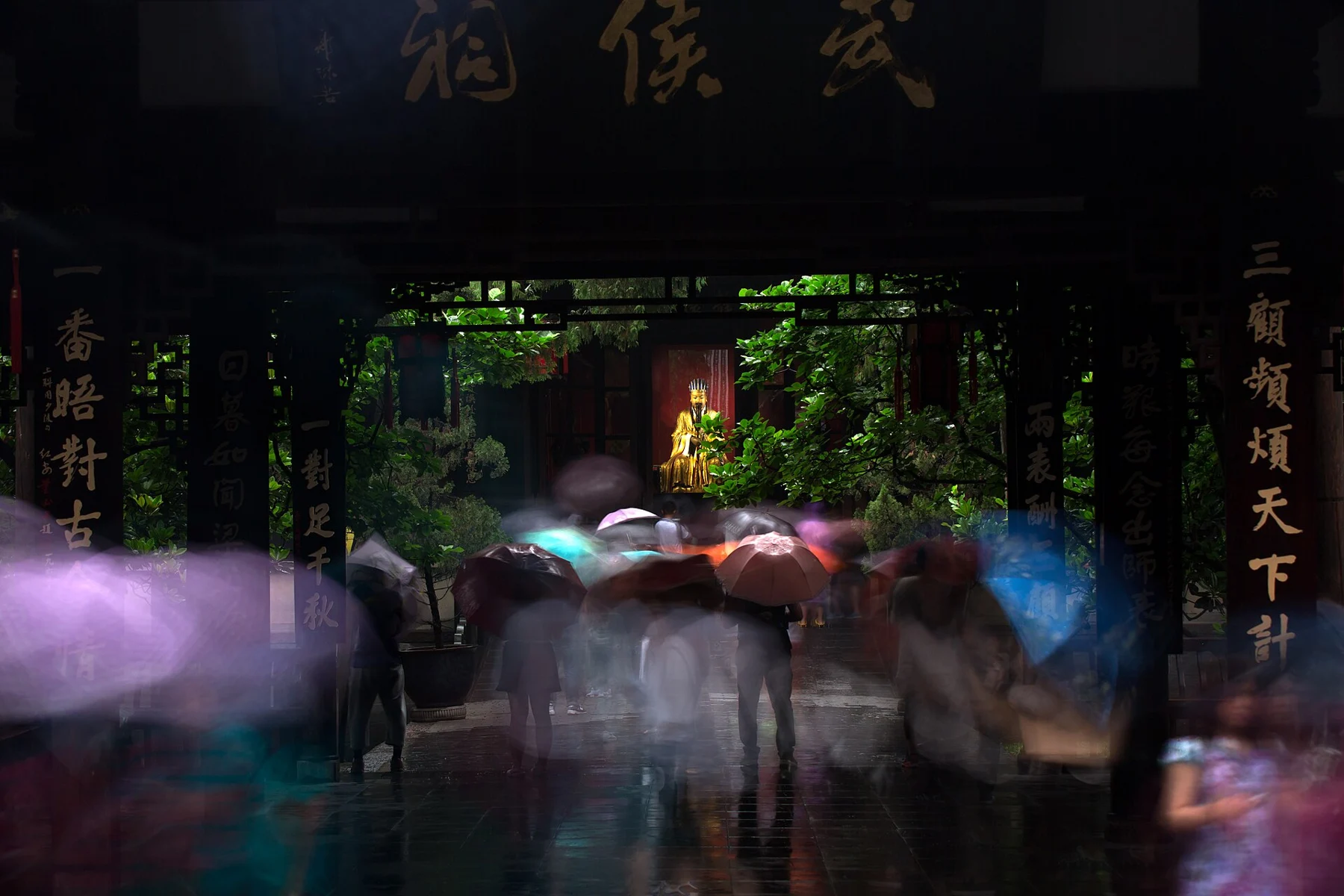
The wider photograph shows visitors as blurred colour beneath plaques and foliage. A long exposure changes the crowd’s appearance; it does not establish a quiet time to visit.
Our looking suggestionLook from the face to the fingers holding the fan.
Writing, calligraphy and cutting
唐碑
A stone with three makers
The Tang stele dates to 809. The museum names Pei Du as writer, Liu Gongchuo as calligrapher and Lu Jian as engraver.[5]
These are different kinds of authorship: composing words, shaping written strokes and cutting them into stone. Ask a guide to show you a small part of the inscription where those roles become easier to understand.
The museum’s digital cultural journey also opens a recorded photograph of this stele with an English interface. It is a useful place to enlarge the surface before or after your visit.[17]
Our looking suggestionDistinguish a historical inscription, a photograph and a rubbing; each gives a different encounter with the same surface.
Read the layers of time
重修忠武侯庙碑记
A record of a later rebuilding
The photographed stone identifies a rebuilding record from Kangxi year 11. Its protective frame and reflective surface are visible; this is a different object from the Tang stele.
The museum’s research books study inscriptions and commemorative sculpture as separate bodies of evidence. A 2022 publication account describes a 47-statue research corpus; that is not a promise of today’s total visible figures.[10]
Notice where the text becomes hard to read and where a label would help. Ask which event a stele records before assuming it dates the entire surrounding building.
Our looking suggestionCompare the date in a caption with the event remembered by the text.
The approach changes the mood
惠陵神道
Stone animals beneath the trees
The approach photograph shows paired stone animals on either side of a wet path. Their repetition draws your eye toward the brick structure beyond.
Try pausing at the edge of the permitted path and looking along the sequence. Tree trunks, animals and paving create successive layers; a face-on view and a side view will read very differently.
Our looking suggestionLet another visitor pass, then look along the line without blocking it.
An exterior memorial
惠陵陵碑
A name in a brick niche
The wall photograph shows a central inscribed stone and two arched side passages. The closer view reads 漢昭烈皇帝之陵, identifying the emperor’s mausoleum. These photographs show the exterior memorial, not entry into a burial chamber.
The name above the approach uses another compact inscription. Comparing the two gives even a non-Chinese reader a way to recognise repeated characters and the identity of the place.
Our looking suggestionLook for the difference between a passage beside the memorial and the inscribed niche itself.
A quieter exterior view
惠陵封土
The planted mound
The museum identifies Huiling as Liu Bei’s mausoleum.[5]
The photograph shows a curving path, a retaining wall and a planted mound. Follow the shape with your eyes; it is a very different visual experience from an excavated display or a hall full of objects.
The plaque photograph names the mausoleum. Use it as an orientation cue while respecting barriers and present access instructions.
Our looking suggestionGive the shape and vegetation a moment before taking a close-up of the name.
Colour, depth and a shared path
红墙竹影
More than a portrait backdrop
The red-wall path rewards a wide photograph: walls carry the eye around a bend while bamboo breaks the flat colour above. A person gives the space scale, but the architecture can hold the picture by itself.
In the wet-weather view, paving reflects the red and the curve feels more pronounced. Neither image establishes a rainy-day forecast, an empty time or permission to occupy the path for a long photo session.
Our looking suggestionTake one wider frame, then step aside for people using the passage.
A different way to photograph the walls
竹影
Wait for a shadow
The shadow photograph turns bamboo into a second drawing on the wall. Look for one crisp leaf beside a softer shadow, then include the tiled cap or wall joint to keep a sense of material.
If the light is flat on your visit, choose texture instead: the plaster, roof tiles or a contrast between wall and foliage. The useful exercise is attention rather than recreating somebody else’s weather.
Our looking suggestionA small section of wall can be a complete picture.
History and literary memory
三义庙
A temple shaped by a famous story
Sanyi Temple’s imagery draws on Romance of the Three Kingdoms. Its surviving fabric is largely associated with 1842, and it moved here in 1998.[5]
The front view and the closer hall photograph let you compare roof line, timber doors and the seated figure. Read the plaque 義重桃園 as a cue to the Peach Garden story, not archaeological proof that a novel’s scene happened here.
Our looking suggestionAsk which part of an explanation comes from a novel and which from an inscription or historical record.
The relocation record
三义庙迁建记
A building can have more than one address
The photographed relocation record explicitly names Sanyi Temple and records its move in 1998. This provides a different kind of encounter from a simple “ancient temple” caption.
Look at a threshold, a roof and a stone record as separate evidence. A building’s age, a rebuilding and the date of its move can all be relevant without being the same date.
Our looking suggestionFind the relocation date before trying to date every timber you see.
Compare with the imperial hall
三义庙刘备像
The same person, a different role
Here Liu Bei wears a plain yellow robe and brown cap. His hands rest together, and the treatment of his face and clothing differs from the crowned figure in Liu Bei Hall.
This comparison makes a good closing question for an English-speaking guide: what changes when a person is represented as a ruler in one setting and within a remembered story in another?
Our looking suggestionReturn mentally to the crown in the earlier photograph. What has changed?
A teaching display
塑像贴金彩绘展示
How colour changes a figure
This photographed display explains painting and gilding after the clay has dried. The small gilded figure is part of a teaching presentation, not the historical seated Zhuge Liang in the main hall.
Now compare the teaching figure’s bright surface with a close view of the larger statue. A craft explanation can help you notice folds, painted edges and the way a face emerges from surrounding colour.
Our looking suggestionAsk about the making of the sculpture as well as the person it represents.
From commemorative image to collection object
蜀汉铭文铜弩机
A small mechanism, a concrete question
The museum’s collection catalogue includes a Shu Han inscribed bronze crossbow trigger. It also lists paintings, calligraphy and rubbings, including a Qing Zhao Fan Gongxin Couplet rubbing.[11]
The photograph shows a trigger mechanism, not a complete crossbow. Look at the separate metal elements and the relationship between them. Ask a guide which part would move and how the label distinguishes an original component from a reconstruction.
A catalogue entry records a collection object; confirm its present display. A rubbing is an impression of an inscribed surface, rather than the original stone itself.
Our looking suggestionUse the object’s small size to slow down your looking.
Choose a question, then a gallery
主题展览与群贤堂
Add one exhibition with a purpose
The museum lists the shrine-history exhibition in side rooms of Zhuge Liang Hall as long-term, opened 31 March 2023. It uses architectural and historical interpretation.[12]
Its ruler-and-minister exhibition is also listed as long-term, opened 1 October 2021. Models, representations and objects should be read as different types of evidence.[13]
A dated option at review: “Ode to the Shu Capital” runs 20 August–24 November 2026 in Qunxian Hall. Its themes move between the hometown, governing Shu and imagining Chengdu, with Yang Xiong, Zhuge Liang and Zuo Si as three perspectives.[14]
Choose the history display if you want to understand the place you just walked through. Choose a temporary exhibition for its actual subject and current opening; do not make every gallery a compulsory extra.
Our looking suggestionCheck the exhibition name and end date before adding it to the visit.
An optional adjacent street
锦里
Leave space for a different kind of visit
Jinli’s current street project began construction in 2000 and opened in October 2004, with a waterside phase in January 2009. Its heritage-inspired street is not an untouched Three Kingdoms lane.[18]
Ordinary entry is free; major-event controls can change that arrangement.[19]
If you want a short browse afterwards, first finish the heritage-area subjects that matter to you. Ask about the exit and re-entry rule before leaving, and check a shop’s actual price and unit before agreeing to a purchase.
Our looking suggestionEnjoy the change of pace without confusing a commercial street with the memorial you have just visited.
Choose what matters
Make the visit yours.
For a first introduction, roughly two to three hours as an editorial estimate.
A few people, a clearer story.
- Keep
- Liu Bei, Zhuge Liang, two contrasting figures and a selective Huiling/red-wall pause.
- The trade-off
- You leave some inscriptions and additional galleries for another time.
Arrive and choose interpretation
Bring the booked original passport and order. Ask at the official counter about an English option if you want one.
Compare ruler and minister
Use the two main hall subjects, then choose one civil and one military figure.
Change the pace
If open, choose a short memorial-landscape and red-wall pause suited to your mobility.
Finish deliberately
Collect stored items, return a device and confirm the actual exit.
This is a selection of subjects, not a surveyed walking sequence or guaranteed open route.
All outlines are editorial estimates, not field-tested routes. Follow current admission rules and venue directions.
Arrival, energy and interpretation
Get the details right.
A station with the right name.
The museum publishes Metro Line 10 to Wuhou Shrine (Jinli), 武侯祠(锦里), Exit A2. Its alternative is Gaoshengqiao, Lines 3/5, Exit A.[8]
The published address is 231 Wuhouci Street. Save 成都武侯祠博物馆 and the intended visitor entrance, not just the wider Wuhou district.[8]
Check the live Metro connection and signs before departure. We have not measured walking times, verified a continuous step-free path or tested the last train. An exit number is not an accessibility guarantee.
Useful questions at the shrine.
Show the exact question and your actual document. These phrases help start a conversation; staff must confirm the arrangement.
- 我用外国护照买了全价票。请问可以用护照原件和订单二维码直接验票吗?
I bought a full-price ticket with a foreign passport. Can I enter with the original passport and order QR?
- 孩子未满十八岁,持外国护照。请问在哪里换免费票?
My child is under 18 and has a foreign passport. Where do we exchange for free admission?
- 请问今天有英语讲解吗?官方讲解的费用和时长是多少?
Is an English tour available today? What are the official fee and duration?
- 请问刘备殿和三义庙分别在哪里?
Where are Liu Bei Hall and Sanyi Temple?
- 请问哪些路线适合轮椅?哪些地方有台阶?
Which paths suit a wheelchair, and where are the steps?
- 从这里去锦里后还能回来吗?寄存的行李最晚几点取?
Can I re-enter after going to Jinli? When must I collect my stored bag?
- 请问《蜀都赋》特展今天开放吗?群贤堂怎么走?
Is the Ode to the Shu Capital exhibition open today? How do I reach Qunxian Hall?
Choose the interpretation you need
The museum publishes approximately one-hour human tours in Chinese, English, Japanese and Korean. The counter is inside the Main/South Gate on the right.[6]
Its free WeChat option includes a ten-minute Chinese/English audio guide. A multilingual map device is listed at CNY 20 plus CNY 100 deposit; a visual guide at CNY 30 without deposit supports Chinese/English/Japanese/Korean.[6]
Ask about availability, the current human-guide price, language, start point and return conditions. The published AR-glasses and study-device options are Chinese-only; they are not substitutes for an English guide.[6]
Bags and returning equipment
The visitor FAQ lists self-service storage at the visitor centre and manual storage at the guide counter inside the Main Gate on the right. It does not establish a storage price.[9]
Confirm size limits, charges and collection time before leaving a bag. Keep your passport and things you need during the visit with you. Return any device at the point and time on your actual rental terms.
Thresholds and a comfortable visit
The heritage area has steps and steep slopes; wheelchairs and strollers are exceptions to its vehicle prohibition.[9]
Ask staff to suggest currently usable paths before committing to a long circuit. A small set of accessible subjects can be a complete visit. We have not physically tested ramps, toilets, a wheelchair loan or access through every hall.
Give the place and other visitors room
The visitor rules require quiet, prohibit touching or climbing historic fabric, and restrict drones.[9]
Keep a shared passage clear, follow signs around the protected objects and ask before using recording or photography equipment that could interfere with other visitors. A beautiful wall does not need a blocked walkway.
Wuhou Shrine Museum · linked digital cultural journey
See the setting before you go.
Wuhou Shrine Museum · linked digital cultural journey · Recorded introduction · about 95 seconds
The shrine, introduced in motion
Choose the English interface using 语言, then Begin experience. Recorded gate, Huiling and portrait-corridor scenes; speech and captions unconfirmed. The original entry was intermittent in separate checks.
Open the original museum-linked introductionOpens the publisher’s own player in a new tab. Chinese source; English subtitles and regional playback are not confirmed. The cover is a credited reference photograph, not a film still.
- The inspected English-interface introduction lasts about 95 seconds. Sampled scenes show the Han Zhaolie gate, the Huiling approach and digital recording inside a portrait corridor.
- Open the original experience, choose “语言” to switch to the English interface, then “Begin experience”. English speech, audio quality and captions have not been confirmed.
- A recorded introduction is separate from a photographic panorama or today’s admission.
- The original entry is intermittent: the local-link check played at 390px but a separate 1440px entry timed out. The narrow original player stretches the video; use it as an optional preview.
Original digital resources
A real exhibition, another way in.
The museum links a recorded “Ode to the Shu Capital” exhibition tour. Its photographic exterior rendered and changed under dragging at both 390px and 1440px, reached through this site’s original-host link.[15]
Ode to the Shu Capital · recorded exhibition
A Chinese-led recorded gallery. The first view has a three-page visual help overlay; finish or dismiss it before dragging. This records an exhibition, not current visitor crowds.[15]
Open the original photographic exhibition tourDigital cultural journey · recorded images & introduction
The English interface opens a recorded introduction and an overview model. A Tang Stele marker opened an actual stone photograph and enlarged image; object rotation was not confirmed.[17]
Explore the museum-linked digital collectionIllustrated heritage-area plan
An illustrated orientation resource, separate from a photographic tour. Use present on-site signs for open paths.
Open the museum’s own illustrated planThe original exhibition tour loaded a photographic scene despite an aborted auxiliary CAD-bundle request. All rooms, model modes, object hotspots and narration have not been tested.
These resources stay on their original hosts. No capture date, live view, physical-phone acceptance or overseas reliability is promised.
Before you ask.
Do I need to know the Three Kingdoms story?
Start with the ruler, minister and a few visual comparisons. An English guide or audio option can add context; choose a service by its actual language and availability.
Are the statues contemporary portraits?
Read them as commemorative representations made later. Dates of a person, a statue, a rebuilding and a relocation can differ. Use a label or guide for the particular object.
Is Jinli part of the same ordinary ticket?
Treat the paid heritage visit and the adjacent street separately. Check the admission table and the current street rules above, especially around special events.
Can I see inside Liu Bei’s burial chamber?
The illustrated Huiling subjects are exterior memorials, an approach and a planted mound. No burial-chamber entry is established by the reviewed visitor information.
Can an online guide seller call itself official?
Check the museum’s dated statement linked above and buy a museum-operated human tour at its stated counter. Do not assume every independent provider is the museum itself.
Dates, sources and photographs
Follow the evidence.
Reviewed 29 October 2026 using original museum visitor pages, the current ticket portal, dated guide and exhibition notices, collection/publication accounts, the Jinli operator and original museum-linked digital resources. Original community discussions informed questions about context and photo-location confusion, not operating rules. All retained originals were individually viewed; captions keep the photograph date and correct subject. Visit lengths, looking exercises and selective outlines are editorial. No physical visit, purchase, payment, refund, device rental or continuous accessibility journey was tested.
Reviewed 2026-10-29. This date records our source review, not a live availability check.
Open 23 source references
- Wuhou Shrine: current Chinese ticket categories and linked mobile booking rules
Original institutional or operator account · Reviewed 2026-10-29
- Museum Japanese ticket page: older conflicting concessions
Original institutional or operator account · Reviewed 2026-10-29
- Older passport registration page: historical exchange procedure
Original institutional or operator account · Reviewed 2026-10-29
- Museum: institutional history, Three Kingdoms and the three areas
Original institutional or operator account · Reviewed 2026-10-29
- Museum: illustrated feature accounts and corridor figures
Original institutional or operator account · Reviewed 2026-10-29
- Museum: guide types, languages, device fees and deposits
Original institutional or operator account · Reviewed 2026-10-29
- Museum: official human-guide service statement, 28 September 2026
Original institutional or operator account · Reviewed 2026-10-29
- Museum: station-specific arrival guidance
Original institutional or operator account · Reviewed 2026-10-29
- Museum: visitor rules and service/storage FAQ
Original institutional or operator account · Reviewed 2026-10-29
- Museum: stone and sculpture research publications, 1 November 2022
Original institutional or operator account · Reviewed 2026-10-29
- Museum: original collection catalogue
Original institutional or operator account · Reviewed 2026-10-29
- Museum: long-term shrine-history exhibition
Original institutional or operator account · Reviewed 2026-10-29
- Museum: long-term ruler-and-minister exhibition
Original institutional or operator account · Reviewed 2026-10-29
- Museum: Ode to the Shu Capital, 20 August–24 November 2026
Original institutional or operator account · Reviewed 2026-10-29
- Museum-hosted recorded Ode to the Shu Capital exhibition tour
Original institutional or operator account · Reviewed 2026-10-29
- Museum: original digital cultural journey entry
Original institutional or operator account · Reviewed 2026-10-29
- Museum-linked digital cultural journey: actual HTTPS experience
Original institutional or operator account · Reviewed 2026-10-29
- Jinli operator: construction, opening and development
Original institutional or operator account · Reviewed 2026-10-29
- Jinli operator: ordinary access and visitor information
Original institutional or operator account · Reviewed 2026-10-29
- Jinli operator: ended 2026 temple-fair arrangements
Original institutional or operator account · Reviewed 2026-10-29
- Original Reddit: Wuhou interest and correction of a Jinli photo location
Visitor perspective; questions only · Reviewed 2026-10-29
- Original Reddit: Chengdu cultural alternatives; leads only
Visitor perspective; questions only · Reviewed 2026-10-29
- Wuhou Shrine: current mobile booking, passport and refund rules
Original ticket portal; account transaction untested · Reviewed 2026-10-29
Photograph authors, dates and licences (26 photographs)
xiquinhosilva · 2018-05-27 10:49 · CC BY 2.0
Resized and converted to WebP. Image-file proportions retained; hero and preview layouts may crop the display. Original licence retained.
xiquinhosilva · 2018-05-27 10:49 · CC BY 2.0
Resized and converted to WebP. Image-file proportions retained; hero and preview layouts may crop the display. Original licence retained.
JianEn Yu · 2017-07-13 15:38 · CC BY 2.0
Resized and converted to WebP. Image-file proportions retained; hero and preview layouts may crop the display. Original licence retained.
xiquinhosilva · 2018-05-27 11:05 · CC BY 2.0
Resized and converted to WebP. Image-file proportions retained; hero and preview layouts may crop the display. Original licence retained.
Ann Lee · 2018-01-02 14:25 · CC BY-SA 2.0
Resized and converted to WebP. Image-file proportions retained; hero and preview layouts may crop the display. Original licence retained.
Jeremy Thompson from Los Angeles, California · 2024-04-21 15:16 · CC BY 2.0
Resized and converted to WebP. Image-file proportions retained; hero and preview layouts may crop the display. Original licence retained.
Kcx36 · 2023-08-30 15:13:11 · CC BY-SA 4.0
Resized and converted to WebP. Image-file proportions retained; hero and preview layouts may crop the display. Original licence retained.
Remixia · 2025-06-06 · CC0
Resized and converted to WebP. Image-file proportions retained; hero and preview layouts may crop the display. Original licence retained.
Kcx36 · 2023-08-30 14:47:10 · CC BY-SA 4.0
Resized and converted to WebP. Image-file proportions retained; hero and preview layouts may crop the display. Original licence retained.
Daderot · 2015-09-25 03:50:45 · CC0
Resized and converted to WebP. Image-file proportions retained; hero and preview layouts may crop the display. Original licence retained.
Morio · 2016-06-09 · CC BY-SA 4.0
Resized and converted to WebP. Image-file proportions retained; hero and preview layouts may crop the display. Original licence retained.
Morio · 2016-06-09 · CC BY-SA 4.0
Resized and converted to WebP. Image-file proportions retained; hero and preview layouts may crop the display. Original licence retained.
Kcx36 · 2023-08-30 15:22:08 · CC BY-SA 4.0
Resized and converted to WebP. Image-file proportions retained; hero and preview layouts may crop the display. Original licence retained.
Kcx36 · 2023-08-30 15:21:47 · CC BY-SA 4.0
Resized and converted to WebP. Image-file proportions retained; hero and preview layouts may crop the display. Original licence retained.
Kcx36 · 2023-08-30 15:35:29 · CC BY-SA 4.0
Resized and converted to WebP. Image-file proportions retained; hero and preview layouts may crop the display. Original licence retained.
Kcx36 · 2023-08-30 15:34:44 · CC BY-SA 4.0
Resized and converted to WebP. Image-file proportions retained; hero and preview layouts may crop the display. Original licence retained.
Daderot · 2015-09-25 03:18:46 · CC0
Resized and converted to WebP. Image-file proportions retained; hero and preview layouts may crop the display. Original licence retained.
Daderot · 2015-09-25 03:44:25 · CC0
Resized and converted to WebP. Image-file proportions retained; hero and preview layouts may crop the display. Original licence retained.
Morio · 2016-06-09 · CC BY-SA 4.0
Resized and converted to WebP. Image-file proportions retained; hero and preview layouts may crop the display. Original licence retained.
JianEn Yu · 2017-07-13 16:40:47 · CC BY 2.0
Resized and converted to WebP. Image-file proportions retained; hero and preview layouts may crop the display. Original licence retained.
Morio · 2016-06-09 · CC BY-SA 4.0
Resized and converted to WebP. Image-file proportions retained; hero and preview layouts may crop the display. Original licence retained.
Daderot · 2015-09-25 03:36:01 · CC0
Resized and converted to WebP. Image-file proportions retained; hero and preview layouts may crop the display. Original licence retained.
Morio · 2016-06-09 · CC BY-SA 4.0
Resized and converted to WebP. Image-file proportions retained; hero and preview layouts may crop the display. Original licence retained.
Morio · 2016-06-09 · CC BY-SA 4.0
Resized and converted to WebP. Image-file proportions retained; hero and preview layouts may crop the display. Original licence retained.
Morio · 2016-06-09 · CC BY-SA 4.0
Resized and converted to WebP. Image-file proportions retained; hero and preview layouts may crop the display. Original licence retained.
Morio · 2016-06-09 · CC BY-SA 4.0
Resized and converted to WebP. Image-file proportions retained; hero and preview layouts may crop the display. Original licence retained.
How conflicting descriptions were handled
Current Chinese/mobile admission takes precedence over the old Japanese concession table and older passport-exchange page. Obsolete COVID text embedded in the booking page was not adopted.[2][3]
The present full-price passport procedure is distinct from the foreign-minor service-window exchange. Resident-document senior/student categories were not broadened to all foreign passports.
The museum’s Line 10 station guidance takes precedence over Jinli’s page, which mislabels the same station as Line 3. Walking-time claims were not field-verified.[19]
The museum introduction’s body distinguishes Shu Han’s 221 founding from the site’s later development. A misleading burial-year meta description was not used.
The Tang stele and digital interface explain “Three Excellences” differently. The guide names the documented makers and does not invent a single settled explanation.
A ruler-and-minister exhibition text and map disagree on a campaign year. That disputed date is omitted.
The two published human-guide price-chart images rendered as blank white squares. No baseline human-guide price is invented; device types, languages and deposits remain separate.
Sanyi’s plain-robed Liu Bei, the crowned imperial hall, a teaching statue and historical sculptures are kept distinct. A commercial sculpture display of uncertain position and a photo with a prominent sleeping visitor were excluded.
The 2026 New Year temple fair has ended. Its combined-zone ticket does not establish ordinary paid Jinli entry.[20]
The recorded exhibition’s visible title matches the operator’s dated temporary-show account. Its online availability does not extend the physical exhibition beyond its published end date.
The digital journey’s overview rendered, but a model drag did not visibly change it. Confirmed Tang Stele photographs and recorded film are not described as a verified rotatable 3D object.
What still needs direct confirmation
- Live ticket stock, full foreign-passport purchase/payment, concession acceptance and refund processing.
- Actual human-guide prices and language availability, device inventory, deposit settlement, storage charges and re-entry conditions.
- Present exhibition access, every listed collection object’s display status, and the exact daily open paths.
- A continuously step-free journey, physical-phone controls, complete digital-tour coverage, audio and overseas access.
Film verification: 29 October 2026: operator-linked host redirected normally from HTTP to HTTPS. English-interface intro-en.mp4 played beyond two seconds; metadata94.933333seconds,1920×1080. Frames at3,43and80seconds were decoded and individually viewed. Local guide → original popup at390px actually played beyond2seconds; original player stretches the narrow image. Separate1440px local popup timed out waiting for a visible Begin experience button. Other original desktop probes had played successfully. No force-click, security bypass or rehosting. Complete playback, audio, physical phones and overseas access untested.
In this guide