
Beijing · In-depth place guide
中国国家博物馆
Read China through its objects
Painted pottery, monumental bronzes and a tiny band on a camel: a considered first visit to the National Museum.
Choose one historical thread, book the right session, and leave time to look closely.
At the National Museum of China, a first visit works best as a series of encounters rather than a race through every room. The collection spans archaeology, art and modern history; Ancient China supplies a broad chronological starting point, with specialist galleries offering a different, material-led approach.[3][4][5]
This is the large museum on the east side of Tian’anmen Square, not the Palace Museum inside the Forbidden City, and not the National Natural History Museum farther south. Keep its separate real-name reservation and North Gate entry instructions with your day’s plan.[1]
Plan your visit
Before you book.
- A sensible first visit
- Allow roughly half a day for one main exhibition and a pause. A longer visit can add one specialist gallery; these are editorial allowances, not measured walking times.
- Opening
- 09:00–17:00, last entry 16:00; from 1 June to 31 October, 09:00–17:30, last entry 16:30. Closed Mondays except Chinese national public holidays.[1]
- Booking release
- Free real-name reservations open up to seven days ahead; the published daily release is 17:00 China time. Select the admission session as well as the date.[1]
- Bring
- The original passport or other identity document used in the reservation, plus the confirmation. Allow time for security and finding the controlled approach.
- Entrance
- Use the North Gate visitor entrance, within your booked time slot. A photograph of the western facade is not an entrance instruction.[1]
Choose the ticket for your visit
Ordinary admission requires a reservation even though it is free. A temporary exhibition, premium commentary or guide rental may have a separate charge; check the exact product before paying.[1][5][15]
Admission and optional services · not live inventory[1]
Ordinary museum admission
- Published admission / arrangement
- Free, with a real-name reservation
- What to check
- Your date, session and original ID must match
Temporary exhibition
- Published admission / arrangement
- Use that exhibition’s own listing
- What to check
- Dates, separate ticket and photography conditions
Commentary / audio device
- Published admission / arrangement
- Optional paid service
- What to check
- Language, price, deposit and availability
| Visit or service | Published admission / arrangement | What to check |
|---|---|---|
| Ordinary museum admission | Free, with a real-name reservation | Your date, session and original ID must match |
| Temporary exhibition | Use that exhibition’s own listing | Dates, separate ticket and photography conditions |
| Commentary / audio device | Optional paid service | Language, price, deposit and availability |
The published booking slots are 09:00–11:00, 11:00–13:30 and 13:30–16:00; the final slot extends to 16:30 during June–October. These are admission windows, not promises that a late arrival will have enough time for the whole collection.[1]
One account may make one reservation per week for up to five people. The same ID is limited to four reservations per month and one per day; cancellations still count. Three cumulative no-shows trigger a 30-day booking restriction. Read the portal’s full contact and cancellation rules before submitting.[1]
Buying with a foreign passport
Start at the museum’s official English reservation portal below. Enter names and passport details exactly as on the original documents, select the date and session, and retain the confirmation. We have verified the official link and published instructions, not completed an overseas passport transaction or tested ticket availability.
Children aged 14 and under must be booked by an accompanying adult and enter with that person. The official rules do not provide a walk-in alternative for visitors without a reservation.[1]
If plans change, the published cancellation deadline is 15:00 on the visit day. At admission, the original booked ID and confirmation are required; a mismatched identity or missed session can mean refused entry. Keep the museum session as the anchor of this day rather than fitting it between other fixed bookings.[1]
Find your bearings
Find a thread before choosing a floor.
Ancient China follows eight broad periods from prehistory through Ming and Qing. The current exhibition directory identifies galleries N20–N25 and S15–S20; the museum’s August 2026 guide places the exhibition entrance on the north side of basement level B1 and its exit on the south side. Use the on-site floor plan for the actual sequence and open galleries.[4][5][15]
The object groups below are an editorial way to read the collection, not a case-by-case navigation map. An object’s presence in the collection does not guarantee it is on view that day. Ask staff for current locations, especially if a particular work is the reason for your visit.
For a material-led visit, the directory separately lists jade, porcelain, Buddhist sculpture, coins, food culture, dress and bronze mirrors. Choose one of these after the main chronology; a list of famous objects is less useful if the visitor is already exhausted.[5]
Before empire: images and ritual
People, performance and exchange
Continue by theme
Open the museum’s floor-plan section ↗
Painted ceramics and carved jade introduce different communities and ways of making images. Their interpretation depends on archaeological context, not simply on resemblance to modern symbols.[6][7]
Bronze vessels link skilled production with ritual, status and—in the Da Yu ding—an extensive written record.[8][10]
Pottery performers bring gestures, music and social worlds into view. They are crafted tomb objects, not photographic records of a street scene.[11][12]
Displays change. A January 2026 museum video records new Ming-tomb finds replacing an imperial archive chest that had returned to its home institution.[22]
A closer reading
What to look for.
Nine starting points for a selective visit. The named objects are verified collection subjects; current display, labels and staff directions take priority over any older photograph or gallery reference.
Prehistory · painted pottery
人面鱼纹彩陶盆
The painted human-face and fish basin
Inside this Yangshao-culture basin, dark painted faces combine with fish forms. Look first at how the eyes, mouth and surrounding fish are arranged against the red pottery; the image is legible before any elaborate explanation.[6]
The museum describes several interpretations connected with ritual and fish imagery. Similar basins have also been found as covers for children’s pottery-jar burials. Present these as archaeological interpretations, rather than a single settled translation of the motif.[6]
Our looking suggestionTrace one face and then find the fish that share its outline. Ask how the bowl’s curved surface changes the design.
Prehistory · carved jade
红山文化玉龙
A dragon before the familiar dragon
The Hongshan jade dragon curls into a hook-like outline, with an elongated snout and a flowing mane. It differs markedly from the clawed, cloud-riding dragons on later palace decoration.[7]
The museum discusses competing ideas about the animals behind early dragon imagery. You do not need to resolve those debates to appreciate the sculptor’s economy: a compact curve, a strongly shaped head and an unusually expressive silhouette.[7]
Our looking suggestionCompare the head with the overall curve. Keep the cultural attribution on the label in view; “jade dragon” describes many different objects.
Shang · bronze and organised production
后母戊青铜方鼎
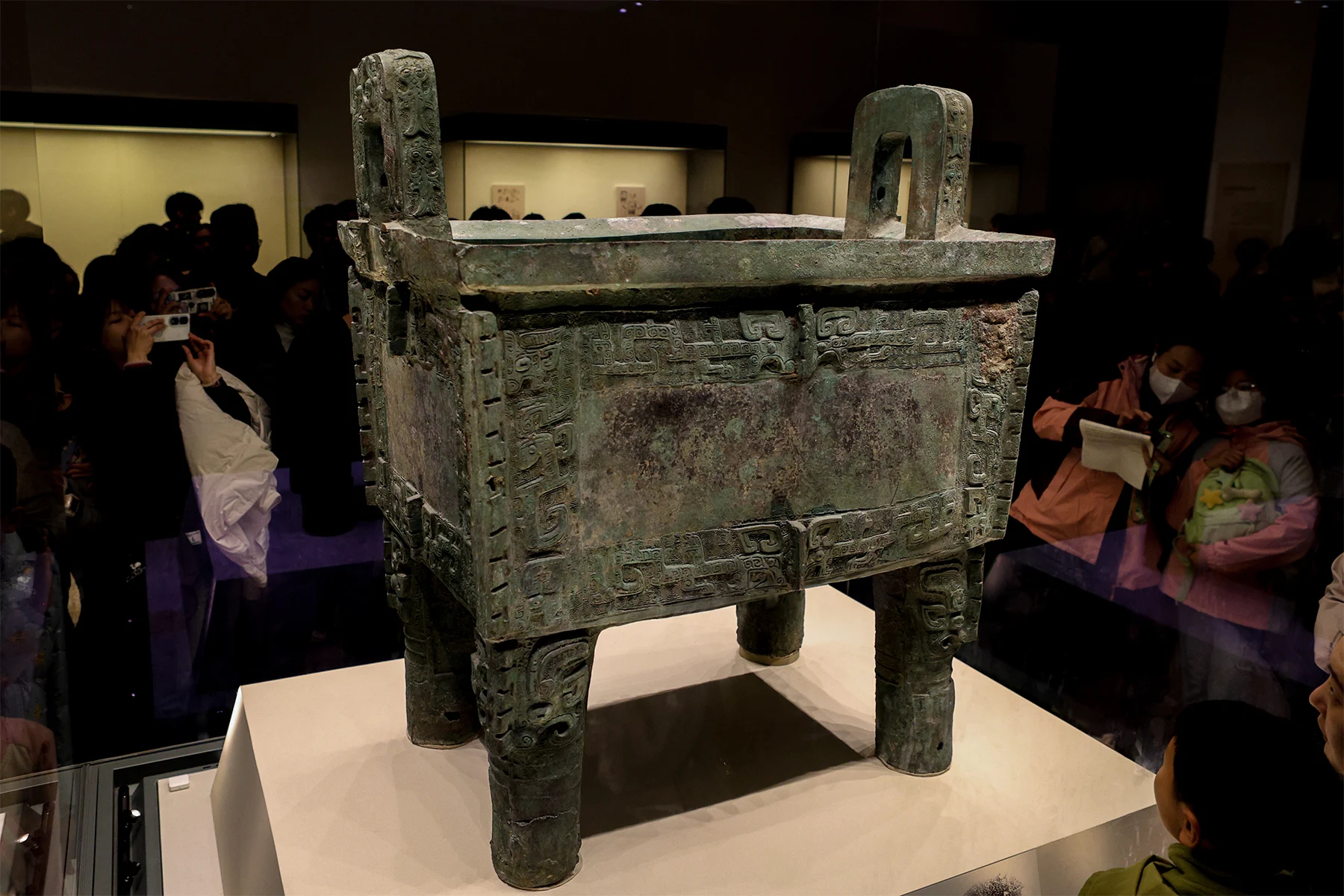
The Houmuwu ding
This enormous rectangular bronze vessel weighs 832.84 kilograms according to the museum’s collection record. Its body and four legs were cast together, with the handles cast on afterward: its impact comes as much from coordinated technical work as from sheer size.[8]
The three-character inscription inside gives the object its present name; older references may call it Simuwu. Along the outside, raised edges and animal-mask decoration organise the heavy form. The current object record is a better authority than a photograph caption that supplies a different weight.[8]
Our looking suggestionStep back for its proportions, then look at the patterned zones around the legs and upper body. Do not mistake a replica photographed at another site for this museum object.
Shang · ritual wine vessel
四羊青铜方尊
The Four Rams square zun
Four projecting ram heads turn the corners of this square bronze wine vessel into its most recognisable feature. Horns, shoulders and patterned surfaces connect animal forms with the geometry of the container.[9]
The museum’s interpretation treats it as a ritual object and explains its dense cloud-and-thunder pattern and other decorative bands. An older centenary page gives a historical gallery location; do not use that as a current room instruction.[9]
Our looking suggestionLook at one corner, then the edge between two rams: the sculpture and the vessel wall are designed to work together.
Western Zhou · writing and memory
盂青铜鼎(大盂鼎)
The Da Yu ding: bronze as a document
The Da Yu ding offers a different reason to study bronze. Its interior inscription contains 291 characters in 19 lines and records a royal appointment in the reign of King Kang of Zhou. The vessel is both a made object and evidence for political language and institutions.[10]
The museum traces its later collecting history, including Pan Dayu’s 1951 donation to the Shanghai Museum and transfer into the predecessor of the National Museum in 1959. A former owner or exhibition location is not the same as its present collection.[10]
Our looking suggestionUse the label, a supplied diagram or the official record to read the inscription. The case angle may not let you see every character directly.
Eastern Han · pottery and gesture
击鼓说唱俑
A drummer caught mid-performance
One arm cradles a flat drum while the other raises a beater; an open mouth and exaggerated posture give the figure remarkable presence. The museum connects this type of pottery performer with humorous and musical entertainment in Han society.[11]
Treat the expression as a crafted representation of performance. It gives a vivid point of entry into the period without proving the exact words, sound or social setting of one historical act.[11]
Our looking suggestionLook at the face, shoulders, hands and feet in turn. Which small changes of angle make the pose feel animated?
Tang · performance and cultural exchange
三彩釉陶载乐骆驼
A band on a camel
The museum’s Tang camel carries five performers: a central dancer and four seated musicians. Only one handheld instrument, a pipa, survives; identifications of the missing instruments draw on scholarly interpretation. Do not read the photograph as an intact set of five instruments.[12]
Excavated in 1957 from the tomb of Xianyu Lian near Xi’an, this object is dated to 723 CE in the museum’s May 2026 feature. The figures deliberately exaggerate the relationship between people and camel; the group makes performance and the exchange of musical traditions tangible.[13]
Similar camel-and-musician groups belong to other museums and have different numbers of performers. Our photographs show the National Museum example, not the better-known eight-person group in Shaanxi.[12][13]
Our looking suggestionCount the figures and find the dancer. Then compare the platform, flowing glaze and camel’s raised neck.
Specialist galleries · select rather than collect
瓷器、玉器、服饰与铜镜
Choose one later material
The museum’s exhibition directory provides separate subjects including porcelain, jade, dress, coins and bronze mirrors. A visitor interested in surfaces and colour might choose porcelain; someone drawn to ornament or everyday practices might prefer dress, mirrors or food culture. These are editorial choices rather than rankings.[5]
For each chosen gallery, use the live directory and entrance notice to confirm its location and access. Do not assume that a famous crown, painting or other collection highlight is currently displayed simply because it appears in an older article.[3][5]
Our looking suggestionChoose one question—how a material was worked, how an object was worn, or how decoration changed—and compare two cases slowly.
Collection scope · time and perspective
近现代历史与专题展览
Modern history is a separate visit choice
The museum also collects objects of modern and revolutionary history as well as art; it is broader than the archaeological highlights in this guide. Temporary and thematic exhibitions can change the emphasis of a visit considerably.[3][5]
Read the exact exhibition description and date before adding it. For example, the current directory now lists the Luo Gongliu art-and-document exhibition for 1 October–30 November 2026; that is a dated example, not an evergreen recommendation.[5]
Our looking suggestionDecide whether to continue into modern history or leave with a clear Ancient China experience. Seeing fewer rooms attentively is a reasonable museum day.
Choose what matters
Make the visit yours.
A first visit focused on historical objects
Ancient China with breathing room
- Keep
- A chronological backbone with a few longer stops.
- The trade-off
- You will need to pass many objects without studying them.
Enter and orient
Finish security, deposit required luggage, and confirm the B1 exhibition entrance on the current plan.
Before empire
Choose one painted vessel, one jade object and a small number of Shang–Zhou bronzes.
Across the imperial periods
Continue through the chronology, pausing for the Han performer and Tang camel if on view.
Pause before adding more
Take a break in a designated area, then decide whether one further room is worthwhile.
This is an editorial outline, not a measured case-to-case route. Current display and your energy decide the pace.
All outlines are editorial estimates, not field-tested routes. Follow current admission rules and venue directions.
Arrival, energy and interpretation
Get the details right.
Arrive at the right gate
The address is 16 East Chang’an Street, Dongcheng District, on the east side of Tian’anmen Square. The museum publishes Metro Line 1 to Tian’anmen East, Exits C or D; current station exits, security channels and event controls can alter the approach. Follow signs to the North Gate visitor entrance rather than walking toward the western facade by default.[1]
Keep the original booked ID and confirmation ready and budget a flexible arrival buffer. Security and district controls are additional to the time you plan to spend in the galleries. We have not walked and timed the current approach.
A National Museum reservation is not a Palace Museum ticket or a reservation for another monument. We do not claim universal access through every Tian’anmen Square checkpoint; follow the current square and museum instructions for your specific visit.
English interpretation
The museum’s August 2026 service guide explicitly identifies an English audio-guide device for Ancient China. Rental and return points include the north B1 exhibition entrance and south B1 exit. Ask about current stock, rental price, deposit and return arrangements before taking a device.[15]
The official app and WeChat services also carry audio and video interpretation, but that does not establish English coverage for every recording. Bring earphones and avoid playing audio aloud in the galleries.[15][16]
Luggage and a genuine break
The Chinese luggage policy requires suitcases and packages larger than 40 centimetres to be deposited after security, for a charge. It specifies collection by 17:00; confirm this at the counter even when the museum has a 17:30 peak-season close. Do not leave collection until the final minutes.[17]
Food and drink belong in designated dining areas, not exhibition galleries or other non-dining areas. Current menus, payment options and opening of individual cafés have not been verified.[16]
Photography and filming
Photography is generally welcomed in displays drawn from the museum’s own collection, without flash, selfie sticks or tripods. Temporary exhibitions can have separate restrictions shown at their entrances and inside.[18]
Organised filming, interviews, commercial shoots and streaming require permission. The current visitor rules also prohibit using power banks inside galleries. Keep enough phone battery for the reservation and your journey home.[16]
Mobility, children and rest
The museum publishes wheelchair and stroller services at its service desk; the older English page describes free same-day use with an ID and a deposit. This is not a guarantee of stock, a current deposit quotation or a verified step-free route.[19]
The current Chinese rules restrict powered mobility devices, and wheelchairs or strollers must not be taken onto escalators. Anyone relying on a powered chair should confirm the permitted arrangement directly with the museum before booking. Ask staff for lifts and an appropriate route on arrival.[16]
With children, choose a few visual subjects—a face on a bowl, a curled jade dragon, a performer and a camel—rather than attempting the complete timeline. This is an editorial suggestion; all accompanying-child reservation rules still apply.
National Museum of China · original museum video · 28 January 2026
A museum changes, even between visits.
National Museum of China · Display update · published 2026-01-28
A changing display: Ming–Qing galleries
A short museum update shows Ming-tomb finds replacing a former display. This dated Chinese-source film illustrates why an older photograph does not establish what is on view today.
Watch the original museum videoOpens the publisher’s own player in a new tab. Chinese source; English subtitles and regional playback are not confirmed. The cover is a credited reference photograph, not a film still.
- Watch for the gold and silver ingots, jade belt and other finds from Dingling introduced in this short museum update.
- The museum explains that the earlier imperial archive chest returned to the First Historical Archives of China. Old photographs and guidebooks cannot guarantee the same objects remain in place.
- Chinese-source video. English subtitles and regional playback are unconfirmed; use the museum’s own player.
Official digital resources
Look again from home.
The museum links its own online exhibitions, including Chinese Civilization Cloud Exhibition. Its January 2025 update describes modelled gallery spaces and rotatable 3D objects: this is a separate digital resource, not a live view of today’s cases.[21][20]
Chinese Civilization Cloud Exhibition
The announced second phase covers prehistory, Xia–Shang–Western Zhou, Spring and Autumn–Warring States, and Qin–Han, with selected objects available to enlarge or rotate. Chinese interface; English guidance and successful interactive loading have not been confirmed here.[20]
Open the museum’s digital exhibitionThe museum’s online-exhibition directory
Use the museum’s own directory to find other digital exhibitions. Their historical display dates need not match current physical exhibitions.[21]
Choose an official online exhibitionThese links open the operator’s website in a new tab. Nothing is framed or copied into this site. The cloud entry presents its own agreements; we have not registered an account, accepted terms for visitors or verified every gallery.[21]
Before you ask.
Is this the Forbidden City museum?
No. The National Museum is beside Tian’anmen Square. The Palace Museum is inside the Forbidden City and has separate booking, entrances and visitor rules.[1]
Can I arrive without booking because admission is free?
The museum’s published rules require a real-name reservation and matching original identity document. Free admission does not mean walk-in entry.[1]
Will all these objects definitely be on display?
No. These are verified collection subjects and useful ways to look. Loans, conservation and gallery changes can alter what is visible; confirm a must-see object’s current location with museum staff.
Can I visit after 17:00 in November?
The published June–October extension ends on 31 October. Outside that period, the regular close is 17:00, with last admission at 16:00; specific notices and national-holiday arrangements can override the normal pattern.[1]
Is an English audio guide available?
The August 2026 museum guide names an English device for Ancient China. Confirm availability, rental and return details at the museum; English coverage of every gallery or app recording is not established.[15]
Is the cloud exhibition a live 360 camera?
No. It is a separately published modelled exhibition with selected interactive objects, described by the museum. It does not show current crowds or prove present physical display.[20]
Dates, sources and photographs
Follow the evidence.
Desk research using the National Museum’s reservation rules, current Chinese visitor policies, collection records, exhibition directory and dated service updates. Object interpretation is separated from current display and historical photographs. Visit choices are editorial outlines, not on-site measurements. All hosted photographs retain their individual open licences and credits.
Reviewed 2026-10-29. This date records our source review, not a live availability check.
Open 22 source references
- National Museum · visitor reservation guidelines, effective 1 August 2025
Official visitor information · Reviewed 2026-10-29
- National Museum · Chinese visitor-service page
Official visitor information · Reviewed 2026-10-29
- National Museum · collection catalogue
Official collection interpretation · Reviewed 2026-10-29
- National Museum · Ancient China permanent exhibition
Official exhibition interpretation; old operating information excluded · Reviewed 2026-10-29
- National Museum · current exhibition directory
Current official exhibition index; individual dates must still be checked · Reviewed 2026-10-29
- National Museum · painted basin with human-face and fish designs
Official collection record · Chinese · Reviewed 2026-10-29
- National Museum · Hongshan jade dragon
Official collection record · Chinese · Reviewed 2026-10-29
- National Museum · Houmuwu bronze cauldron
Official collection record · Chinese · Reviewed 2026-10-29
- National Museum · Four Rams square zun
Official object interpretation; historical gallery location not used · Reviewed 2026-10-29
- National Museum · Da Yu ding
Official collection record · Chinese · Reviewed 2026-10-29
- National Museum · storyteller figurine
Official collection record · Chinese · Reviewed 2026-10-29
- National Museum · camel carrying musicians
Official collection record · Chinese · Reviewed 2026-10-29
- National Museum · a closer look at the camel and its performers
Dated official collection feature · Chinese · Published 2026-05-18 · Reviewed 2026-10-29
- National Museum · July 2026 bronze-exhibition interpretation
Dated official programme; not a current event booking · Published 2026-07-20 · Reviewed 2026-10-29
- National Museum · self-guided visits and English audio devices
Official service guidance · Chinese · Published 2026-08-10 · Reviewed 2026-10-29
- National Museum · current visitor conduct
Official visitor rules · Chinese · Reviewed 2026-10-29
- National Museum · luggage deposit rules
Official luggage policy · Chinese · Reviewed 2026-10-29
- National Museum · photography rules
Official photography policy · Chinese · Reviewed 2026-10-29
- National Museum · wheelchairs and strollers
Published English service page; current stock and deposit not confirmed · Reviewed 2026-10-29
- National Museum · second phase of Chinese Civilization Cloud Exhibition
Official digital-exhibition announcement · Chinese · Published 2025-01-01 · Reviewed 2026-10-29
- National Museum · official online-exhibition directory
Official links to external digital exhibitions · Reviewed 2026-10-29
- National Museum · changes to the Ming–Qing display
Dated original museum video · Chinese · Published 2026-01-28 · Reviewed 2026-10-29
Photograph authors, dates and licences (12 photographs)
Daniel Case · 2014-03-29 · CC BY-SA 3.0
Resized and converted to WebP. Display may crop. Original attribution and share-alike licence retained.
Windmemories · 2025-10-26 14:47:54 · CC BY-SA 4.0
Resized and converted to WebP. Image-file proportions retained; hero and preview layouts may crop the display. Original licence retained.
Windmemories · 2025-10-26 14:45:56 · CC BY-SA 4.0
Resized and converted to WebP. Image-file proportions retained; hero and preview layouts may crop the display. Original licence retained.
Windmemories · 2025-10-26 15:18:36 · CC BY-SA 4.0
Resized and converted to WebP. Image-file proportions retained; hero and preview layouts may crop the display. Original licence retained.
Windmemories · 2025-10-26 15:18:05 · CC BY-SA 4.0
Resized and converted to WebP. Image-file proportions retained; hero and preview layouts may crop the display. Original licence retained.
Windmemories · 2025-10-26 14:20:36 · CC BY-SA 4.0
Resized and converted to WebP. Image-file proportions retained; hero and preview layouts may crop the display. Original licence retained.
Windmemories · 2025-10-26 14:26:45 · CC BY-SA 4.0
Resized and converted to WebP. Image-file proportions retained; hero and preview layouts may crop the display. Original licence retained.
Windmemories · 2025-10-26 15:09:00 · CC BY-SA 4.0
Resized and converted to WebP. Image-file proportions retained; hero and preview layouts may crop the display. Original licence retained.
Gary Todd · 2011-09-02 10:04:24 · CC0
Resized and converted to WebP. Image-file proportions retained; hero and preview layouts may crop the display. Original licence retained.
Siyuwj · 2011-09-24 11:33:04 · CC BY-SA 4.0
Resized and converted to WebP. Image-file proportions retained; hero and preview layouts may crop the display. Original licence retained.
Siyuwj · 2011-09-24 11:33:17 · CC BY-SA 4.0
Resized and converted to WebP. Image-file proportions retained; hero and preview layouts may crop the display. Original licence retained.
Daniel Case · 2014-03-29 · CC BY-SA 3.0
Resized and converted to WebP. Image-file proportions retained; hero and preview layouts may crop the display. Original licence retained.
How conflicting descriptions were handled
The museum’s general visitor page shows the extended headline hours, while its detailed reservation rules explicitly limit that extension to June–October. This guide preserves both seasonal schedules rather than applying 17:30 all year. The old Ancient China microsite’s timetable is not used.[1][4]
An older museum centenary page places some bronzes in a specialist bronze exhibition. The July 2026 programme instead explicitly discusses Houmuwu and Da Yu within Ancient China. We use the current directory and staff directions for finding works, not the older room label.[9][14][5]
The Chinese cloakroom page gives a 17:00 collection deadline even though peak-season museum admission guidance closes at 17:30. Both are reported, with counter confirmation advised; a later museum close does not establish a later bag collection.[17][1]
Expired temporary exhibitions are not listed as current attractions. The museum’s January 2026 display-change video is deliberately dated and illustrates why collection membership and on-view status must be kept separate.[22][5]
The official virtual-exhibition index verifies the cloud link; the 2025 announcement verifies its advertised 3D functions. Neither is treated as a successful end-to-end interactive session or an English-language experience.[21][20]
What still needs direct confirmation
- Successful registration and reservation using an overseas email/passport, live inventory, and any new account-verification changes.
- Current case locations, object rotations, loans, temporary gallery closures and specialist exhibition access on the actual visit date.
- Latest security-approach times, Tian’anmen checkpoint controls, accessible entrance routing and powered-chair arrangements.
- Audio-device availability, current prices/deposits and foreign-card payment at rental or catering points.
- Successful cloud-gallery interaction, account requirements in each mode, English interpretation and original-video regional playback.
Film verification: Original museum article and video identity checked. External-player playback and subtitle coverage have not been confirmed.
In this guide