
Beijing · In-depth place guide
雍和宫
A living temple beyond the palace walls
Yonghegong brings together imperial history, Tibetan Buddhist learning and some extraordinary timber architecture.
Follow the courtyards slowly, learn what the halls mean, and make space for the people who come to worship.
Yonghegong, usually called the Lama Temple in English, began as a Qing princely residence and became a Gelug Tibetan Buddhist monastery in 1744. Its history as a royal home matters, but so does its continuing religious life: this is more than a set of spectacular roofs and statues.[5][6]
A useful first visit follows the main sequence of halls while paying attention to the spaces between them. Learn a few names before arriving, keep photography to the areas where it is allowed, and let worshippers use the halls without turning prayer into a photo opportunity.
Plan your visit
Before you book.
- Time to allow
- About two hours for a selective main-axis visit; half a day allows interpretation and a slower pause nearby. These are editorial estimates, not measured routes.
- November–March
- 09:00–16:30; ticket sales and entry stop at 16:00. Date-specific notices can override the regular schedule.[2][3]
- Published tickets
- Full price CNY 25; reduced ticket CNY 12 for qualifying visitors under the operator’s policy. Check identity and concession evidence in the current official booking channel.[1]
- Inside the halls
- The operator’s visitor rules prohibit photography and filming inside halls. Our selected photographs show exteriors and architectural details visible from outside.[2]
Choose the ticket for your visit
Use the operator’s real-name booking information. Its passport procedure distinguishes a full-price entry QR code from a reduced-ticket reservation number requiring verification at the ticket-handling centre.[1]
Operator ticket policy · CNY · concession verification still required[1]
Full-price adult
- Published ticket
- 25
- Published next step
- Official WeChat booking; passport category uses an entry QR code
Eligible reduced ticket
- Published ticket
- 12
- Published next step
- Identity / eligibility evidence; passport procedure includes ticket-centre verification
Children aged 6 or under, or height 1.2m or below
- Published ticket
- Free under the published rule
- Published next step
- Bring the required original evidence; use the operator’s current free-entry instructions
| Visitor / document | Published ticket | Published next step |
|---|---|---|
| Full-price adult | 25 | Official WeChat booking; passport category uses an entry QR code |
| Eligible reduced ticket | 12 | Identity / eligibility evidence; passport procedure includes ticket-centre verification |
| Children aged 6 or under, or height 1.2m or below | Free under the published rule | Bring the required original evidence; use the operator’s current free-entry instructions |
The published reduced-ticket categories include ages over 6 through 18, qualifying full-time undergraduate-level-and-below students, and visitors aged 60 or above with valid evidence. Do not assume that one proof or concession automatically applies to every foreign passport; confirm what the current operator accepts.[1]
Each valid identity document is limited to one ticket per day, for one use; the published policy permits up to three tickets per WeChat account per day. The current booking interface supplies available dates and sessions. We do not present a 2022 holiday advance-sale rule as a newly verified year-round release calendar.[1]
The 2026 Spring Festival notice directs visitors to the official account 雍和宫游客信众服务 and states that no third-party platform or individual has been authorised to sell temple tickets. Its special festival hours and capacity limits are not a normal-season timetable.[18]
Buying with a foreign passport
In WeChat, find the exact official account name 雍和宫游客信众服务. The operator’s official page below provides its entry and QR information. Select the appropriate document type and date, enter details matching the original passport, and retain the resulting confirmation.[4][1]
Under the published passport instructions, a successful full-price purchase supplies an entry QR code. A reduced-ticket booking instead supplies a reservation number; take that and the original evidence to the 票务处理中心 for verification and purchase of a paper ticket. These are different procedures.[1]
We have read the official instructions rather than completed a booking with an overseas phone, passport and payment account. If verification fails, contact the temple at +86 10 84191906 or +86 10 84191907 before travelling; no staffed walk-in fallback is promised here.[1][18]
Find your bearings
Five main halls, with a different purpose in each.
The main sequence runs from the southern approach through Yonghe Gate Hall, Yonghegong Hall, Yongyou Hall, Falun Hall and Wanfu Pavilion. The temple’s bilingual plan also identifies side study halls, the Four-Language Stele Pavilion, museum buildings, toilets and visitor-service points.[7]
This is a south-to-north way of understanding the complex, not permission to enter every door or return against a controlled flow. The 2026 holiday notice used a one-way arrangement; follow the actual signs and staff directions on your visit.[18]
Gate halls, the main worship halls and the towering pavilion do different work. Looking at the same Buddha name in more than one setting does not mean the statues or the halls are interchangeable.[8][9][12]
Approach and threshold
Main hall sequence
Learning and interpretation
Open the temple’s bilingual named-building plan ↗
The heritage authority dates the princely residence to 1694. It was associated with the future Yongzheng emperor and the birth of Qianlong.[6]
The residence became an imperial temporary palace, before its later conversion into a monastery.[5][6]
Yonghegong was converted into a Gelug Tibetan Buddhist temple. Its religious and educational role is part of the story of Qing imperial patronage.[5]
The temple reopened to the public as a Buddhist religious venue inFebruary 1981; a Tibetan Buddhist art museum was subsequently recognised in 1995.[5]
A closer reading
What to look for.
Ten starting points, from the southern approach to the northern pavilion. Hall access and religious activities take priority over the sequence suggested here.
Southern approach · entering a different rhythm
牌楼、辇道与昭泰门
The archways and Zhaotai Gate
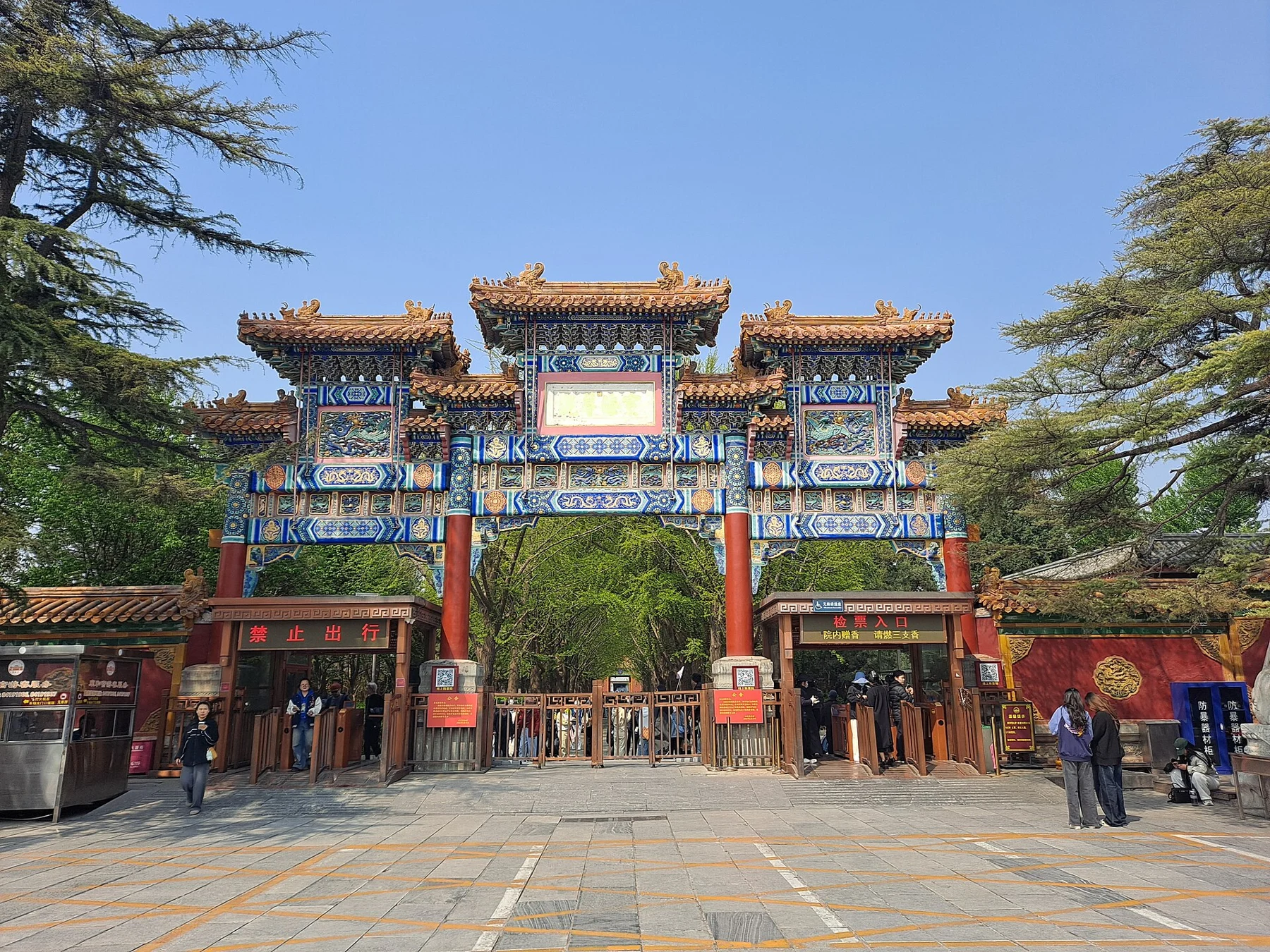
The temple’s named plan begins with the ceremonial archways and Imperial Carriage Pathway, then Zhaotai Gate. The successive thresholds make the change from the busy city to a religious compound visible before the main halls begin.[7]
Pause at the Zhaotai plaque and look at the different scripts rather than treating it as an interchangeable temple sign. Continue toward the open route for that day; the presence of a gateway in an old photograph does not establish today’s ticket queue.[7]
Our looking suggestionNotice the progression from open archway to enclosed gateway, and give people space as they enter.
At the threshold · paired architecture
钟楼与鼓楼
The temple’s Bell and Drum towers
The bilingual plan identifies a Bell Tower and a Drum Tower beside the southern part of the complex. These are temple buildings; they are not Beijing’s separate Bell and Drum Towers on the Central Axis.[7]
Seen together, their roof forms, painted brackets and relationship to the surrounding courts provide a useful introduction to the compound’s architectural rhythm. Their presence does not mean visitors can climb them or attend a scheduled ringing.
Our looking suggestionCompare the towers from the open courtyard. Keep any interior or upper-level visit conditional on actual public access.
First main hall · the threshold has a role
雍和门殿(天王殿)
Yonghe Gate Hall: the Heavenly Kings
The temple identifies the seated Budai figure at the centre, the Four Heavenly Kings to the sides and the guardian Weituo behind. Their arrangement makes this a threshold hall rather than a duplicate of the main worship hall farther north.[8]
The Four Heavenly Kings are distinguished by the objects they hold: a pipa, a sword, a snake-like creature and a banner in the temple’s account. Look quietly, without trying to photograph the interior.[8][2]
Our looking suggestionLet the hall’s arrangement explain the movement through it: central figure, side guardians and the image behind.
Between the first halls · text, patronage and power
四体碑亭与喇嘛说碑
The four-script Lama Shuo stele
The stele records Qianlong’s Lama Shuo text, dated 1792, in Chinese, Manchu, Mongolian and Tibetan. It is a physical record of imperial involvement in Tibetan Buddhist affairs, not simply an ornamental stone.[16]
Its placement and scripts help connect the temple’s royal origins with its wider religious and administrative history. You can appreciate the contrast of the writing systems without pretending to read or translate all four.[16][7]
Our looking suggestionLook for the different faces of the stele where the public route permits. A single front-facing photograph will not show all four texts.
Main worship hall · distinguish the central group
雍和宫殿
Yonghegong Hall: Buddhas of three periods
The temple identifies Shakyamuni in the centre, the Buddha of the past to the west and Maitreya as Buddha of the future to the east, with Eighteen Arhats along the sides. The grouping is more useful than calling every central figure simply “the Buddha”.[9]
This hall belonged to the earlier princely residence before the temple conversion. The change in function is one way to understand why imperial architecture and a living Buddhist setting occupy the same space.[9][5]
Our looking suggestionLook from the permitted public position and leave the central worship space clear. Read the exterior plaque before entering.
Continuing north · names matter
永佑殿
Yongyou Hall: a different group of images
The temple’s individual record identifies Amitayus, the Buddha of Infinite Life, at the centre, with the Medicine Buddha to the west and Lion’s Roar Buddha to the east. It also names Tara images on the side walls.[10]
A broad tourism description instead emphasises royal memorial associations. For the actual present iconographic group, this guide follows the temple’s own hall record; historical use and the images visible in a worship hall are different questions.[10][23]
Our looking suggestionCompare the purpose of this central group with the preceding hall. Do not assume that every image has the same identity or devotional function.
Monastic centre · architecture and teaching
法轮殿
Falun Hall: the Wheel of Dharma
Built in 1744 according to the temple’s record, Falun Hall is a place for major religious ceremonies. Its five roof skylights, crowned with gilded ornaments, make the exterior a distinctive part of the complex.[11]
The central image is Tsongkhapa, founder of the Gelug tradition. The temple also identifies the carved zitan-wood Five Hundred Arhats Mountain behind; this is a different woodcarving subject from the giant white-sandalwood figure in Wanfu Pavilion.[11][5]
Our looking suggestionStudy the roofline from outside, then the hall’s setting. Religious use can affect how closely visitors may approach the interior.
Northern main pavilion · scale and timber
万福阁与弥勒大佛
Wanfu Pavilion and the standing Maitreya
The temple dates Wanfu Pavilion’s construction to 1748–1750. Its immense standing Maitreya is carved from a white-sandalwood trunk: the operator gives 18 metres for the figure above ground and a further 8 metres for the buried base.26 metres is the total timber length described, not the visible statue’s height.[12]
The main pavilion and neighbouring linked structures create a strong vertical finish to the sequence of courtyards. Take time with the exterior before joining any controlled entry, and remember that the no-interior-photography rule applies here too.[7][12][2]
Our looking suggestionLook up at the multiple roofs and connecting galleries. Inside, if access permits, let your eyes adjust and experience the scale without taking a photograph.
Side halls · a monastery as a place of learning
讲经殿、密宗殿、时轮殿与药师殿
The four monastic study halls
The official plan identifies four named study halls, while the temple’s teaching-hall record describes the study of exoteric Buddhist teachings in the Exoteric Hall. This is a reminder that the complex is a monastic institution as well as a destination for visitors.[7][13]
Names on a visitor plan do not establish public entry to every teaching space, daily lectures or an English class timetable. Appreciate the relationship of the side halls to the main courts, and respect the boundaries set by current religious use.
Our looking suggestionChoose one side-hall name on the map and understand its role before looking for more doors to enter.
Side buildings · extend the visit selectively
戒台楼、班禅楼与藏传佛教艺术博物馆
Art-museum rooms and a final question
The heritage authority describes the temple’s Tibetan Buddhist art museum and collection, and the operator lists Jietai and Panchen buildings within the complex. These provide a route into objects, painting and the temple’s institutional history when the relevant displays are open.[6][14][15]
Check the actual open exhibition and its room notice before adding it. This guide does not promise the appearance of a particular golden urn, thangka or other collection object on the day. A collection description and a current display list serve different purposes.
Our looking suggestionIf an exhibition is open, choose one object and read its context. Otherwise, leave with a clear understanding of the main halls rather than chasing a closed room.
Choose what matters
Make the visit yours.
A first visit with time to understand what you see
Architecture, images and learning
- Keep
- The five main halls, a few exterior details and official interpretation.
- The trade-off
- You still need to choose among side rooms and nearby visits.
Prepare a few names
Read the hall summaries and save the official plan.
Arrive with room to spare
Complete security and the correct ticket verification; luggage storage is not a reliable assumption.
Move slowly through the courts
Look at the exterior plaques and roof forms, leaving worship space clear.
One optional extension
If open, choose a museum display or official English interpretation rather than rushing to another major attraction.
Outdoor photography does not authorise indoor photography. Current staff directions decide access and return routes.
All outlines are editorial estimates, not field-tested routes. Follow current admission rules and venue directions.
Arrival, energy and interpretation
Get the details right.
Arrive at the right gate
The published address is 12 Yonghegong Street, Dongcheng District. Yonghegong (Lama Temple) is a station on Metro Lines 2 and 5; choose a currently open exit and follow the signed approach to the temple’s southern entrance. No exact walking time or guaranteed exit is supplied here.[3][24]
The station and neighbouring streets can have special controls on major religious or public holidays. A 2024 Lantern Festival closure is retained only as an example of why dated notices matter, not presented as today’s service status.[24]
For help at the temple, the 2026 operator notice repeats +86 10 84191906 and +86 10 84191907. Guozijian Street, the Confucian Temple and nearby hutongs are separate visits, with their own access and venue rules.[18]
English interpretation
The temple’s published guide page lists English live interpretation and free Chinese/English phone-scanned audio. It is dated 2017, so current staffing, QR access, prices and language coverage require a check at the official service point; we have not tested an entire English audio tour.[17]
Use staff-identified official services. The 2026 notice tells visitors to decline unsolicited offers of divination, merchandise or paid guiding and report them to staff.[18]
Photography and a living religious place
The operator says no photography or filming inside halls. Stay with exterior photographs and follow any additional current signs. Our selected image set deliberately excludes interior statue photographs; public availability of a photograph is not permission to take your own.[2]
Keep voices and phone audio low, allow people to worship, and ask before photographing an identifiable person closely. These are our respectful-visit suggestions rather than a script for performing a ritual.
Incense without a shopping detour
The temple’s free-incense policy provides environmentally oriented incense at its own distribution points and excludes outside incense. The 2026 notice reaffirms this, recommends three sticks and forbids carrying burning incense into halls or around the compound. Extreme weather can suspend distribution and burning.[19][18]
You do not need to purchase a larger bundle outside to follow the temple’s published arrangement. If you do not wish to burn incense, observe quietly and give others space; ask staff where to stand.
Luggage, steps and the pace of the day
The 2026 visitor notice states that the site cannot provide parking or luggage deposit. Keep large bags at a separately arranged place before the visit, rather than treating the temple as a stop en route to the airport with suitcases.[18]
Historic halls have thresholds and steps; a complete step-free route and current wheelchair arrangements have not been verified. Contact the temple before travelling if access to a particular hall is essential, and follow the suitable route advised on site.
Temple retail, museum rooms, guide availability and incense distribution can have schedules separate from the regular gate hours. A temporary holiday shop closure is not evidence of a permanent closure.[18]
Yonghegong · original temple video page · published 9 January 2017
A filmed introduction to the temple.
Yonghegong official website · Original temple film page · published 2017-01-09
Tibetan Buddhist Temple: Beijing Yonghegong
A named filmed introduction on the temple’s own website. It is cultural background, separate from an interactive panorama or current visitor information. Playback and English subtitles remain unconfirmed.
Open the original temple video pageOpens the publisher’s own player in a new tab. Chinese source; English subtitles and regional playback are not confirmed. The cover is a credited reference photograph, not a film still.
- The temple’s own video page provides a filmed introduction, separate from an interactive 360-degree experience.
- Use it as background for the architecture and religious setting; it does not establish current opening, interior access or ticket arrangements.
- Chinese-source page. Full playback, English subtitles and regional availability are unconfirmed.
Before you ask.
Is the visible Maitreya statue 26 metres high?
The operator gives 18 metres above ground and 8 metres underground for the supporting timber,26 metres in total. The visible statue should not be described as 26 metres high.[12]
Does a passport reduced ticket work like a full-price QR ticket?
The published rules distinguish them: full-price passport purchase supplies an entry QR code; a reduced-ticket reservation number requires verification at the ticket-handling centre with original documents. Check the current official procedure before travelling.[1]
May I photograph inside the halls?
The temple’s visitor rules say no indoor photography or filming. Keep photographs outside and respect the current signs.[2]
Must I buy incense from a nearby shop?
The operator supplies incense under its own free-incense arrangement and does not admit outside incense. Current weather or religious-use rules can change distribution.[19][18]
Is there a verified interactive panorama here?
This guide links the temple’s named official film. We have not confirmed a working public 360-degree temple experience and do not label the film as one.
Are the temple’s bell and drum towers the city’s famous Bell and Drum Towers?
No. The temple plan identifies its own pair within Yonghegong. Beijing’s separate Central Axis towers are a different visit.[7]
Dates, sources and photographs
Follow the evidence.
Desk research using the temple’s own hall records, official visitor and booking pages, the Beijing cultural heritage and religious affairs authorities, and dated operator notices. All five original 2026 notice images were visually read, including the three-page Spring Festival notice. Published procedures are distinguished from successful passport transactions. Hosted images are selected exterior photographs with individual open licences; interior images and misleading photo suggestions are excluded.
Reviewed 2026-10-29. This date records our source review, not a live availability check.
Open 24 source references
- Yonghegong · passport tickets, concessions and QR admission
Official visitor rules, still linked from operator services; date retained · Published 2021-03-13 · Reviewed 2026-10-29
- Yonghegong · seasonal opening, photography and incense rules
Operator regular visitor guidance · Published 2017-01-05 · Reviewed 2026-10-29
- Beijing government · current English travel overview
Official English overview; Yonghe-specific section used for address and seasonal hours · Reviewed 2026-10-29
- Yonghegong · official home and current notices
Official visitor information · Reviewed 2026-10-29
- Yonghegong · history and religious character
Official historical interpretation · Published 2017-01-05 · Reviewed 2026-10-29
- Beijing cultural heritage authority · temple and art museum
Official heritage and museum profile · Reviewed 2026-10-29
- Yonghegong · bilingual named-building map
Official orientation; not a surveyed current accessible-route map · Published 2016-12-26 · Reviewed 2026-10-29
- Yonghegong · Yonghe Gate / Heavenly Kings Hall
Official hall and iconography record · Reviewed 2026-10-29
- Yonghegong · main Yonghegong Hall
Official hall and iconography record · Reviewed 2026-10-29
- Yonghegong · Yongyou Hall
Official hall and iconography record · Reviewed 2026-10-29
- Yonghegong · Hall of the Wheel of Dharma
Official hall and iconography record · Reviewed 2026-10-29
- Yonghegong · Wanfu Pavilion and Maitreya
Official hall and sculpture record · Reviewed 2026-10-29
- Yonghegong · Exoteric teaching hall
Official account of one of the four monastic study halls · Reviewed 2026-10-29
- Yonghegong · Panchen Building
Official side-building record; present opening not established · Reviewed 2026-10-29
- Yonghegong · Jietai Building
Official side-building record; present opening not established · Reviewed 2026-10-29
- Beijing ethnic and religious affairs authority · Lama Shuo stele
Official historical interpretation · four scripts and 1792 date · Published 2022-12-10 · Reviewed 2026-10-29
- Yonghegong · English interpretation and guide services
Older service description; current staff, QR language and charges not guaranteed · Published 2017-01-05 · Reviewed 2026-10-29
- Yonghegong · 2026 Spring Festival notice, three original image pages
Dated operator notice; all three image pages visually read; holiday hours expired · Published 2026-02-06 · Reviewed 2026-10-29
- Yonghegong · free incense and no outside incense
Historical policy announcement, reaffirmed by 2026 notice · Published 2013-12-10 · Reviewed 2026-10-29
- Yonghegong · August 2026 weather closure
Dated image notice visually read; superseded by reopening · Published 2026-08-11 · Reviewed 2026-10-29
- Yonghegong · reopening from 13 August 2026
Image notice signed 12 August and published 13 August; visually read · Published 2026-08-13 · Reviewed 2026-10-29
- Yonghegong · Tibetan Buddhist temple film
Original operator video page; external playback unconfirmed · Published 2017-01-09 · Reviewed 2026-10-29
- Visit Beijing · temple visitor description
Municipal tourism reference; ambiguous measurements and interior photo suggestions not adopted · Reviewed 2026-10-29
- Beijing government / subway notice · Line 2 and 5 Yonghegong station
Dated station identification and example of holiday controls;2024 closure not current · Published 2024-02-23 · Reviewed 2026-10-29
Photograph authors, dates and licences (14 photographs)
호고호 · 2026-04-06 13:36:40 · CC0
Resized and converted to WebP. Image-file proportions retained; hero and preview layouts may crop the display. Original licence retained.
호고호 · 2026-04-06 12:23:30 · CC0
Resized and converted to WebP. Image-file proportions retained; hero and preview layouts may crop the display. Original licence retained.
호고호 · 2026-04-06 12:24:30 · CC0
Resized and converted to WebP. Image-file proportions retained; hero and preview layouts may crop the display. Original licence retained.
호고호 · 2026-04-06 13:26:05 · CC0
Resized and converted to WebP. Image-file proportions retained; hero and preview layouts may crop the display. Original licence retained.
호고호 · 2026-04-06 12:32:58 · CC0
Resized and converted to WebP. Image-file proportions retained; hero and preview layouts may crop the display. Original licence retained.
호고호 · 2026-04-06 12:55:44 · CC0
Resized and converted to WebP. Image-file proportions retained; hero and preview layouts may crop the display. Original licence retained.
호고호 · 2026-04-06 12:38:17 · CC0
Resized and converted to WebP. Image-file proportions retained; hero and preview layouts may crop the display. Original licence retained.
MiiCii · 2022-08-11 10:46:43 · CC BY-SA 4.0
Resized and converted to WebP. Image-file proportions retained; hero and preview layouts may crop the display. Original licence retained.
MiiCii · 2022-08-11 11:25:06 · CC BY-SA 4.0
Resized and converted to WebP. Image-file proportions retained; hero and preview layouts may crop the display. Original licence retained.
호고호 · 2026-04-06 12:44:26 · CC0
Resized and converted to WebP. Image-file proportions retained; hero and preview layouts may crop the display. Original licence retained.
ScareCriterion12 · 2019-06-14 16:36:00 · CC BY-SA 4.0
Resized and converted to WebP. Image-file proportions retained; hero and preview layouts may crop the display. Original licence retained.
Andrzej Otrębski · 2023-09-22 15:44:04 · CC BY-SA 4.0
Resized and converted to WebP. Image-file proportions retained; hero and preview layouts may crop the display. Original licence retained.
Bjoertvedt · 2017-07-15 13:22:30 · CC BY-SA 4.0
Resized and converted to WebP. Image-file proportions retained; hero and preview layouts may crop the display. Original licence retained.
Bjoertvedt · 2017-07-15 13:17:05 · CC BY-SA 4.0
Resized and converted to WebP. Image-file proportions retained; hero and preview layouts may crop the display. Original licence retained.
How conflicting descriptions were handled
A tourism page suggests indoor photo subjects, while the operator’s visitor page explicitly prohibits photography and filming inside halls. The operator’s rule takes priority, and our article uses exterior photography.[23][2]
The broad tourism description refers to a 26-metre Buddha and stresses memorial use of Yongyou Hall. The individual operator records distinguish 18 metres visible plus 8 metres buried timber and identify the present named images in Yongyou. This guide follows those more specific records.[23][12][10]
The ticket page’s 2021 date is retained, and the 2026 notice still directs detailed ticket policy to the official WeChat channel. Foreign-phone registration, payment and concession-document acceptance have not been inferred from a published form.[1][18]
The August closure notice suspended opening from 12 August 2026 due to extreme rain. A later notice, signed 12 August and published 13 August, says reopening from 13 August. The earlier closure is not left on the site as a current blanket closure.[20][21]
Expired holiday hours, traffic restrictions, ticket caps and temporary retail closures are not reused as normal-season facts. The permanent visitor guidance is compared with the current municipal English overview for seasonal hours.[2][3][18]
What still needs direct confirmation
- Successful current booking with an overseas phone, passport and payment method; present date/session inventory and detailed concession evidence for foreign visitors.
- Current official English guide staffing, audio QR functionality, guide fees and a complete tested English interpretation route.
- Current side-hall and museum exhibition access, temporary worship restrictions, retail hours and a measured step-free route.
- A working public 360-degree temple experience, complete official video playback and English subtitle availability.
Film verification: Original temple article and its named video identified. Direct media access returned 403; no bypass attempted. Use the original source page; actual external playback remains unconfirmed.
In this guide