
Beijing · In-depth place guide
恭王府博物馆
Behind the walls of Prince Kung’s Palace
Formal courtyards give way to a garden of rock, water, theatre and wishes for good fortune.
Read the residence first, then let the garden change the pace.
Prince Kung’s Palace Museum is an aristocratic residence with a garden, rather than another imperial palace to rush through after the Forbidden City. Its southern courtyards explain hierarchy and domestic life; the northern garden plays with stone, framed views, water and the language of good fortune.[7]
The house has several owners’ histories. Heshen and Princess Hexiao belong to its earlier story; Yixin, Prince Kung, moved in during 1852, giving the residence the identity by which it is best known today. The museum’s current educational material supplies this distinction more clearly than a generic photograph caption.[6]
Plan your visit
Before you book.
- Time to allow
- Roughly half a day for a considered visit, or a shorter architecture-and-garden selection. These are editorial allowances, not measured routes.
- Normal opening
- 08:30–17:00. Ticket sales stop at 16:00; last entry is 16:10. Closed Mondays except statutory holidays. Specific closure notices still take priority.[1][3]
- Published adult ticket
- CNY 40 per person. Use the official purchase channel for the date and correct identity-document category.[1][2]
- Booking window
- The published policy opens purchase ten days before the visit at 20:00 China time. Tickets may sell out; a guide or reseller listing is not a confirmed museum reservation.[2]
- Passport entry
- After online purchase, passport holders are instructed to exchange for an admission credential at the comprehensive service point on the visit day. Bring the same valid passport used for booking.[2]
Choose the ticket for your visit
The museum publishes a full-price ticket and concession rules. Ordinary online booking is real-name; this page does not sell tickets, supply inventory or guarantee overseas payment support.[2]
Museum admission · CNY · published policy, not live inventory[2]
Full-price admission
- Published policy
- 40
- What to bring or confirm
- Date and valid booked document
Children aged 6 or under, or height 1.2m or below
- Published policy
- Free under the published rule
- What to bring or confirm
- Check the required free-entry arrangement
Ages over 6 through 18; eligible full-time students
- Published policy
- Half price under the published rule
- What to bring or confirm
- Identity / student evidence; inbound youth are explicitly included
Audio-guide device
- Published policy
- Optional rental
- What to bring or confirm
- English availability, current fee and return point
| Visitor / service | Published policy | What to bring or confirm |
|---|---|---|
| Full-price admission | 40 | Date and valid booked document |
| Children aged 6 or under, or height 1.2m or below | Free under the published rule | Check the required free-entry arrangement |
| Ages over 6 through 18; eligible full-time students | Half price under the published rule | Identity / student evidence; inbound youth are explicitly included |
| Audio-guide device | Optional rental | English availability, current fee and return point |
The ticket policy explicitly includes foreign, Hong Kong, Macao and Taiwan youth in the student half-price arrangement with valid identity or student documents. Its separate senior rule mentions an identity card; we do not infer passport eligibility for every concession without confirmation.[2]
For unused tickets, the policy permits a refund application before 22:00 on the booked day. That is not the same as the no-show deadline: cancellation after 16:00 is counted as a no-show, and three no-shows within 60 days trigger a 60-day booking restriction. An already checked ticket cannot be refunded.[2]
Buying with a foreign passport
Use the current museum home page’s official online-ticket link, which leads to mall.pgm.org.cn. Select “passport” (护照) as the document type and enter details matching the original. The older FAQ names a different web booking address; follow the current operator link rather than an archived browser bookmark.[1][2][5]
The published instructions require passport holders to exchange for an admission credential at the comprehensive service point. This differs from the direct ID-card scan described for mainland identity-card bookings. Keep the purchase confirmation and allow time for the exchange before last entry.[2]
If account verification or payment fails, consult the museum’s ticket service at +86 10 83286859, published hours 08:20–17:00 daily. We have not completed a foreign-phone or foreign-card purchase and cannot promise a walk-in workaround.[5]
Find your bearings
A residence in front, a garden behind.
The southern residence is arranged along eastern, central and western sequences of courtyards. Ceremonial space occupies the central route; the east includes reception and residential rooms, while the west includes Xijin Studio and its elaborate interior woodwork. This is a useful framework even if the current open route does not let you enter every room.[7]
The long Rear Building marks the transition to the northern garden. Behind it, Archery Path and three historically distinct approaches lead toward different garden scenes. The white Western-style Gate is a garden gateway, not the museum’s street entrance.[11][19]
Our groups below are a way to choose an emphasis. They are not a surveyed walking map, do not show accessible alternatives, and should not override current one-way directions or conservation closures.
Southern residence
Entering the garden
Performance and a slower finish
Museum guide and current approach ↗
The museum’s 2026 educational account dates the residence’s foundation to 1780, in its earlier Heshen and princess-related history.[6]
After Heshen’s fall, the residence passed to Yonglin, Prince Qing. The present name should not be applied to every period of its ownership.[6]
Yixin moved in as Prince Kung. Later alterations to the garden helped shape the residence-and-garden experience seen today.[6][7]
The present Yin’an Hall was rebuilt in 2008 to the Prince Kung-period arrangement. It should not be described as an untouched eighteenth-century original.[8]
A closer reading
What to look for.
Ten individual features to understand before choosing a route. Rooms, the stele cave and theatre may have queues or separate opening conditions; photographs record their own dates, not current access.
Central residence · rank and formality
银安殿
Yin’an Hall: ceremony and reconstruction
The formal central courtyard is organised around a five-bay hall with green glazed roof tiles, matched side halls and a raised terrace. Its symmetry offers a clear contrast with the more meandering garden beyond.[8]
The original hall was lost to fire in the early twentieth century. The museum identifies the present building as a 2008 reconstruction based on the Prince Kung-period layout. Read it as an evidence-based rebuilding of ceremonial space, not a room surviving unchanged with its original furnishings.[8]
Our looking suggestionLook from the courtyard toward the roof, terrace and paired side halls. Then notice which doors and rooms are actually open.
Eastern residence · reception and symbolism
多福轩
Duofu Belvedere: words and painted wishes
Duofu combines reception space with a rich language of blessing. The museum describes a central plaque given by the Empress Dowager Cixi for Prince Kung’s fiftieth birthday, and square compositions of the characters fu and shou—good fortune and longevity.[9]
Its painted ceiling and beams reward a slower look. The museum discusses flower imagery and surviving Qianlong-period phoenix painting; use the labels and visible fragments to distinguish historical decoration from later repairs or presentation.[9]
Our looking suggestionIf the room is open, look upward before photographing the furniture. Ask how characters, flowers and colour make the room’s message legible.
Western residence · craft and collecting
锡晋斋
Xijin Studio and its timber screens
Xijin Studio’s interior is known for elaborately carved nanmu screens and two-level internal galleries. These partitions shape views and movement within the room as deliberately as a garden wall frames a landscape.[10]
Its later name relates to the collecting history of Lu Ji’s Pingfu Tie calligraphy. That historical association does not mean the original work is displayed here now. Use the room’s present interpretation to separate a former collection from today’s exhibits.[10]
Our looking suggestionStudy the rhythm of solid panels and open lattice where visible. Do not assume that an open hall allows access to the upper level.
Residence–garden boundary · a change of world
后罩楼
The Rear Building and its varied windows
A long two-storey building runs across the back of the residence. On the garden side, decorative brick windows of different shapes punctuate the wall; the building forms a substantial screen between formal courtyards and the garden.[11]
It is popularly called “ninety-nine and a half rooms”, while the museum’s specific description counts 116 rooms. The popular expression is a cultural name, not a literal room inventory or a way to infer separate hidden treasure chambers.[11]
Our looking suggestionFind two windows that frame the wall differently. Treat stories about coded treasure windows as stories unless the museum supplies evidence.
Across the residence · attention to craft
院门与建筑彩画
Gateways, painted surfaces and a closer look
The museum’s architectural interpretation identifies several traditions of painted decoration across the compound. A small selection of eaves, ceiling panels, doors and window frames can make a more memorable visit than an attempt to see every room.[6]
The photographs here show residence architecture at their recorded dates. They illustrate surfaces and framing rather than establish that a named room, original painted scheme or exhibition is accessible today.
Our looking suggestionChoose one doorway and one painted surface. Compare how symmetry, colour and repeated shapes organise the view.
Garden threshold · an unexpected silhouette
西洋门
The Western-style Gate
A carved white-marble arch forms the central garden gateway. The museum describes Rococo-related elements—columns, an arch, shell ornament and floral relief—combined with traditional Chinese forms in the tablet and base.[12]
The gate’s outside and inside inscriptions are different, inviting the visitor to think about quietness and enduring spring. It is a small architectural encounter with a large effect: the garden begins by changing the visual rules.[12]
Our looking suggestionCompare the sculpted top with the base and then look at the adjacent wall. This is a garden entrance inside the museum, not the street-level ticket gate.
Garden middle route · symbols and framed views
独乐峰与蝠池
Solitary Joy Peak and the Bat-shaped Pond
Beyond the central gate, the museum places Solitary Joy Peak as a large ornamental stone that partly screens the garden view. It is not simply a rock to photograph and pass: it controls how much of the garden becomes visible at once.[13]
The nearby Bat-shaped Pond draws on the shape and sound of the bat: fu, a homophone for good fortune. The museum also explains the image of elm seeds as small coins. You may need a plan or interpretation to grasp the whole outline from ground level.[14]
Our looking suggestionNotice the views interrupted by stone, then the relationship between water, planting and architecture. The symbolism need not be fully visible in one photograph.
Rockwork · water, shade and paths
滴翠岩
Verdant Rock and the changing garden levels
Verdant Rock is an artificial hill assembled from Taihu-style stones. Miyun Cave lies within it, while the higher Moon Appreciation Terrace provides another level in the garden composition.[15]
The museum’s explanation connects the “verdant” name with the historical use of water and growth on the stone surfaces. This describes a landscape-making practice; it is not a promise of flowing water or access to the upper path on your visit.[15]
Our looking suggestionLook for the smallness of the cave opening against the larger composition. Keep any climb optional and obey barriers rather than trying to reproduce a historical view.
Miyun Cave · calligraphy and good fortune
康熙御笔福字碑
The Fu-character stele
Inside Miyun Cave, the stele bears a large fu character and the Kangxi imperial-brush seal. The museum’s historical discussion compares early photographs and accounts with the present setting.[16]
The character’s strokes have inspired popular readings of multiple forms of good fortune. These are cultural interpretations, not a guarantee of luck. The museum’s research also leaves room for uncertainty over which earlier owner brought the stele into the garden; we do not state that Heshen stole it as established fact.[16]
Our looking suggestionIf access is open and the queue manageable, look at the whole character and seal. A rubbing or souvenir is a separate object; follow the current rules about touching the stone.
Eastern garden · performance architecture
怡神所(大戏楼)
The Grand Theatre
The enclosed timber theatre combines a stage, audience space and a northern guest area. Its decorative painting creates a canopy-like impression of leaves and flowering vines, making the interior feel different from an undecorated hall.[17]
The stage is at the southern end and faces north. The museum explains how columns and partitions preserve the audience’s view while supporting the structure. The room’s historical use does not establish a daily performance or an included show ticket today.[17]
Our looking suggestionLook from the audience area toward the stage, then upward at the painted surfaces and lanterns, when interior access permits.
A slower finish · looking rather than collecting
安善堂与园林水石
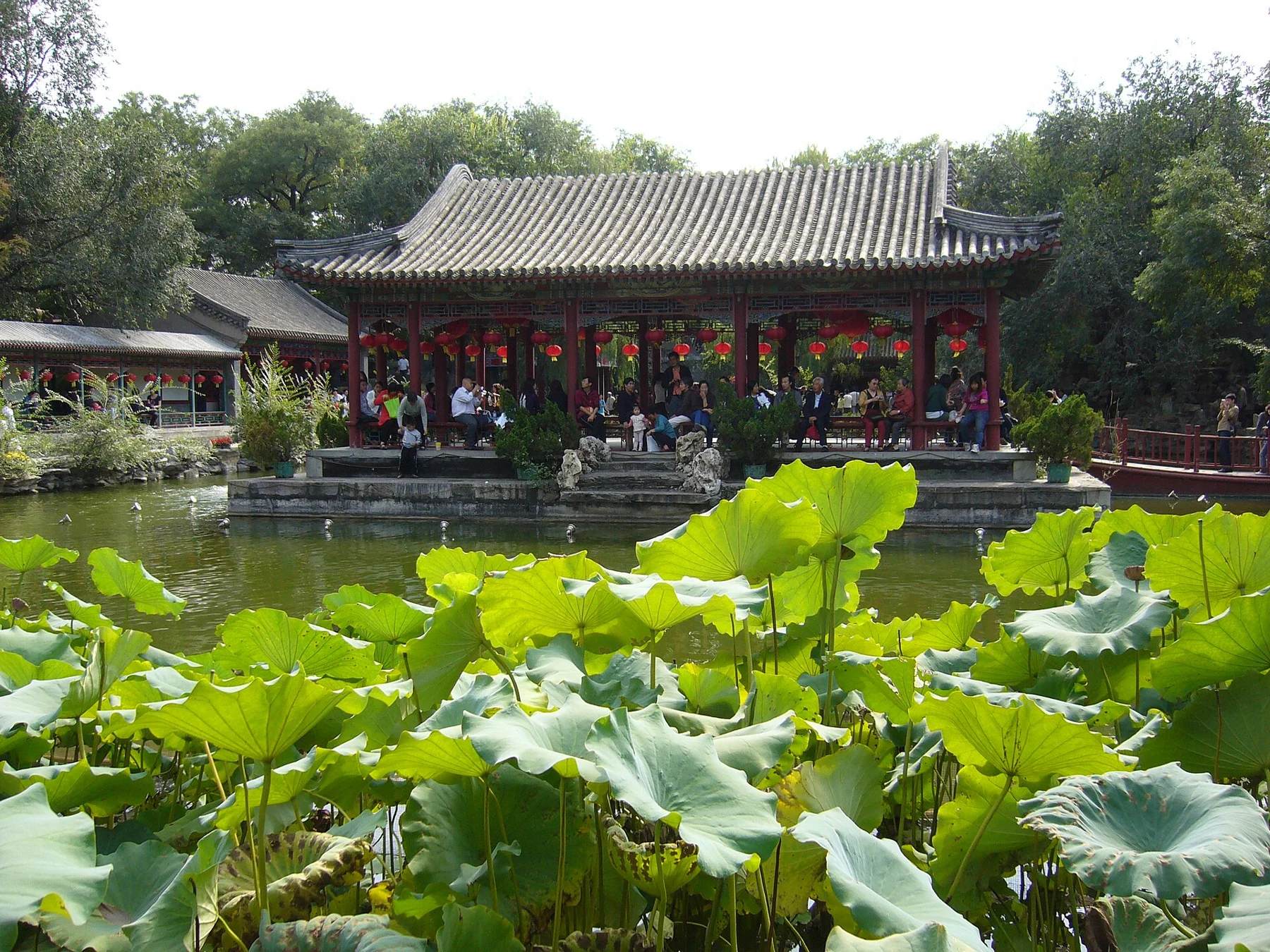
Leave room for the garden around the landmarks
Anshan Hall is a major building on the garden’s middle route, set among pond pavilions, rockwork and the theatre. The museum connects it with painting, poetry and the reception of important guests.[18]
A garden visit gains from the spaces between the named sights: a view across water, a turn in a path, a window or a planted courtyard. Choose a few connected scenes and leave room to stop. This is an editorial approach rather than an instruction to cover every path.
Our looking suggestionTurn back once: a framed view often changes when seen from the opposite side. Finish before fatigue turns the garden into another checklist.
Choose what matters
Make the visit yours.
A first visit with room to read
Courtyards, craft and garden
- Keep
- A few residence interiors and the garden’s main landscape ideas.
- The trade-off
- You will still need to skip some exhibitions or garden branches.
Reserve and exchange
Bring the booked original passport and complete the published credential exchange at the service point.
Read the residence
Look at the central hall and choose Duofu or Xijin according to the current open route.
Cross into the garden
Pause at the Rear Building, then compare the garden gateway, stone and water.
Choose one deeper stop
Spend time at the theatre or the Fu stele if open; finish with a slower garden scene.
Current access, queues and your energy determine the order. This outline is not an accessible-route assessment.
All outlines are editorial estimates, not field-tested routes. Follow current admission rules and venue directions.
Arrival, energy and interpretation
Get the details right.
Arrive at the right gate
Use the official Gate 1 approach. The museum publishes Metro Line 6 to Beihai North (Beihai Bei), Exit B on the northeast side, with signed approaches through nearby hutongs. Current station exits and road works can alter the final walk; the operator’s map is the better next step than an exact minute estimate.[3]
The museum’s published address is 17 Qianhai West Street, Xicheng District. The visitor service centre is inside Gate 1 to the east; the ticket policy separately refers passport holders to the comprehensive service point for their credential exchange. Follow staff directions for that day’s counter.[4][2]
The white Western-style Gate shown in garden photographs is not the public street entrance. Shichahai is nearby as a separate neighbourhood visit, not a promise that every lake path or residence forms one continuous ticketed route.[12]
Interpretation in English
The museum’s published audio-guide page lists English alongside Chinese, French, Spanish and Japanese. It is dated 2018 and quotes CNY 30 for two hours; ask the rental counter for the current device, language, charge and return procedure rather than treating the old quotation as today’s offer.[20]
The visitor guide places staffed guide and rental points by the first palace gate and self-service rental by the second. Ask about the current official English service and agree scope and price before choosing a guide.[4]
Useful facilities
The visitor service centre lists advice, luggage deposit, phone charging, hot water, wheelchair and stroller loans. The guide also identifies a nursing room and family/unisex toilet on the eastern side of the square. Availability and exact arrangements should be checked on arrival.[4]
For published visitor-service help, use +86 10 83288149 on opening days, 08:30–16:30. Ticket-service queries have a separate number and schedule above.[2]
Steps and garden access
The museum explicitly warns that the grounds contain many rocks and steps. A wheelchair-loan service does not establish step-free access to every hall, cave or terrace. Ask staff for the suitable route and keep climbs optional.[4]
Do not climb on rockwork or cross closed passages for a photograph. A shorter residence-and-garden selection may be more useful than trying to complete every branch.[4]
Photographs, exhibitions and a pause
Use the current notices in each room for photography and exhibit access. This desk-researched guide does not establish one universal indoor-photography permission or an operating theatre programme.
A quiet garden pause is part of the visit. Food, retail, special exhibitions and performances can have their own arrangements; this guide makes no tested restaurant, menu or foreign-payment recommendation.
Prince Kung’s Palace Museum · original film page · 27 March 2024
See the palace as a whole.
Prince Kung’s Palace Museum · Official museum film · published 2024-03-27
Prince Kung’s Palace: the museum’s own film
The museum’s original film presents the palace and its garden. This is a filmed introduction, separate from its interactive panorama. Current access and ticket arrangements require a fresh check.
Watch the film on the museum’s own pageOpens the publisher’s own player in a new tab. Chinese source; English subtitles and regional playback are not confirmed. The cover is a credited reference photograph, not a film still.
- Use the museum film for the relationship between courtyard, interior craftsmanship and garden landscape.
- It is filmed interpretation, separate from the interactive panorama below. Neither confirms present queues, ticket inventory or access to every room.
- Language and subtitle coverage, and playback from every region, are not yet fully checked.
Official digital resources
Step into the official panorama.
The museum’s official panorama has an English entry, a labelled palace map and selectable building scenes. We opened the Yin’an Hall scene, read its English interpretation and changed the view by dragging; this is an interactive panoramic visit, separate from the film.[3][22]
Panoramic Walk · English menu available
Choose EN, then Panoramic Walk → Virtual Tours of the Palace. Select a named building on the map, then drag within the scene to look around. Period Halls/Rooms and exhibition categories are separate choices. We checked Yin’an Hall, not every scene or narration.[22]
Open the official panoramic visitOfficial digital-exhibition directory
The museum also keeps a directory of separately published digital exhibitions. Online display and physical exhibition dates can differ.[23]
Explore the museum’s digital exhibitionsOpens on the museum’s own site in a new tab. Digital scenes record their source material and should not be used as a current accessibility map or evidence that a room is open.[22]
Before you ask.
Is Prince Kung’s Palace another name for the Forbidden City?
No. It is a separate aristocratic residence and garden with its own museum admission, in the Shichahai area.[7][3]
Can a foreign passport simply scan at the gate?
The published policy instructs passport holders to exchange for an admission credential at the comprehensive service point after online purchase. Direct identity-card scanning is described separately. Follow the current operator instruction.[2]
Does a ticket include a theatre performance?
The theatre’s historic role does not establish a daily show or an included performance. Check the exact dated programme with the museum.[17]
Are there literally ninety-nine and a half rooms in the Rear Building?
That is the popular name. The museum’s individual building record instead gives 116 rooms and explains the cultural expression.[11]
Should I touch the Fu stele for good luck?
The character and its popular meanings are cultural subjects. Follow today’s conservation and staff instructions about touching; this guide does not promise luck or endorse touching a protected object.[16]
Can I explore in English before travelling?
Yes. The official panorama’s English entry, map and Yin’an Hall scene were tested, including dragging the view and reading the English description. Other scenes, narration languages and devices have not all been checked.[22]
Dates, sources and photographs
Follow the evidence.
Desk research using the museum’s current home page, ticket policy linked from that page, visitor-service rules, named-building records and museum-hosted historical interpretation. Historical names, reconstructed buildings, popular stories and present operating rules are kept distinct. Editorial visit outlines are not surveyed paths. Individual photo dates and licences are retained.
Reviewed 2026-10-29. This date records our source review, not a live availability check.
Open 23 source references
- Prince Kung’s Palace Museum · current hours and full-price admission
Official visitor information · Reviewed 2026-10-29
- Museum · real-name purchase, passport exchange and refund rules
Official ticket policy; still linked from current home page · Published 2023-07-24 · Reviewed 2026-10-29
- Museum · official guide, gates, transport and route themes
Official visitor information · Reviewed 2026-10-29
- Museum · visitor services and conduct
Official visitor information · Reviewed 2026-10-29
- Museum · booking-window and service-line answers
Official visitor information · Reviewed 2026-10-29
- Museum · 2026 historical and architectural questions
Official educational material; conflicting older dates discussed · Published 2026-09 · Reviewed 2026-10-29
- Museum researcher · residence and garden layout
Museum-hosted interpretation · Reviewed 2026-10-29
- Museum · Yin’an Hall
Official architectural interpretation · Published 2014-02-20 · Reviewed 2026-10-29
- Museum · Duofu Belvedere
Official architectural interpretation · Published 2014-02-20 · Reviewed 2026-10-29
- Museum · Xijin Studio
Official architectural interpretation · Published 2014-09-23 · Reviewed 2026-10-29
- Museum · Rear Building
Official architectural interpretation · Published 2014-02-24 · Reviewed 2026-10-29
- Museum · Western-style Gate
Official architectural interpretation · Published 2014-02-24 · Reviewed 2026-10-29
- Museum · Solitary Joy Peak
Official landscape interpretation · Published 2014-03-03 · Reviewed 2026-10-29
- Museum · Bat-shaped Pond
Official landscape interpretation · Published 2014-02-24 · Reviewed 2026-10-29
- Museum · Verdant Rock and Miyun Cave
Official landscape interpretation · Published 2014-02-20 · Reviewed 2026-10-29
- Museum · research into the Kangxi Fu-character stele
Museum-hosted historical discussion; provenance uncertainty retained · Reviewed 2026-10-29
- Museum · Grand Theatre / Yishen Suo
Official architectural interpretation · Published 2014-02-24 · Reviewed 2026-10-29
- Museum · Anshan Hall
Official garden-building interpretation · Published 2014-02-24 · Reviewed 2026-10-29
- Museum · Archery Path and three garden approaches
Official landscape interpretation · Published 2014-03-03 · Reviewed 2026-10-29
- Museum · audio-guide languages and published rental terms
Older service description; current price and stock require confirmation · Published 2018-08-08 · Reviewed 2026-10-29
- Museum · original film, published 27 March 2024
Original museum video source · Published 2024-03-27 · Reviewed 2026-10-29
- Museum · Panoramic Prince Kung’s Palace
Official interactive resource; English entry and menus checked · Reviewed 2026-10-29
- Museum · digital-exhibition directory
Official digital-resource index · Reviewed 2026-10-29
Photograph authors, dates and licences (12 photographs)
Caitriana Nicholson from 北京 ~ Beijing, 中国 ~ China · 2008-10-03 05:10 · CC BY-SA 2.0
Resized and converted to WebP. Image-file proportions retained; hero and preview layouts may crop the display. Original licence retained.
The original uploader was 用心阁 at Chinese Wikipedia. · 19 April 2005 (original upload date) · CC BY-SA 3.0
Resized and converted to WebP. Image-file proportions retained; hero and preview layouts may crop the display. Original licence retained.
lienyuan lee · Taken on 17 June 2007 · CC BY 3.0
Resized and converted to WebP. Image-file proportions retained; hero and preview layouts may crop the display. Original licence retained.
Temlsth · 2003-01-01 · CC BY-SA 3.0
Resized and converted to WebP. Image-file proportions retained; hero and preview layouts may crop the display. Original licence retained.
Bridget Coila from New Orleans, USA · 2008-06-17 14:15 · CC BY-SA 2.0
Resized and converted to WebP. Image-file proportions retained; hero and preview layouts may crop the display. Original licence retained.
Hermann Luyken · 2014-08-17 15:49:48 · CC0
Resized and converted to WebP. Image-file proportions retained; hero and preview layouts may crop the display. Original licence retained.
Hermann Luyken · 2014-08-17 16:02:04 · CC0
Resized and converted to WebP. Image-file proportions retained; hero and preview layouts may crop the display. Original licence retained.
Hermann Luyken · 2014-08-17 16:03:19 · CC0
Resized and converted to WebP. Image-file proportions retained; hero and preview layouts may crop the display. Original licence retained.
Caitriana Nicholson from 北京 ~ Beijing, 中国 ~ China · 2008-10-03 04:31 · CC BY-SA 2.0
Resized and converted to WebP. Image-file proportions retained; hero and preview layouts may crop the display. Original licence retained.
Caitriana Nicholson from 北京 ~ Beijing, 中国 ~ China · 2008-10-03 04:56 · CC BY-SA 2.0
Resized and converted to WebP. Image-file proportions retained; hero and preview layouts may crop the display. Original licence retained.
Hermann Luyken · 2014-08-17 16:47:02 · CC0
Resized and converted to WebP. Image-file proportions retained; hero and preview layouts may crop the display. Original licence retained.
Hermann Luyken · 2014-08-17 16:23:12 · CC0
Resized and converted to WebP. Image-file proportions retained; hero and preview layouts may crop the display. Original licence retained.
How conflicting descriptions were handled
The current home page points to mall.pgm.org.cn, while the FAQ still names web.pgm.org.cn. We use the current home-page purchase link and retain the FAQ as a booking-window/service reference. No successful overseas checkout is claimed.[1][5][2]
The museum’s older Yin’an Hall record dates its fire to 1920, while its September 2026 educational question gives 1921. The guide says early twentieth century rather than silently choosing between inconsistent dates; both agree the current building is a reconstruction, with the building page specifying 2008.[8][6]
The Rear Building’s popular “99½ rooms” name is separated from the 116-room count in its individual record. A name and a measured inventory are different kinds of information.[11]
The research article on the Fu stele discusses uncertainty over which owner acquired it. That is stronger grounds for cautious interpretation than the familiar claim that Heshen stole it.[16]
The public English main-site host returned a certificate-name mismatch during this review. We did not bypass it or rely on it for current ticket instructions. The separately linked official panorama successfully displayed English entry and category menus.[1][22]
What still needs direct confirmation
- Successful purchase with an overseas phone/passport and foreign card, live availability, and current counter-exchange staffing.
- Passport eligibility for concession categories not explicitly covered by the published wording.
- Current device-rental prices and stock, official English live-guide availability, indoor-photography restrictions and performance programmes.
- Open interiors, cave queues, temporary closures and a field-tested step-free route.
- Every panoramic scene, narration/subtitle language and device; full official film playback and overseas regional availability.
Film verification: Original museum article and its video source identified. Full-film viewing, subtitles and regional playback are not confirmed.
In this guide