
Shanghai · In-depth place guide
南翔
Bamboo, brick, and soup.
A garden day with room for old streets, twin pagodas and a basket of soup dumplings.
Start with the garden. Let the rest unfold.
Nanxiang has separate garden and twin-pagoda heritage areas. Choose Guyi Garden or the old streets as your anchor before adding more.[9]
A bamboo-lined garden visit and a slower look at the old streets can make a satisfying outing. Soup dumplings add a craft story as well as lunch. You can follow one of those interests without fitting every named venue into the day.
Plan your visit
Start with the right gate.
- Choose it for
- Classical garden details, unusual brick towers and the craft behind soup dumplings.
- Choose a garden
- Guyi and Tanyuan have different histories, locations and admission arrangements.
- Save two names
- Line 11 Nanxiang Station and Nanxiang North railway station are different destinations.
- Leave room for lunch
- Choose a current menu and a manageable portion. A famous name is not an ingredient list.
November: read the Chinese gate timetable
The Chinese homepage uses March–November hours; the English page has a different calendar. We follow the Chinese gate table.[1][2]
Tanyuan’s Ming connection is not the age of every building
The October 2026 municipal account identifies the present Tanyuan as a 2011 reconstruction at a different location after the earlier garden was destroyed.[9]
A garden ticket does not cover the whole town.
Use the current Chinese garden timetable for the gate you intend to use. Old-town streets, paid gardens, religious interiors and food businesses have separate arrangements.
Reviewed 29 October 2026. Published gate/sales times and dated prices are not a live stock, closure or payment check.[1][14][11][12]
Guyi Garden · March–November
- Published arrangement
- South gate 07:00–18:30; sales 07:00–18:00. North gate 05:30–19:30; sales 05:30–19:00.
- Practical decision
- Choose the correct gate for an early arrival or late finish. Sales stop before the gate closes.
Guyi Garden · December–February
- Published arrangement
- South gate 07:00–19:00; sales 07:00–18:30. North gate 06:00–17:00; sales 06:00–16:30.
- Practical decision
- Winter north-gate closure is earlier. Temporary notices may alter the published arrangement.
Guyi Garden · admission
- Published arrangement
- The park’s February 2026 authority notice publishes full-price admission at CNY 12.
- Practical decision
- It lists the 古猗园 WeChat mini-program and on-site purchase. Actual foreign-document, concession and payment processing are untested.
Public old-town streets
- Published arrangement
- The tourism listing describes the street area as open all day.
- Practical decision
- This does not establish opening hours for a garden, temple, shop or museum interior.
Tanyuan and other interiors
- Published arrangement
- Separate admission and current opening need confirmation.
- Practical decision
- The 2021 authority feature lists Tanyuan at CNY 22, 09:00–17:00. That historical listing is not presented as a verified current tariff or access notice.
| Place / season | Published arrangement | Practical decision |
|---|---|---|
| Guyi Garden · March–November | South gate 07:00–18:30; sales 07:00–18:00. North gate 05:30–19:30; sales 05:30–19:00. | Choose the correct gate for an early arrival or late finish. Sales stop before the gate closes. |
| Guyi Garden · December–February | South gate 07:00–19:00; sales 07:00–18:30. North gate 06:00–17:00; sales 06:00–16:30. | Winter north-gate closure is earlier. Temporary notices may alter the published arrangement. |
| Guyi Garden · admission | The park’s February 2026 authority notice publishes full-price admission at CNY 12. | It lists the 古猗园 WeChat mini-program and on-site purchase. Actual foreign-document, concession and payment processing are untested. |
| Public old-town streets | The tourism listing describes the street area as open all day. | This does not establish opening hours for a garden, temple, shop or museum interior. |
| Tanyuan and other interiors | Separate admission and current opening need confirmation. | The 2021 authority feature lists Tanyuan at CNY 22, 09:00–17:00. That historical listing is not presented as a verified current tariff or access notice. |
The February event notice says visitors can buy directly at the garden or through its mini-program. Its special holiday schedule should not replace the ordinary seasonal table.[14]
The old-town authority listing gives the visitor destination at 206 Jiefang Street and telephone +86 21 59125503. Ask about the specific interior rather than assuming one town ticket.[11]
Buy the visit you actually want.
The February 2026 notice lists the 古猗园 WeChat mini-program’s 在线购票 and on-site desks. No purchase has been tested.[14]
For Tanyuan, a temple or an experience class, check the current product and entrance separately. The older town feature’s prices and schedules are dated references; a 2011 reconstructed garden, a religious site and a food workshop are different visits.[12]
If you need a guide, a particular language or an accessible route, arrange the support directly before travelling.
Find your bearings
Decide which Nanxiang you are going to.
For the garden, save 古猗园,嘉定区南翔镇沪宜公路218号. For the old-street visitor destination, save 南翔老街,解放街206号. Treat them as separate places rather than two names for the same entrance.[10][11]
The municipal October 2026 guide suggests Line 11 to Nanxiang, then approximately 15 minutes’ walk to Guyi or 20 to the old streets. These are publisher estimates, not our measurements.[9]
Distinguish the Line 11 metro stop 南翔站 from the railway station 南翔北站. Save your chosen return destination.[9]
Guyi: read the garden
Old town: read the layers
Craft, lunch and a pause
The white-crane story connects a temple with the town’s name. The frequently repeated 505 date belongs to that traditional account; a museum-hosted historical study questions it using surviving sources.[6][17]
Guyi’s own introduction places its origins in the early Jiajing period and connects its later bamboo-themed design with Zhu Sansong.[3]
Ye Jin expanded and repaired the estate and the name Guyi Garden came into use.[3]
The national heritage record associates Huang Mingxian’s smaller, thin-skinned filled buns with the beginnings of the Nanxiang technique.[19]
The museum account describes substantial tower restoration completed in December 1986.[16]
The bamboo-house extension opened on 1 October 2009, a later chapter in the garden’s development.[5]
A closer reading
What to look for.
Look at how materials work: brick that imitates timber, water that frames a building, and a thin wrapper that holds a rich filling.
Guyi Garden
绿竹猗猗
The garden’s name begins with bamboo
The garden’s own account links its name to the Book of Songs and its bamboo imagery. It describes repeated expansion as well as Ming origins. Read the planting as part of the design: stems can screen a view, soften a wall or change the sound and light of a path.[3]
Our looking suggestionCompare the height and density of the bamboo with the space left between stems.
Guyi Garden
不系舟
A boat-shaped building with a changed inscription
The operator describes Bu Xi Zhou as a waterside place for painting and calligraphy. Its original inscription by Zhu Zhishan was lost and later rewritten by He Hongfang. Do not mistake the story of a Ming inscription for proof that the present plaque is the original hand.[4]
Our looking suggestionRead the building as a vessel held at the water’s edge, then look at its name and later repair history.
Across Goose Pond
浮筠阁
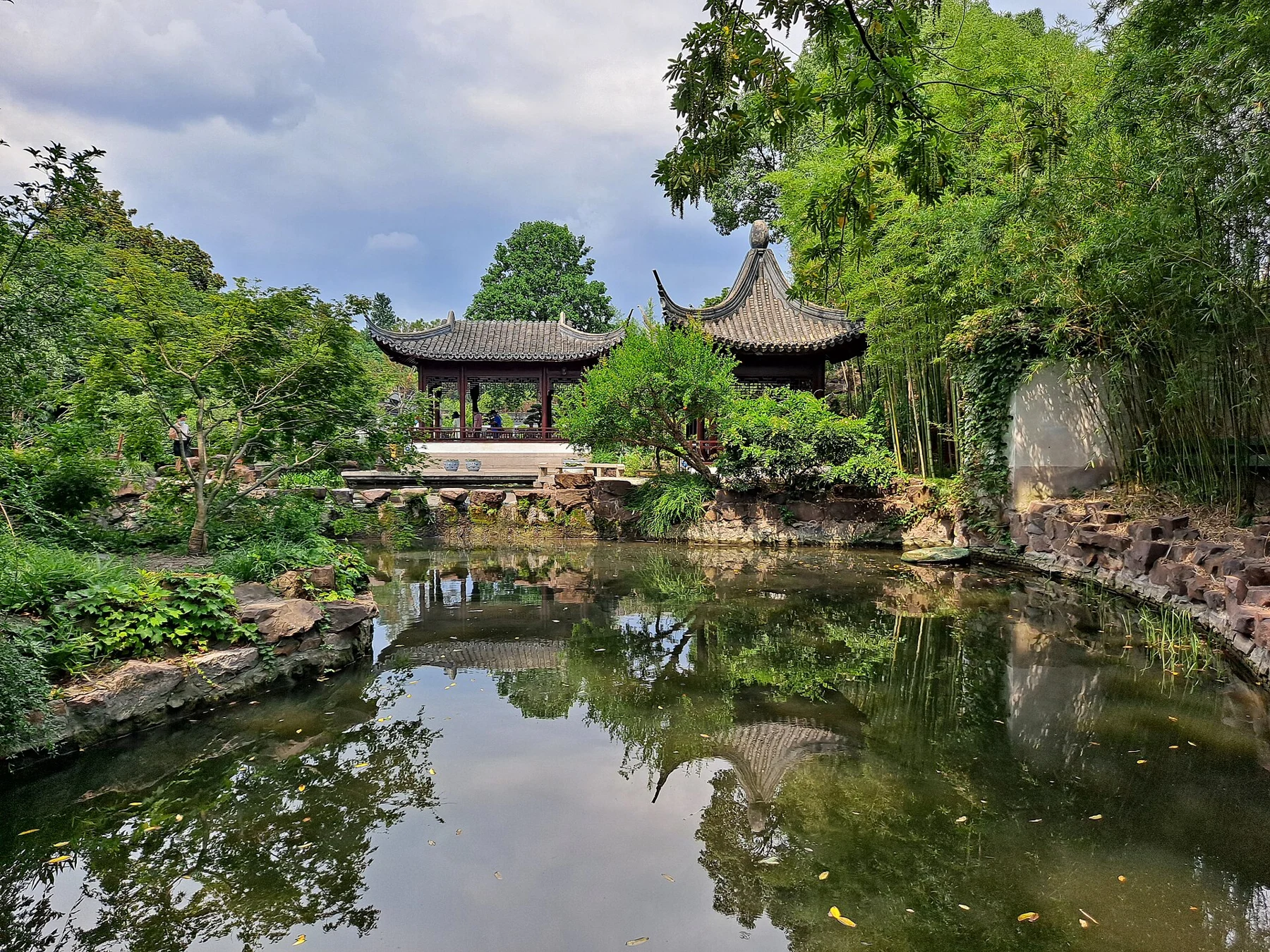
A pavilion read across the water
The operator’s historical account describes Fu Yun Ge’s original bamboo construction and its relationship with the boat-shaped building across the pond. That describes an architectural idea and earlier material history, not a claim that every visible part remains Ming bamboo.[4]
Our looking suggestionCompare the opposite bank with the reflection. A garden scene changes as you move, without adding another attraction.
Guyi Garden
隔水相望
Read across a pond
The garden’s English account describes linked pools. Use an open stretch of water to read relationships between buildings.[2]
Our looking suggestionCompare the same scene from more than one public viewpoint. Look at the empty water as well as what it reflects.
Guyi Garden
白鹤亭
A white crane as a name-story
The crane pavilion and a related poem retell the White Crane Flying South legend. The operator labels this as a traditional story about the town’s origins. Enjoy the cultural narrative while keeping it distinct from securely dated architectural evidence.[6]
Our looking suggestionLook for the crane motif and the way a small structure gives a name-story a physical setting.
Guyi Garden · Zhuzhi Hill
补阙亭 / 缺角亭
A missing corner with a deliberate meaning
The tourism authority’s monument record dates the pavilion’s fundraising to April 1933. Its absent north-east corner recalls the occupation of north-eastern China after the 1931 Mukden Incident; the other raised corners take the form of clenched fists. This is a commemorative design, not an unfinished repair.[7]
Our looking suggestionRead the silhouette before looking at decorative details. It carries a specific twentieth-century memory.
Guyi Garden
唐经幢与普同塔
Scripture pillars are different from the twin towers
The garden identifies Tang scripture pillars, the Song Putong Tower and Yuan Wan’an Tower among its stone remains. These are different monuments from the old town’s paired brick towers.[3]
The October 2026 municipal account dates Putong to 1222.[9]
Our looking suggestionCompare the outline of a tall inscribed pillar with a small tiered stone tower; read the individual label before naming it.
Guyi Garden
不可无竹居
A bamboo room in a later extension
The operator dates the opening of this extension to 1 October 2009. Its room, surrounding water and linked corridors continue the bamboo theme in a newer part of the garden. A classical architectural language does not make the whole setting equally old.[5]
Our looking suggestionCompare the proportions of room, window and water, then look back towards the older garden areas.
Guyi Garden
窗、廊与倒影
Let a frame do some of the looking
The operator’s English interpretation connects buildings, corridors, inscriptions and reflections. Look at how one opening frames a view differently from the next.[2]
Our looking suggestionStand to one side, then move a few steps. Notice what enters and leaves the frame.
Guyi Garden
花石小路
Look down as well as across
The operator treats patterned paving as part of the design. Compare a decorated surface with a plain path between the buildings.[2]
Our looking suggestionCompare a patterned paved area with a plain path, and keep your own footing in mind.
Guyi Garden
荷塘与水景
A summer photograph is a seasonal record
The municipal garden introduction highlights flowers, water and cultural activities. The July photographs here show a particular summer setting. Choose the actual planting you find interesting on your visit; you do not need a promised mass bloom or a scheduled performance to enjoy the water and buildings.[8]
Our looking suggestionCompare open water with leaves and reflections. The space around a plant is part of the scene.
The old-town area
南翔老街
Read the shops and water together
The authority listing identifies Renmin, Gonghe, Jiefang and Shengli streets as a traditional commercial and residential area. Keep the working neighbourhood in view: a shop sign, upper-floor window and doorway may belong to different uses of the same building.[11]
Our looking suggestionChoose a shorter public section, leaving doorways and narrow crossings usable.
Old-town twin pagodas
南翔寺砖塔
Brick shaped as a timber building
The museum account describes the restored pair as seven-storey, eight-sided brick towers about 11 metres high, with forms borrowed from timber pavilion architecture. The brackets, rails and projecting eaves are especially useful details to compare.[16]
Our looking suggestionLook for something that resembles a wooden bracket, then notice that it is made in brick.
Around the historic pair
双塔修复
Restoration is part of what you see
The museum’s account describes severe loss before the 1980s work: collapsed upper parts, eroded bricks and missing details. Specialists used surviving traces, excavated components and documentary sources to plan the restoration. The coherent outlines today include that conservation history.[16]
Our looking suggestionRead a restored outline with the same interest as an older fragment; the visible whole has several dates.
Old town
云翔寺 / 留云禅寺
An old institution, a rebuilt compound
A contemporary Wenhui report in June 2005 describes the rebuilt temple’s Tang-style architecture. This makes the present compound different from a claim that every hall dates from the traditional foundation story. Follow the religious site’s own current access and photography instructions.[18]
Our looking suggestionCompare the layout and roof forms with the much smaller brick towers outside the modern compound.
Old town · separate admission
檀园
A reconstructed garden at a new site
The city’s October 2026 account connects Tanyuan with the Ming writer and painter Li Liufang, while explicitly recording the loss of the earlier garden and the 2011 relocation and reconstruction. Read it as a modern interpretation of an older garden tradition.[9]
Our looking suggestionLook at the relationship between a small pool, enclosing walls and rooms, rather than using apparent age as the only measure.
Tanyuan
李流芳与园林
A painter’s garden as an idea
The earlier authority introduction names Baozun Hall, Shanyu Tower, Cizui Hall and Furong Pan within the reconstructed setting. Use the literary associations as a way of looking, while checking today’s room access and actual labels.[12]
Our looking suggestionChoose one framed view and imagine how its wall, roof, rock and water might be arranged on a painted page.
Separate old-town venues
历史文化陈列与体验空间
A smaller interior is another choice
The information office describes historical buildings and a dumpling-culture experience space among the old town’s resources. These can be reasons to enquire, rather than a promise of a walk-in workshop or every room being open. A small interpreted story may suit you better than a second full garden.[13]
Our looking suggestionAsk about the current programme, language, booking and what is included before committing.
Food craft
南翔小笼馒头
A filled bun, not a plain steamed bread
The national heritage record explains that the local name xiaolong mantou refers to a filled bun. Its traditional method uses an unfermented wheat wrapper around a pork filling with skin-jelly seasoning. The skill entered the national heritage list in 2014; this is not a UNESCO inscription.[19]
Our looking suggestionNotice the relation between wrapper and filling. A fold count alone is not a reliable test of every modern product.
Individual restaurants
馅料与汤汁
The menu name is the start of a question
The heritage record lists pork and later crab, shrimp and other variants. The filling, broth and seasoning of a current restaurant’s version still need asking about. A seafood name does not establish a pork-free or vegetarian recipe.[19]
Our looking suggestionRead the actual menu, ask about the stock as well as the filling, and start with a portion you can enjoy without rushing.
A flexible finish
一园、一街、一笼
Let the day end with enough room
You can choose one garden, one manageable public street section and one meal. A second paid garden or a full list of interiors is optional. Leave a margin for the journey home and use a pause to decide whether you want more walking.
Our looking suggestionTake one last look at a material or detail you noticed earlier. It may be more memorable than another checklist photograph.
Choose what matters
Make the visit yours.
For visitors who want planting, architecture and quiet looking.
One garden, read slowly
- Keep
- A chosen Guyi section, one material detail and a seated pause.
- The trade-off
- The old town can remain optional.
Choose the gate
Use its actual seasonal opening and ticket-sales window.
Follow one idea
Bamboo, water, stone or a commemorative structure can guide the visit.
Stop looking at the checklist
Spend time with a small number of views and details.
Finish while comfortable
Leave a margin for the journey back.
Editorial outline, not a measured or on-site-tested route. Current access, weather, stairs, rest needs and the return journey can change the choice.
All outlines are editorial estimates, not field-tested routes. Follow current admission rules and venue directions.
Arrival, energy and interpretation
Get the details right.
A metro station, a railway station, two destinations.
For Guyi Garden, the authority’s 2026 spring notice suggests Line 11 to Nanxiang, Exit 2, then buses 129 or 111, with other road services listed. Treat this as a dated approach reference and check today’s route and stop before boarding.[14]
For the old streets, save 解放街206号. Choose the actual temple, garden or workshop entrance from its current instructions once you arrive; a visitor-centre address is not every venue’s gate.[11]
Plan the complete metro return and any onward transfer. Current first/last services, bus frequency, lift operation and a continuous step-free route have not been verified.
Useful questions for a garden and a meal.
Show the question that matters to you. Staff can point to a gate, an item or the relevant part of a menu.
- 请问今天南门和北门分别几点关门?
What time do the south and north gates close today?
Qǐngwèn jīntiān nánmén hé běimén fēnbié jǐ diǎn guānmén?
- 请问这个入口有台阶吗?
Does this entrance have steps?
Qǐngwèn zhè ge rùkǒu yǒu táijiē ma?
- 请问这里可以借轮椅吗?
Can I borrow a wheelchair here?
Qǐngwèn zhèlǐ kěyǐ jiè lúnyǐ ma?
- 请问这是古猗园还是檀园的门票?
Is this ticket for Guyi Garden or Tanyuan?
Qǐngwèn zhè shì Gǔyī Yuán háishi Tányuán de ménpiào?
- 请问一笼有几个?
How many dumplings are in one basket?
Qǐngwèn yì lóng yǒu jǐ ge?
- 这个小笼的馅料和汤汁里有哪些肉?
Which meats are in this dumpling’s filling and broth?
Zhè ge xiǎolóng de xiànliào hé tāngzhī lǐ yǒu nǎxiē ròu?
- 请问蟹粉小笼里也有猪肉吗?
Do the crab dumplings also contain pork?
Qǐngwèn xièfěn xiǎolóng lǐ yě yǒu zhūròu ma?
- 请问这个里面有小麦吗?
Does this contain wheat?
Qǐngwèn zhè ge lǐmiàn yǒu xiǎomài ma?
These questions do not assure a service, recipe or safe preparation. If an allergy matters, state the allergy itself and check the preparation with the business.
Rest and mobility needs
The garden’s English page describes a visitor centre and equipment such as umbrellas, walking sticks and wheelchairs. Current availability, identity/deposit conditions and a complete accessible route need direct confirmation; old fee quotations are not repeated here.[2]
Choose a shorter section and allow a seated pause. A classical garden can include thresholds, steps and uneven surfaces; the photographed route is not an accessibility audit.
A guide or a hands-on activity
The information office describes dumpling-making and interpretation among the old town’s cultural resources. Ask about the actual date, language, booking, age suitability and price before arranging a workshop. A promotional introduction is not a confirmed slot.[13]
One name can refer to different places
The municipal food introduction distinguishes Nanxiang’s origin story from its later development around Shanghai’s City God Temple area. A restaurant with “Nanxiang” in its name elsewhere is not proof that your destination is this town.[20]
No restaurant has been visited or endorsed in this review. Menus, recipes, prices, queues, seating and payment conditions require checking with the actual business.
Shanghai television / KankanNews · municipal archive · 6 June 2024
A recorded glimpse of culture in the garden.
Shanghai television / KankanNews · municipal archive · 6 June 2024 · Chinese-language recorded heritage feature · about 1 minute 48 seconds
Heritage activities in Guyi Garden
A recorded report on a past heritage event at Guyi Garden. It does not establish current performances, workshops or night opening. The cover is a separately credited July 2022 photograph.
Open the original municipal archive playerOpens the publisher’s own player in a new tab. The original player was played and an event-launch frame inspected. English captions, regional and physical-phone playback remain untested. The cover is a credited reference photograph, not a film still.
- A Chinese-language report on a past heritage event at the garden. It is ordinary recorded video, not a live camera, current event schedule or browser panorama.
- The cover is a separately credited historical garden photograph, not a film frame.
Original illustrated resources
Read the design before choosing a route.
These original resources offer a useful way to prepare. They explain architecture and historical evidence; no working complete Nanxiang browser panorama has been verified.
The boat-shaped building and the pavilion opposite
The operator describes an earlier plaque and later rewriting, as well as the building’s relationship with the water. Original-page access can vary; no current room access is implied.[4]
Read the garden’s original architectural accountHow the twin brick towers were restored
The article is printed on page 85 of the journal, corresponding to PDF page 81. It describes material evidence and the restoration process. The full file is large and Chinese-language.[16]
Open the museum-hosted record at PDF page 81The technique behind the soup dumplings
The original record describes the craft and its 2014 national listing. It is a cultural record, not a current restaurant menu or a UNESCO listing.[19]
Read the national heritage recordThe garden’s current public homepage and historical pages were read. Later browser requests to several visitor-information pages met a security block; that is not evidence that the physical garden is closed.
The publisher film and original documents open only when selected. They do not load automatically in this guide.
Before you ask.
Is Guyi Garden the same as Tanyuan?
They are separate gardens with different locations and histories. Choose one as the anchor and check its own admission.
Which garden timetable should I follow in November?
Use the Chinese March–November table and check newer notices; the English calendar differs.[1][2]
Are the twin towers made of wood?
The museum’s record describes brick construction imitating timber architectural details. Look at the brackets and eaves.[16]
Do “crab” or “shrimp” dumplings mean no pork?
Ask the business about both filling and broth. A menu name alone does not establish the recipe or dietary suitability.
Must I reserve a full-day tour?
Our visit choices can be a shorter garden or old-town outing. Confirm the transport and actual venue arrangements that matter to you before deciding whether organised support is useful.
Dates, sources and photographs
Follow the evidence.
Original garden information, dated authority notices and heritage records are distinguished by their scope. The museum-hosted study is a scholarly interpretation rather than an undisputed founding-date certificate. Current admission transactions, physical access and individual businesses have not been tested. Our visit choices and looking prompts are editorial suggestions, not measured itineraries. Genuine licensed photographs were visually checked, dated and matched to their actual visible subjects.
Reviewed 2026-10-29. This date records our source review, not a live availability check.
Open 21 source references
- Guyi Garden: current Chinese homepage and seasonal gate/sales table
Original operator, authority, heritage record or clearly dated contemporary reporting; limitations described in the guide · Reviewed 2026-10-29
- Guyi Garden: English page with differing calendar and dated service quotations
Original operator, authority, heritage record or clearly dated contemporary reporting; limitations described in the guide · Reviewed 2026-10-29
- Guyi Garden: original Chinese history and successive expansions
Original operator, authority, heritage record or clearly dated contemporary reporting; limitations described in the guide · Reviewed 2026-10-29
- Guyi Garden: Bu Xi Zhou, rewritten plaque and Fu Yun Ge account, July 2018
Original operator, authority, heritage record or clearly dated contemporary reporting; limitations described in the guide · Reviewed 2026-10-29
- Guyi Garden: bamboo-house extension opened October 2009, account July 2018
Original operator, authority, heritage record or clearly dated contemporary reporting; limitations described in the guide · Reviewed 2026-10-29
- Guyi Garden: white-crane pavilion and explicitly traditional name-story, July 2018
Original operator, authority, heritage record or clearly dated contemporary reporting; limitations described in the guide · Reviewed 2026-10-29
- Municipal tourism heritage listing: commemorative pavilion and 1933 fundraising
Original operator, authority, heritage record or clearly dated contemporary reporting; limitations described in the guide · Reviewed 2026-10-29
- Municipal English garden introduction, updated October 2025
Original operator, authority, heritage record or clearly dated contemporary reporting; limitations described in the guide · Reviewed 2026-10-29
- Shanghai Release / housing heritage authority: Nanxiang landmarks, 26 October 2026
Original operator, authority, heritage record or clearly dated contemporary reporting; limitations described in the guide · Reviewed 2026-10-29
- Municipal tourism listing: Guyi location and general garden character
Original operator, authority, heritage record or clearly dated contemporary reporting; limitations described in the guide · Reviewed 2026-10-29
- Municipal tourism listing: public old streets, visitor address and enquiry phone
Original operator, authority, heritage record or clearly dated contemporary reporting; limitations described in the guide · Reviewed 2026-10-29
- Municipal tourism feature, 19 October 2021: historical interior/business arrangements
Original operator, authority, heritage record or clearly dated contemporary reporting; limitations described in the guide · Reviewed 2026-10-29
- Shanghai Information Office: old-town cultural resources and experience introduction
Original operator, authority, heritage record or clearly dated contemporary reporting; limitations described in the guide · Reviewed 2026-10-29
- Municipal park authority: CNY 12, mini-program/desk channels and expired spring hours, February 2026
Original operator, authority, heritage record or clearly dated contemporary reporting; limitations described in the guide · Reviewed 2026-10-29
- Municipal cultural authority: dated heritage event, offers and late-opening dates, September 2026
Original operator, authority, heritage record or clearly dated contemporary reporting; limitations described in the guide · Reviewed 2026-10-29
- Shanghai Museum-hosted Shanghai Wenbo: Nanxiang brick towers, printed page 85 / PDF page 81
Original operator, authority, heritage record or clearly dated contemporary reporting; limitations described in the guide · Reviewed 2026-10-29
- Xu Hongxin: historical study of temple founding and white-crane legend, printed pages 74–80
Museum-hosted historical research; scholar’s interpretation and page scope retained · Reviewed 2026-10-29
- Wenhui / Oriental Net contemporary rebuilding report, Sina archive, 19 June 2005
Original operator, authority, heritage record or clearly dated contemporary reporting; limitations described in the guide · Reviewed 2026-10-29
- China Intangible Cultural Heritage digital museum: Nanxiang technique, 2014 national listing
Original operator, authority, heritage record or clearly dated contemporary reporting; limitations described in the guide · Reviewed 2026-10-29
- Shanghai / Huangpu food heritage: town origin versus later City God Temple development, June 2026
Original operator, authority, heritage record or clearly dated contemporary reporting; limitations described in the guide · Reviewed 2026-10-29
- Shanghai television / KankanNews original report in municipal video archive, 6 June 2024
Original operator, authority, heritage record or clearly dated contemporary reporting; limitations described in the guide · Reviewed 2026-10-29
Photograph authors, dates and licences (22 photographs)
钉钉 · 2022-07-09 · CC BY-SA 4.0
Resized and converted to WebP. Image-file proportions retained; hero and preview layouts may crop the display. Original licence retained.
钉钉 · 2022-07-09 · CC BY-SA 4.0
Resized and converted to WebP. Image-file proportions retained; hero and preview layouts may crop the display. Original licence retained.
钉钉 · 2022-07-09 · CC BY-SA 4.0
Resized and converted to WebP. Image-file proportions retained; hero and preview layouts may crop the display. Original licence retained.
钉钉 · 2022-07-09 · CC BY-SA 4.0
Resized and converted to WebP. Image-file proportions retained; hero and preview layouts may crop the display. Original licence retained.
钉钉 · 2022-07-09 · CC BY-SA 4.0
Resized and converted to WebP. Image-file proportions retained; hero and preview layouts may crop the display. Original licence retained.
钉钉 · 2022-07-09 · CC BY-SA 4.0
Resized and converted to WebP. Image-file proportions retained; hero and preview layouts may crop the display. Original licence retained.
钉钉 · 2022-07-09 · CC BY-SA 4.0
Resized and converted to WebP. Image-file proportions retained; hero and preview layouts may crop the display. Original licence retained.
钉钉 · 2022-07-09 · CC BY-SA 4.0
Resized and converted to WebP. Image-file proportions retained; hero and preview layouts may crop the display. Original licence retained.
钉钉 · 2022-07-09 · CC BY-SA 4.0
Resized and converted to WebP. Image-file proportions retained; hero and preview layouts may crop the display. Original licence retained.
钉钉 · 2022-07-09 · CC BY-SA 4.0
Resized and converted to WebP. Image-file proportions retained; hero and preview layouts may crop the display. Original licence retained.
钉钉 · 2022-07-09 · CC BY-SA 4.0
Resized and converted to WebP. Image-file proportions retained; hero and preview layouts may crop the display. Original licence retained.
钉钉 · 2022-07-09 · CC BY-SA 4.0
Resized and converted to WebP. Image-file proportions retained; hero and preview layouts may crop the display. Original licence retained.
钉钉 · 2022-07-09 · CC BY-SA 4.0
Resized and converted to WebP. Image-file proportions retained; hero and preview layouts may crop the display. Original licence retained.
钉钉 · 2022-07-03 · CC BY-SA 4.0
Resized and converted to WebP. Image-file proportions retained; hero and preview layouts may crop the display. Original licence retained.
钉钉 · 2022-07-09 · CC BY-SA 4.0
Resized and converted to WebP. Image-file proportions retained; hero and preview layouts may crop the display. Original licence retained.
钉钉 · 2022-07-09 · CC BY-SA 4.0
Resized and converted to WebP. Image-file proportions retained; hero and preview layouts may crop the display. Original licence retained.
钉钉 · 2022-07-09 · CC BY-SA 4.0
Resized and converted to WebP. Image-file proportions retained; hero and preview layouts may crop the display. Original licence retained.
钉钉 · 2022-07-09 · CC BY-SA 4.0
Resized and converted to WebP. Image-file proportions retained; hero and preview layouts may crop the display. Original licence retained.
钉钉 · 2022-07-09 · CC BY-SA 4.0
Resized and converted to WebP. Image-file proportions retained; hero and preview layouts may crop the display. Original licence retained.
钉钉 · 2022-07-09 · CC BY-SA 4.0
Resized and converted to WebP. Image-file proportions retained; hero and preview layouts may crop the display. Original licence retained.
钉钉 · 2022-07-09 · CC BY-SA 4.0
Resized and converted to WebP. Image-file proportions retained; hero and preview layouts may crop the display. Original licence retained.
Robigasp · 2016-12-29 20:15:38 · CC BY-SA 4.0
Resized and converted to WebP. Image-file proportions retained; hero and preview layouts may crop the display. Original licence retained.
How conflicting descriptions were handled
The Chinese homepage and English page use different season boundaries and winter gate hours. We retain the current Chinese homepage’s table and identify the English discrepancy rather than mixing them.[1][2]
The Chinese introduction gives 9.8 hectares after expansion; the English page describes a smaller stage. Avoid applying one old size to every period.[3][2]
The traditional temple foundation in 505 is questioned by Xu Hongxin’s museum-hosted study, which argues for 839 from surviving sources. We keep the popular account qualified rather than claiming one uncontested precise foundation date.[17]
The museum’s detailed tower account dates restoration completion to December 1986; the brief October 2026 municipal article gives 1985 for repair. We describe the broader 1980s restoration and retain the more specific completion statement with its source.[16][9]
The 2021 town feature’s interior prices, workshop fee and business hours are dated background. The February 2026 garden notice supplies a newer CNY 12 reference but does not establish today’s actual transaction or every concession.[12][14]
The September/October and spring extended hours are event-specific and expired. The publisher’s 2024 film does not create a standing heritage performance.[15][14][21]
What still needs direct confirmation
- Actual foreign-document concessions, mini-program accounts, overseas-phone support, payment and admission have not been tested.
- Current Tanyuan tariff and entrance, temple room access, old-town museum hours and actual workshop availability require direct confirmation.
- Complete step-free routes, equipment stock, working lifts, toilets, storage and seating have not been checked in person.
- Current metro/bus first and last services, temporary controls and full return connections have not been verified.
- No complete usable browser360 tour has been verified. Some original visitor-information pages were blocked in browser checks.
- Restaurant recipes, prices, current service, ingredient handling and physical-phone media playback remain untested.
Film verification: The original archive player advanced to 3.161128 seconds; duration 108.32 seconds, 1280 × 720 pixels. A 25-second event-launch frame was inspected. The original media URL is HTTP and its HTTPS endpoint returned 403, so the site offers the publisher’s own player as an external link. Physical-phone, regional and English-caption coverage are untested. The external player also advanced beyond 2 seconds at 390- and 1440-pixel viewport widths; its old archive page remains 1000 pixels wide on mobile and may need horizontal scrolling.
In this guide