
Shanghai · In-depth place guide
豫园
A mountain landscape inside the city.
Rock, water and framed views in Shanghai’s old city.
Slow down at a window. Watch a whole landscape fit inside its frame.
Yu Garden began as Pan Yunduan’s private garden in 1559, beside what is now the surrounding bazaar and City God Temple. Its name carries the wish to bring ease and pleasure to his parents. The garden, shops and temple are adjacent places with different visitor arrangements.[13]
Our suggestion: give the garden its own daylight visit. Read the large rockery, a window, a dragon wall and the water together; the pleasure lies in how a view changes as you move. Leave a separate allowance for food, tea or the streets outside.
Plan your visit
Before you go.
- Time to allow
- Our suggestion: 1½–2½ hours inside for an unhurried selective visit; add time separately for the bazaar, temple, food or a booked night tour.
- Regular daytime hours
- 09:00–16:30, last entry 16:00; Monday closed except national public holidays. Check special-date notices.[2]
- Choose the experience
- Daytime garden, a separately booked garden night tour, the surrounding bazaar and a seasonal lantern event are different choices.
- Bags and mobility
- Leave bulky luggage elsewhere before arriving; read the uneven-path and step information below.
Choose the garden, not just the name
The garden ticket covers the named garden visit. Shop purchases, tea, temple admission, special night experiences and seasonal events have separate conditions. Read the actual product before paying.[13]
Daytime adult garden prices are in CNY. Night/event products have their own dated terms; current inventory and foreign-document transactions have not been tested.[1]
Daytime peak season
- Published price / arrangement
- CNY 40: 1 April–30 June and 1 September–30 November.
- Before choosing
- The regular daytime garden visit.
Daytime low season
- Published price / arrangement
- CNY 30: 1 July–31 August and 1 December–31 March.
- Before choosing
- July and August are low-price months; do not assume all summer is peak price.
Garden night tour: 豫享山林
- Published price / arrangement
- Separate timed product; current price and slots need a direct check.
- Before choosing
- A daytime ticket is not evidence of a night-tour reservation.
Bazaar, tea, temple or lantern event
- Published price / arrangement
- Check the actual venue/event and purchase.
- Before choosing
- An outside bridge or shop photograph does not establish entry into the garden.
| Experience | Published price / arrangement | Before choosing |
|---|---|---|
| Daytime peak season | CNY 40: 1 April–30 June and 1 September–30 November. | The regular daytime garden visit. |
| Daytime low season | CNY 30: 1 July–31 August and 1 December–31 March. | July and August are low-price months; do not assume all summer is peak price. |
| Garden night tour: 豫享山林 | Separate timed product; current price and slots need a direct check. | A daytime ticket is not evidence of a night-tour reservation. |
| Bazaar, tea, temple or lantern event | Check the actual venue/event and purchase. | An outside bridge or shop photograph does not establish entry into the garden. |
Half-price eligibility includes ages over 6 through 18, full-time undergraduate-and-below students, and ages 60 or over, with valid proof. Foreign document acceptance is untested.[1]
Daytime child exemption: height ≤1.3 m OR age ≤6, with an adult; up to three qualifying children per adult for non-group visits. Check night-tour conditions separately.[1]
Find the actual gate and product
Use the named official 上海豫园 mini-program or the published gate windows. Bring the original passport and any concession evidence; ask staff how your actual booking or window purchase is verified. Current foreign-phone registration, payment, document fields, refunds and availability have not been tested.
The 2020 page names passports but belongs to a limited pandemic reopening. It supports the existence of an older document process, not a successful current foreign booking or a reason to require its health-code procedure.[14]
Find your bearings
Find a view, then find the next one.
The operator divides the garden into six named areas: Sansui Hall, Wanhua Tower, Huijing Tower, Dianchun Hall, Yuhua Hall and the Inner Garden. The themes below help you read them rather than race through a checklist.[6]
This diagram is an editorial grouping, not a surveyed route or a current one-way system. Follow open paths, barriers and staff directions; a historical description of a staircase or rockery does not make climbing it permissible.
Mountain and threshold
Water and cultural detail
A garden within, and outside
The garden’s history dates the first works to 1559 and a long period of enlargement. The founding intention and the final form did not happen in a single building season.[5]
A major restoration began in 1956, and the garden reopened in 1961. Its present form reflects several periods of change.[5]
A closer reading
What to look for.
Sixteen details for a more attentive visit. Choose the open spaces that interest you; the sequence is a reading guide, not an enforced walking order.
Sansui Hall area
三穗堂 · 仰山堂
A hall that introduces a mountain
Sansui Hall was used for official ceremonies and the reading of imperial instructions in the Qing period. Nearby Yangshan Hall faces the pond and rockery: the architecture makes a place from which to contemplate the mountain.[6]
Our suggestion: pause at an allowed waterside viewpoint before walking on. Compare a hall’s straight structural frame with the irregular rocks and water outside. A garden hall is part of the landscape, not simply an indoor room to tick off.
Our looking suggestionLook through the building as well as at its roof.
A designed landscape
大假山
An assembled mountain
The operator attributes the Great Rockery to Ming rockery designer Zhang Nanyang and describes a height of about 14 metres. It is a constructed mountain of cliffs, gullies and concealed turns, rather than a naturally occurring hill.[6]
Our suggestion: read the joins of peaks and the deep shaded gaps from the permitted path. Resist the urge to interpret old descriptions of summit views as current permission to climb. The garden’s rules prohibit climbing historic buildings and rockeries.[3]
Our looking suggestionFollow the silhouette, then look into the shaded recesses.
Near the Jianrujiajing corridor
元代铁狮
Two objects older than the garden
The paired iron lions are dated by the operator to 1290, with a cast inscription identifying an Anyang-area maker. That makes them older than the garden’s 1559 beginning. Objects can arrive with their own histories.[6]
Our suggestion: distinguish these dark metal lions from later stone lions elsewhere. Look at the material and surviving surface without touching; do not identify every lion sculpture in a garden photograph as the Yuan pair.
Our looking suggestionMaterial and provenance matter more than a generic “guardian lion” label.
Wanhua Tower area
复廊 · 漏窗
A wall that lets the landscape through
The double corridor is divided by a wall, with differently shaped openwork windows. The operator’s description stresses the shifting glimpses of buildings, stream and rocks through those openings. A dividing wall also becomes a way to join views.[7]
Our suggestion: compare two windows from a permitted place. Move a little to one side and notice how their frames crop different layers of the garden. Let other visitors pass before stopping to photograph.
Our looking suggestionLook at the space seen through the pattern, not only the pattern itself.
Trees, shade and seasonal reading
万花楼 · 鱼乐榭
The garden also moves in time
The operator identifies a ginkgo near Wanhua Tower and an old wisteria by Yule Pavilion. The pavilion’s name alludes to Zhuangzi’s dialogue about the happiness of fish. The claim that the garden owner planted the ginkgo is presented as a tradition.[7]
Our suggestion: look for the way branches soften rooflines and create shade over stone and water. Blossom, leaf colour and the flowering day cannot be promised by an archival photograph or by a calendar month alone.
Our looking suggestionRead living plants as part of the composition, without promising a peak-flower date.
Huijing Tower area
会景楼 · 九狮轩
A room made by reflections
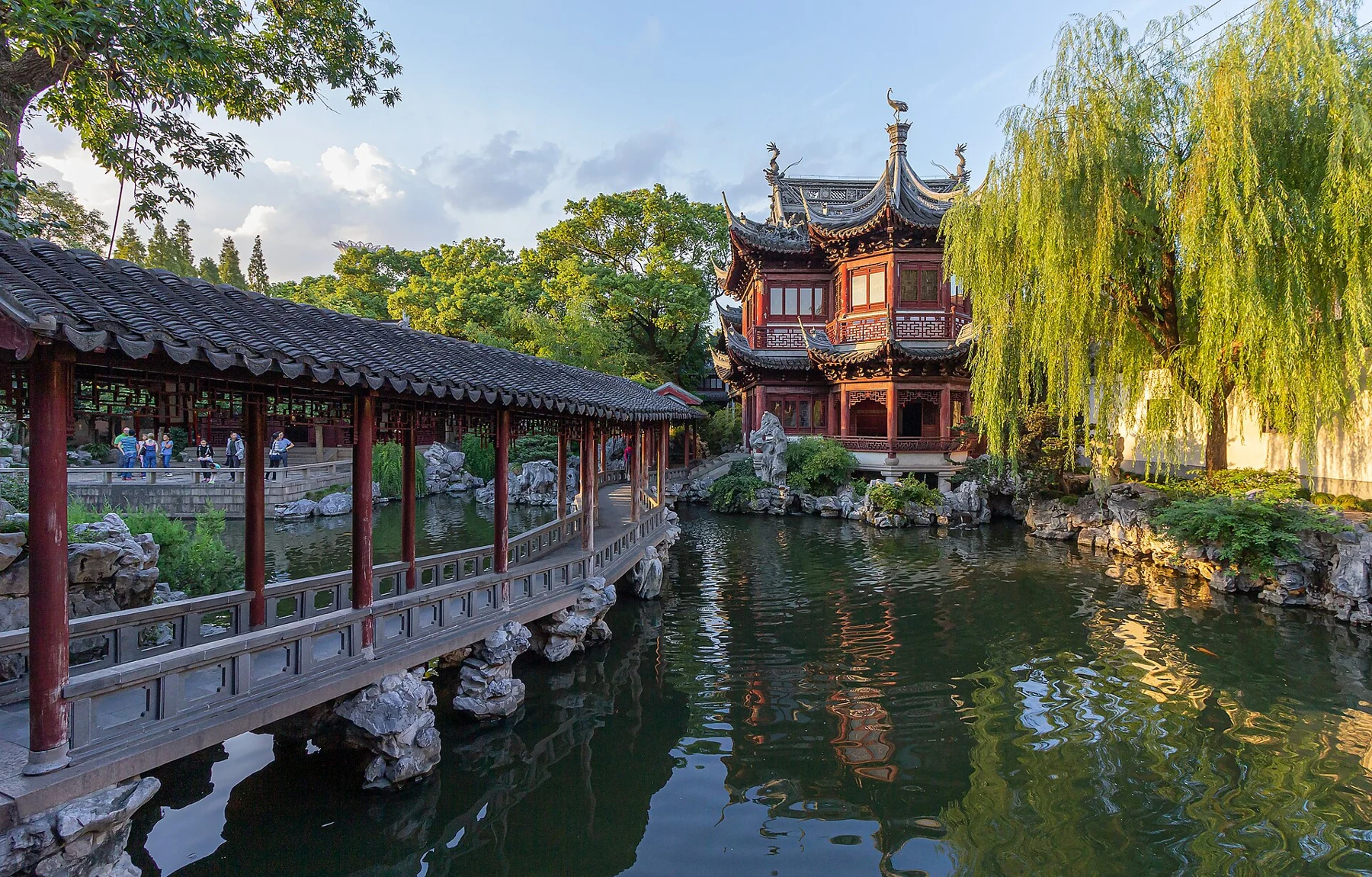
Huijing Tower occupies a central position with water on three sides. The operator describes Jiushi Pavilion as extending part-way over its pond. Built edges, water and reflected roofs shape a different kind of enclosure from a courtyard wall.[8]
Our suggestion: take a ground-level view, then look at the reflection rather than treating water as empty foreground. Current access to any upper room is a separate matter; a tower name does not promise an observation platform.
Our looking suggestionNotice where a building ends and its reflected counterpart begins.
A connecting experience
积玉水廊
Walking beside, then above, water
The Jiyu waterside corridor links the Huijing and Hanbi areas and is named for the Jiyu rock nearby. In the operator’s account, the corridor bends through a succession of views rather than functioning only as the shortest connection.[8]
Our suggestion: walk a short open stretch slowly and compare near railings, water, rocks and distant buildings. Keep to permitted paths; do not presume that every bridge, cave or apparently continuous corridor is open today.
Our looking suggestionRead the layers across the water from several permitted pauses.
Dianchun Hall area
点春堂 · 打唱台
A garden hall enters political history
Dianchun Hall served as the northern headquarters of the Shanghai Small Swords Society in 1853–1855. The operator links its name to a line by Su Shi and describes related historical material in the hall. The facing small performance stage is known as Dachangtai.[9]
Our suggestion: separate the garden’s private origins from the later uprising and restoration. Read the actual object labels and room notices; a history page does not establish that each mentioned document is currently displayed.
Our looking suggestionCompare a hall for assembly with the small stage facing it.
West of Dianchun Hall
穿云龙墙
A boundary becomes a creature
The Cloud-Piercing Dragon Wall lies west of Dianchun Hall. Its head is modelled in plaster and its body uses roof tiles as scales. The operator identifies other dragon compositions elsewhere, so one dragon photograph does not stand for every wall.[9]
Our suggestion: trace the line from head to tail and notice how it also divides the garden. Count details for yourself if visible, but do not turn an unsupported tale about an emperor’s punishment or a missing claw into established history.
Our looking suggestionThe same tiles make a roof edge, a boundary and a dragon’s body.
Yuhua Hall area
玉玲珑
A rock worth looking at twice
Yulinglong’s pierced form exemplifies slenderness, openings, wrinkled texture and permeability. The operator links it to Song imperial stone collecting; the restoration account quotes that association as tradition.[10][12]
Our suggestion: compare the solid outline with the holes through it. Historical stories about smoke or water passing through the stone are descriptions to read, not experiments to perform at a protected object.
Our looking suggestionLook for both the stone and the spaces it encloses.
A study facing the rock
玉华堂
Architecture arranged for an object
The operator associates Yuhua Hall with Pan Yunduan’s study and Yulinglong. The restoration account identifies the present hall as a reconstruction using the old garden record. Historical function and surviving fabric are different questions.[10][12]
Our suggestion: compare the rock’s position with the room facing it. Ask what a seated observer would see. Current furniture, displays and admission to the interior should be read from the actual labels and staff instructions.
Our looking suggestionImagine a view composed for a person sitting in a study.
Timber and narrative ornament
涵碧楼
A building you can read in carved detail
The operator describes Hanbi Tower as a carved timber building, with flowers and scenes from The Story of the Western Wing on its beams. “Hanbi” draws on a line by Zhu Xi about water holding green colour.[10]
Our suggestion: where details are visible from public paths, look at one beam or panel rather than trying to decode the whole building at once. Do not infer that every carved section can be approached closely or photographed with professional equipment.
Our looking suggestionNotice the change in scale from a whole roof to a small narrative carving.
Collections and changing exhibitions
听涛阁
A garden is also a place for art
The operator identifies Tingtao Tower’s exhibition rooms, and its collections feature explains the garden’s long relationship with Shanghai painting and calligraphy. The collections include works by modern Shanghai-school artists; that is not a promise that every named work is on display.[10][18]
Our suggestion: if an exhibition room is open, read the current title, dates and object labels. A short indoor exhibition can change the pace of the garden walk, but it should not replace the visitor’s own check of what is actually shown.
Our looking suggestionSeparate a collection catalogue, an exhibition room and a current display.
A later layer
内园 · 静观厅
A garden within the garden
The operator dates the Inner Garden to 1709 and says it was joined to Yu Garden during the late-1950s restoration. Jingguan Hall, also called Qingxue Hall, faces rockwork. A dry boat-shaped pavilion, also called Buxizhou, turns a building on rock into the image of a vessel.[11]
Our suggestion: compare its more enclosed spaces with the broad water views you have already seen. The boat-like structure is an architectural conceit; it is not a boat service or a guarantee that its steps are open.
Our looking suggestionRead the dry boat as a playful change of expectation.
Not the small Dachangtai
内园古戏台
A theatre with a journey of its own
The Inner Garden stage has an elaborate coffered ceiling. The restoration account traces it to the Qianye guild building on Tanggu Road, dismantled and re-erected here, entering use in 1988. It is a relocated structure.[11][12]
Our suggestion: distinguish this large stage from the smaller Dachangtai near Dianchun Hall. If the viewing area is open, look upwards at the ceiling’s layered pattern. Confirm actual performances separately; architecture does not imply a show today.
Our looking suggestionLook up from a permitted position without blocking the courtyard.
Outside the garden boundary
九曲桥 · 湖心亭 · 豫园商城
The famous bridge is a different visit
The restoration account separates the pond, teahouse and Nine-Turn Bridge from the enclosed garden.[12]
The teahouse operator reports reopening on 10 July 2025 after protective restoration. Building history and commercial tea service have different dates.[17]
Our suggestion: leave time for the surrounding streets if they appeal, but choose tea, food and temple visits deliberately. Check prices, order size and venue rules before buying. A night photograph outside is not evidence that the garden gate is open.
Our looking suggestionDecide whether you want a garden, a tea service, a shopping street or a seasonal event.
Choose what matters
Make the visit yours.
Our suggestion: 1½–2½ flexible hours
Rock, window, water
- Keep
- The garden’s different ways of framing a landscape
- The trade-off
- A selective visit, with no promise to cover every hall
Enter through the actual open gate
Use the gate named for your ticket or visitor type.
Read the large rockery and a framed view
Choose permitted viewpoints; do not climb a closed rockery.
Choose one water-and-corridor sequence
Compare reflections and near/far layers.
Leave time for one small detail
A dragon, pierced rock or stage may reward more attention than another hurried circuit.
This is an editorial outline, not a measured or accessible-route inspection. Follow current paths and allow time before clearing.
All outlines are editorial estimates, not field-tested routes. Follow current admission rules and venue directions.
Arrival, energy and interpretation
Get the details right.
Arrive at the garden you booked
The operator’s transport page identifies Yuyuan Garden / 豫园 station on metro Lines 10 and 14. Use current station signs for the open exit and walking approach; no fixed exit or walking-minute promise is made. The garden has no dedicated visitor car park.[4]
North gate: 福佑路168号, for groups and individuals. South gate: 豫园老街279号, by the Nine-Turn Bridge, for individuals. 安仁街218号 is the office address on the visitor page, not a substitute for the published visitor gates.[2][1]
Our suggestion: show a driver the actual gate name and street address. Leave a separate allowance for the walk through busy streets; the metro station name or a bazaar entrance is not the garden ticket checkpoint.
Luggage and a practical arrival
The garden says it cannot currently provide luggage storage. Its rules warn about uneven paths, steps, stone bridges, slopes, ponds, caves, low branches and slippery surfaces. Leave bulky bags elsewhere and ask staff about a manageable open route.[3]
Wheelchairs, strollers and wet weather
The operator describes the garden as suited to walking and asks wheelchair/stroller users to take particular care. A complete step-free route, accessible toilet, loan equipment or lift has not been inspected. Follow current repair closures and weather instructions.[3]
Toilets, nursing room and the official map
The operator’s illustrated map marks toilets near the north gate and Hanbi Tower, a nursing room by Tingtao Tower and a visitor centre at the west-gate area. These are map references, not inspected facilities or a complete accessible route; ask staff what is operating.[22]
Photography and protection
The rules exclude unapproved commercial, wedding and portrait shoots, large cameras, flash and reflectors. They also prohibit drones, smoking and climbing protected structures. Plan ordinary photography around other visitors and check any specialised equipment with staff.[3]
Daylight, night tour and the lantern season
The January 2026 operator notice gives the November–April night pattern as Friday–Sunday, 18:00–21:20, last entry 20:30. Its specific February suspension and March resumption were festival arrangements; check today’s mini-program product before relying on that pattern.[16]
The July 2025 launch guide gives a separate May–October evening pattern and guided, timed entry. Current tariff, language, route and any new exceptions remain unconfirmed. A daytime concession or family companion limit is not automatically a night-tour condition.[15]
Outside food, tea and changing events
The teahouse operator dates the restored building’s reopening to July 2025. Current menus, minimum spend, seating, reservation and payment conditions have not been inspected. Choose a tea service only after seeing its actual terms.[17]
The September 2026 music-season announcement covers Yuyuan Bazaar and BFC through 15 November, with changing programmes. It is not a permanent schedule inside the classical garden. The 2026 lantern event is also a dated event, not everyday garden admission.[20][21]
Kankan News feature · Yu Garden official host
See how the views fit together.
Kankan News feature · Yu Garden official host · Recorded garden feature · about 3 minutes 4 seconds · recording date unconfirmed
Yu Garden: a celebrated garden of the southeast
The operator-hosted original video was played and its roof-and-pond frame inspected. The visible Kankan News logo identifies the programme source. This is an ordinary recorded film, not a live view, a 360 panorama or today’s visitor-access notice. English captions and regional/real-phone playback remain unconfirmed.
Open the garden’s original film pageOpens the publisher’s own player in a new tab. The film plays on the garden’s own page; the local embedded request was rejected. English captions and regional or real-phone playback remain unconfirmed. The cover is a credited reference photograph, not a film still.
- The official page’s visible play control was clicked. Its original-host video played beyond 3 seconds and a garden frame after 40 seconds was inspected; duration about 3 minutes 4 seconds. The film opens at that original source.
- The visible Kankan News logo identifies the programme source; the garden hosts this copy. No publication or recording date is established on the page.
- This is ordinary recorded video, separate from a live view or an interactive 360 panorama. Spoken language, caption options and regional playback should be checked in the actual player.
- An attempted local embedded request was rejected. The guide therefore links to the publisher’s working page instead of claiming in-page playback.
Official digital resources
Read the six areas before arriving.
The garden’s own illustrated pages describe six areas. They are photographs and written explanations, useful for recognising names and details, rather than a navigable 360-degree tour.[6]
The official garden and facility map
The map labels halls, paths, toilets and a nursing room. Its west-gate address is not a substitute for the current north/south visitor-entry instructions; use your actual booking and today’s signs.[22][2]
Open the operator’s illustrated mapThe official illustrated garden areas
Begin with Sansui Hall and use the page’s area links to explore the rest. Read a historical view or climbing description separately from current visitor access.[6]
Open the six-area guideCollection and painting context
The collection feature introduces painting, calligraphy and the garden’s artistic associations. It is background reading, not a list of works confirmed on display today.[18]
Read the garden’s collection featureNo suitable working official multi-position 360 viewer has been established for this garden. The separate Bund panorama is a recorded riverfront viewpoint and does not depict Yu Garden.
Before you ask.
Is the garden the same as Yuyuan Bazaar?
No. Choose the enclosed garden, surrounding shops, tea, temple or a seasonal event deliberately. Their names and photographs often overlap, but their access and purchase conditions do not.
Can I buy a daytime ticket at the gate?
The current page lists gate windows and the mini-program, replacing the old online-only reopening. Live availability and foreign transactions remain untested.[1][14]
Does a daytime ticket include a night tour?
Treat the garden night tour as its own product. Check the current date, slot, language, gate and confirmation; a daytime garden order is not a confirmed evening booking.
Can I climb the rockery?
Follow current barriers and staff directions. The rules prohibit climbing historic structures and rockeries; a page describing a former summit view is not permission to climb.[3]
Will I see every Ming building in its original state?
The garden has been restored and reconstructed, and some structures were moved here. Read the founding date separately from the age and history of each thing you see.
Can I leave my suitcase at the garden?
The garden says luggage storage is unavailable. Arrange it elsewhere before arriving.[3]
Is the lantern event the same as the garden night tour?
They have separate dates and products. In 2026 the garden night tour was temporarily suspended during part of the lantern season, a useful warning against assuming one ticket covers both.[16]
Is the garden a UNESCO-listed Suzhou garden?
It is a Shanghai garden and a nationally protected heritage site. Do not transfer the UNESCO designation of Suzhou’s listed gardens to this separate place.[13]
Dates, sources and photographs
Follow the evidence.
Read operator visitor rules, the six illustrated garden areas, original restoration accounts, municipal records, the teahouse operator and dated night/event notices. Forum questions shaped the garden/bazaar, gate-purchase and evening FAQs; anecdotes do not establish admission. All time allowances and visit outlines are editorial. Image subjects and capture dates are checked separately from filenames. No booking, foreign payment, tea/restaurant purchase, physical route, complete accessibility provision or current inventory has been inspected.
Reviewed 2026-10-29. This date records our source review, not a live availability check.
Open 22 source references
- Yu Garden: current visitor information
Primary operator prices, channels and concessions; live transaction untested · Reviewed 2026-10-29
- Municipal Huangpu guide: Yu Garden visitor entry
Primary cross-check of daytime hours/gates; current inventory untested · Reviewed 2026-10-29
- Yu Garden: visitor rules
Current operator rules; no on-site accessibility inspection · Reviewed 2026-10-29
- Yu Garden: transport information
Primary Lines 10/14 and dedicated-parking distinction · Reviewed 2026-10-29
- Yu Garden: garden history
Original operator historical account; initial works distinguished from later layers · Reviewed 2026-10-29
- Yu Garden: Sansui Hall area
Original illustrated area text including content not exposed in web text extraction · Reviewed 2026-10-29
- Yu Garden: Wanhua Tower area
Original illustrated area descriptions; ginkgo planting story labelled tradition · Reviewed 2026-10-29
- Yu Garden: Huijing Tower area
Original illustrated water/corridor descriptions; no current upstairs access claim · Reviewed 2026-10-29
- Yu Garden: Dianchun Hall area
Original history and dragon/stage descriptions; current display unconfirmed · Reviewed 2026-10-29
- Yu Garden: Yuhua Hall area
Original object/building descriptions; traditional stone story qualified · Reviewed 2026-10-29
- Yu Garden: Inner Garden area
Original illustrated garden/stage descriptions · Reviewed 2026-10-29
- Tongji: Chen Congzhou and the restoration of Yu Garden
University article adapted with the contributing pupil’s permission; dates/construction layers critically read · Published 2014-12-26 · Reviewed 2026-10-29
- Municipal June 2026 Yu Garden introduction
Primary garden, setting and national heritage context · Published 2026-06-25 · Reviewed 2026-10-29
- Yu Garden: March 2020 limited reopening
Historical pandemic notice; superseded sales/hours/health-code procedure not current policy · Published 2020-03-16 · Reviewed 2026-10-29
- Municipal July 2025 night-tour launch guide
Dated launch-year product and schedules; not current availability · Published 2025-07-29 · Reviewed 2026-10-29
- Garden operator: January 2026 night-tour notice via Huangpu
Original operator notice republished by verified district news account; temporary changes date-specific · Published 2026-01-31 · Reviewed 2026-10-29
- Yuyuan company: restored Huxinting reopening
Original property/operator restoration report; full native text read; web fetch error does not invalidate saved primary text · Published 2025-07-15 · Reviewed 2026-10-29
- Yu Garden: collections and Shanghai painting feature
Original collection context; catalogue does not establish present display · Reviewed 2026-10-29
- Yu Garden: celebrated garden film page
Original garden-hosted video played, visible Kankan News logo; date not established · Reviewed 2026-10-29
- Municipal September 2026 Yuyuan/BFC music season
Dated programme through 15 November; not permanent garden performance · Published 2026-09-21 · Reviewed 2026-10-29
- Municipal 2026 Yuyuan lantern event
Seasonal event; not a routine daytime garden product · Published 2026-01-27 · Reviewed 2026-10-29
- Yu Garden: facilities page
Original illustrated map downloaded and visually read; no live facility or step-free-route inspection · Reviewed 2026-10-29
Photograph authors, dates and licences (25 photographs)
ScareCriterion12 · 2021-06-20 10:44:16 · CC BY-SA 4.0
Resized and converted to WebP. Image-file proportions retained; hero and preview layouts may crop the display. Original licence retained.
King of Hearts · 2017-11-20 13:09 · CC BY-SA 4.0
Resized and converted to WebP. Image-file proportions retained; hero and preview layouts may crop the display. Original licence retained.
猫猫的日记本 · 2015-09-19 10:49:33 · CC BY-SA 4.0
Resized and converted to WebP. Image-file proportions retained; hero and preview layouts may crop the display. Original licence retained.
钉钉 · 2022-08-13 · CC BY-SA 4.0
Resized and converted to WebP. Image-file proportions retained; hero and preview layouts may crop the display. Original licence retained.
Yumeto · 2024-06-22 09:10:03 · CC BY-SA 4.0
Resized and converted to WebP. Image-file proportions retained; hero and preview layouts may crop the display. Original licence retained.
ScareCriterion12 · 2021-06-20 09:32:54 · CC BY-SA 4.0
Resized and converted to WebP. Image-file proportions retained; hero and preview layouts may crop the display. Original licence retained.
shankar s. from Dubai, united arab emirates · 2017-05-01 00:00 · CC BY 2.0
Resized and converted to WebP. Image-file proportions retained; hero and preview layouts may crop the display. Original licence retained.
Daniel Case · 2013-08-03 · CC BY-SA 3.0
Resized and converted to WebP. Image-file proportions retained; hero and preview layouts may crop the display. Original licence retained.
Me (w:User:pfctdayelise) · January 2005 (30 January 2005, according to Exif data) · CC BY-SA 2.5
Resized and converted to WebP. Image-file proportions retained; hero and preview layouts may crop the display. Original licence retained.
King of Hearts · 2017-11-20 13:14 · CC BY-SA 4.0
Resized and converted to WebP. Image-file proportions retained; hero and preview layouts may crop the display. Original licence retained.
King of Hearts · 2017-11-20 14:08 · CC BY-SA 4.0
Resized and converted to WebP. Image-file proportions retained; hero and preview layouts may crop the display. Original licence retained.
King of Hearts · 2017-11-20 14:15 · CC BY-SA 4.0
Resized and converted to WebP. Image-file proportions retained; hero and preview layouts may crop the display. Original licence retained.
Stefan Fussan · 2016-09-20 · CC BY-SA 3.0
Resized and converted to WebP. Image-file proportions retained; hero and preview layouts may crop the display. Original licence retained.
Yumeto · 2024-06-22 09:08:30 · CC BY-SA 4.0
Resized and converted to WebP. Image-file proportions retained; hero and preview layouts may crop the display. Original licence retained.
shankar s. from Dubai, united arab emirates · 2017-05-01 00:00 · CC BY 2.0
Resized and converted to WebP. Image-file proportions retained; hero and preview layouts may crop the display. Original licence retained.
Yumeto · 2024-06-22 09:34:52 · CC BY-SA 4.0
Resized and converted to WebP. Image-file proportions retained; hero and preview layouts may crop the display. Original licence retained.
ScareCriterion12 · 2021-06-20 12:33:54 · CC BY-SA 4.0
Resized and converted to WebP. Image-file proportions retained; hero and preview layouts may crop the display. Original licence retained.
Zossolino · 2015-09-26 06:25:52 · CC BY-SA 4.0
Resized and converted to WebP. Image-file proportions retained; hero and preview layouts may crop the display. Original licence retained.
Hermann Luyken · 2014-11-16 12:12:01 · CC0
Resized and converted to WebP. Image-file proportions retained; hero and preview layouts may crop the display. Original licence retained.
Daniel Case · 2013-08-03 · CC BY-SA 3.0
Resized and converted to WebP. Image-file proportions retained; hero and preview layouts may crop the display. Original licence retained.
Hans A. Rosbach · 2009-07-24 · CC BY-SA 3.0
Resized and converted to WebP. Image-file proportions retained; hero and preview layouts may crop the display. Original licence retained.
shankar s. from Dubai, united arab emirates · 2017-05-01 00:00 · CC BY 2.0
Resized and converted to WebP. Image-file proportions retained; hero and preview layouts may crop the display. Original licence retained.
shankar s. from Dubai, united arab emirates · 2017-05-01 00:00 · CC BY 2.0
Resized and converted to WebP. Image-file proportions retained; hero and preview layouts may crop the display. Original licence retained.
源義信 · 2026-10-02 19:36:21 · CC BY 4.0
Resized and converted to WebP. Image-file proportions retained; hero and preview layouts may crop the display. Original licence retained.
源義信 · 2026-10-02 19:36:43 · CC BY 4.0
Resized and converted to WebP. Image-file proportions retained; hero and preview layouts may crop the display. Original licence retained.
How conflicting descriptions were handled
The current sales channels supersede the March 2020 online-only reopening. Passport wording on that old page is not a current end-to-end booking test.[1][14]
Initial works in 1559, major enlargement from 1577 and later restorations are different stages.[5][12]
The Song connection is retained as tradition. The pierced rock’s appearance does not by itself prove its imperial transport history.[10][12]
The 2025 launch prices and companion conditions are not promoted to a current 2026 night tariff. The 2026 notice’s temporary north gate and festival suspension do not apply to every later night.[15][16]
Building, teahouse use and July 2025 reopening are different dates. A pre-restoration photo does not establish today’s interior or menu.[17]
The facilities page’s useful content is an image, not extractable body text. The map was opened and visually read. It identifies facilities but does not certify current availability or an accessible route.[22]
What still needs direct confirmation
- Successful current passport/foreign-phone registration, payment, concession verification, refund conditions and available entry slots.
- Current night-tour price, English guiding/captions, meeting gate, seasonal exceptions and route.
- Open upper rooms, rockery approaches, current exhibitions, object placement and stage performances.
- Current operation and accessible specification of the mapped toilets/nursing room, lifts, loan aids and a complete step-free route.
- Current tea/menu prices, minimum spend, shops, temple access and any future lantern-event dates.
Film verification: Publisher-visible play clicked; original-host MP4 advanced beyond 3 seconds, duration 184.085333 seconds, 1280×720. Frame at 40 seconds shows roofs/pond/garden; visible Kankan News logo. Publication/recording date, English captions and real-phone operation unconfirmed. Local embedded request rejected (NotSupportedError); external publisher-page link used.
In this guide