
Shanghai · In-depth place guide
静安寺
Stillness, in the city’s rush.
Look beyond the golden skyline: timber, sculpture and a living Buddhist setting on West Nanjing Road.
A roofline catches your eye. The details reward your time.
The tourism account records relocation in 1216 and modern rebuilding from 1998.[1]
An exterior look and an interior visit offer different rewards. Outside, frame the roofs against the surrounding towers. Inside, leave time for the main hall, woodwork and sculpture, and give people worshipping the space they need.
Plan your visit
Choose how you want to visit.
- Come for
- Temple architecture in a dense city setting, a monumental seated Buddha and small roof details.
- Allow
- Our suggestion: 60–90 minutes for an interior visit, with an optional park pause. Allow separately for queues.
- Choose
- Street views alone, or a paid religious-site visit. Evening exterior viewing is a separate choice.
- Save the name
- 静安寺 · Jing’an Temple. A metro station, public plaza and religious compound share the name.
Plan with dated prices, confirm the live notice
A February 2026 authority-hosted travel-agency itinerary lists ordinary admission at CNY 50 and 07:30–17:00. This is useful planning background; the temple’s current notice, last entry, concessions and transaction have not been independently confirmed.[3]
A long history, substantial modern rebuilding
Reconstruction began in 1998; later phases are explained in the timeline.[1]
A street view and temple admission are different choices.
Use the figures below to plan a budget and a daytime visit. Confirm the current temple notice before making a non-refundable arrangement. Public space, temple admission and an optional commercial stop have separate rules.
Reviewed 29 October 2026. These are attributed published arrangements, with the current transaction and on-site exceptions still to confirm.[3][4][2][10]
Ordinary temple admission
- Published information
- CNY 50 in the itinerary published 23 February 2026.
- What to confirm
- A dated authority-hosted agency itinerary, not a live temple tariff. Check your intended date, any age concession and whether booking is required.
Published daytime hours
- Published information
- 07:30–17:00 in the February 2026 itinerary and an undated municipal landmarks brochure.
- What to confirm
- A current last-entry time was not established. Do not turn the closing time into a promise of entry just before 17:00.
Temple booking channel
- Published information
- The official website links to a WeChat-only entry point; the 2026 itinerary names 上海静安寺.
- What to confirm
- The portal requested the WeChat client in our browser. Passport handling, overseas phone numbers, payment and ticket availability remain untested.
Exterior / adjacent square
- Published information
- The adjoining plaza reopened to the public in March 2024.
- What to confirm
- It is separate from temple admission. A night view does not imply access to halls or a guaranteed lighting schedule.
| Part of the visit | Published information | What to confirm |
|---|---|---|
| Ordinary temple admission | CNY 50 in the itinerary published 23 February 2026. | A dated authority-hosted agency itinerary, not a live temple tariff. Check your intended date, any age concession and whether booking is required. |
| Published daytime hours | 07:30–17:00 in the February 2026 itinerary and an undated municipal landmarks brochure. | A current last-entry time was not established. Do not turn the closing time into a promise of entry just before 17:00. |
| Temple booking channel | The official website links to a WeChat-only entry point; the 2026 itinerary names 上海静安寺. | The portal requested the WeChat client in our browser. Passport handling, overseas phone numbers, payment and ticket availability remain untested. |
| Exterior / adjacent square | The adjoining plaza reopened to the public in March 2024. | It is separate from temple admission. A night view does not imply access to halls or a guaranteed lighting schedule. |
January and April 2026 Reddit answers give conflicting advice about advance booking versus buying at the entrance. They identify a real traveller question; neither answer establishes the temple’s general policy.[17][18]
We have not confirmed free lunar-calendar days, holiday prices, whether incense is included, or overseas visitor concession eligibility. Ask for the arrangement on your actual date.
Check the temple’s own channel.
Open the temple’s own website and follow its link if you are using WeChat. A normal desktop browser reached an instruction to use the WeChat client; it did not expose a readable current ticket notice.[2]
The February 2026 itinerary describes 上海静安寺 → 古刹导览 → 香花券请购. Treat that as a dated navigation lead, and check the account’s current menus and the named venue before buying.[3]
If online purchase does not work, ask the temple about a supported alternative before relying on a walk-up visit. Keep the Chinese question below ready. No purchase or reservation is made by this website.
Find your bearings
One name, several places.
Save 静安寺,上海市静安区南京西路1686号. The temple is distinct from the station, the sunken commercial square and the park across the road.[4]
The metro operator identifies Jing’an Temple as an interchange for Lines 2, 7 and 14. Follow the current station diagram for the temple on West Nanjing Road, rather than assuming every station exit reaches its gate.[7]
A July 2024 reporter found visitors confused by missing temple signs; the operator said it was adding them. That is dated context, not a claim that today’s signs are still missing. Ask staff for 静安寺寺庙 if the station name alone is ambiguous.[8]
Read the city edge
Slow down inside
Look up, then pause
The traditional 247 foundation does not date visible buildings.[1]
The account dates renaming to 1008, relocation to 1216.[1]
A 2020 feature describes how the former temple fair brought agricultural products, crafts and worshippers together, and says it ended after 1963.[5]
Large-scale reconstruction began in 1998.[1]
A closer reading
What to look for.
Start with a whole building, then choose one small detail. Roofs, carved surfaces, hand gestures and the space left for worship tell different parts of the story.
Exterior
古刹与都市
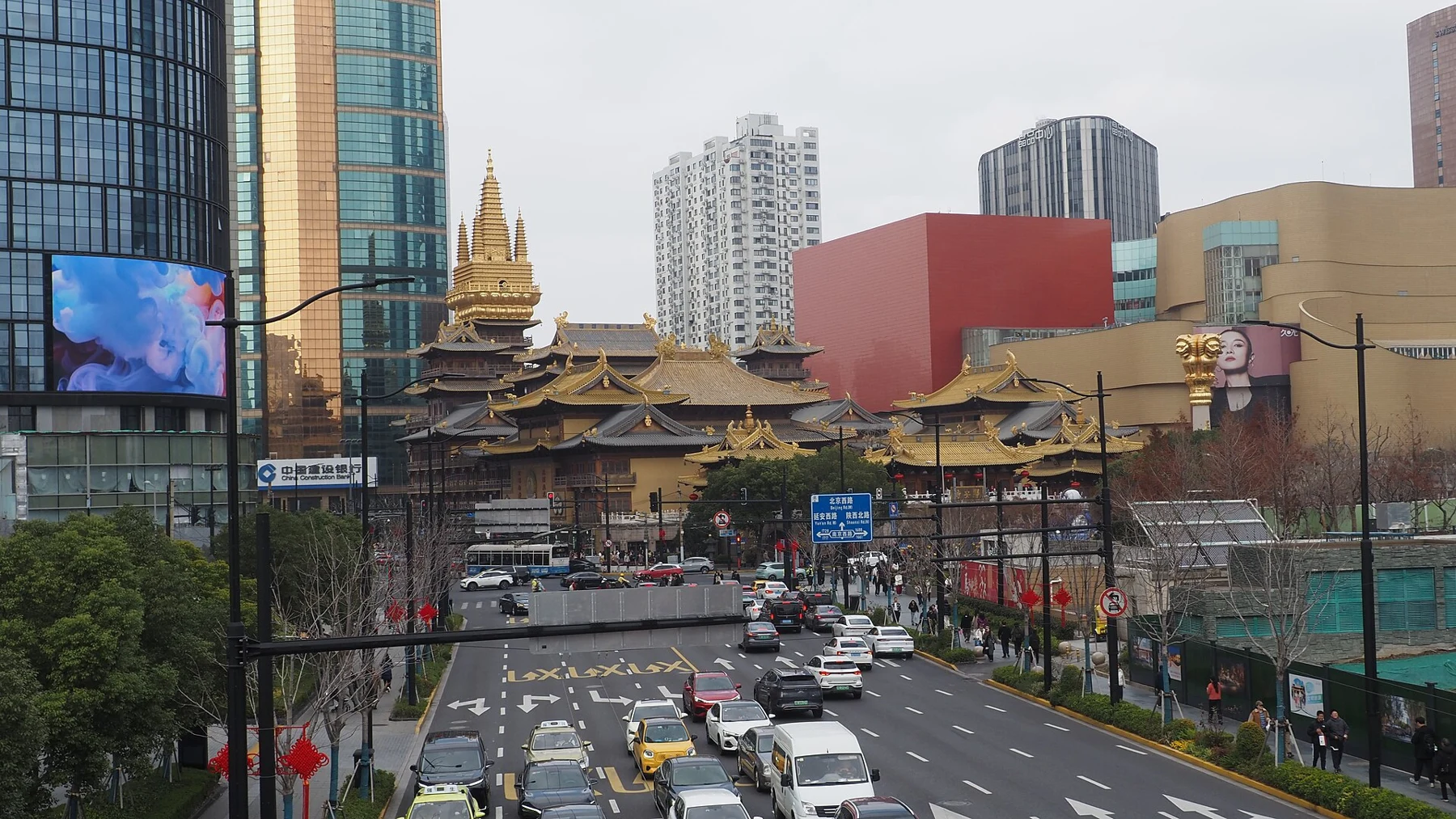
A roofline against the towers
The wide street view is part of this visit’s appeal. Let your eye move between the temple’s horizontal roof layers and the tall buildings behind them. A lower viewpoint stresses the eaves; a wider composition shows how little distance separates the temple from the surrounding city.
If you only want this contrast, an exterior look can be enough. You do not need to buy an interior visit simply to make the same wide street photograph.
Our looking suggestionUse a public pavement or permitted viewpoint. Keep pedestrian crossings, station entrances and the path of other people clear.
Entrance
山门
Read the entrance before joining a queue
The tourism account lists a gate, bell and drum towers, and hall wings. Check the visitor notice and admission arrangement before queueing.[1]
Arrive with time to make a calm decision. If a ceremony or access arrangement changes the visit you wanted, keep an exterior-and-park alternative available.
Our looking suggestionThe metro entrance is not the religious-site gate. Look for the actual temple name and the current admission arrangement rather than following an old photograph.
Temple interior
庭院
A courtyard with a purpose
A courtyard lets you read several buildings together: changes of height, the relationship between a hall and its approach, and the way balconies and eaves enclose the open space. The central incense form and people moving around it also make this a working religious setting, not an empty architectural stage.
The photograph records a particular day in 2011. It helps explain the spatial arrangement; it does not establish today’s crowd level or a permanent visitor route.
Our looking suggestionStand to one side and watch the circulation before choosing a place to pause. Do not block a route used by worshippers or staff.
Temple interior
大雄宝殿
The main hall, at building scale
The 2020 feature describes the main hall as 26 metres high, with 46 large teak columns. Those dimensions help explain the change of scale from courtyard to hall. Look first at the whole composition before trying to take in every carved or gilded detail.[5]
Our looking suggestionCompare the broad roof with the supporting columns and the width of the stair approach. Follow the current boundary rather than treating every stair or balcony as open.
Main hall
银佛
A seated Buddha in silver
The same feature identifies the main hall’s central Buddha as made from 15 tonnes of silver. The reflected light can make its surface appear dark, cool or bright in different photographs. Material and illumination are useful things to notice before looking for size records.[5]
The credited picture is from 2012. Decoration, offerings and the position from which visitors may look can change; the photograph is not a current access guarantee.
Our looking suggestionLook at the relation between the seated figure, its lotus base and the timber structure around it. Ask permission before taking an indoor photograph.
Sculpture
佛像的形与意
Learn to look at a Buddha
The Asian Art Museum explains conventional features such as elongated earlobes, robes, a cranial prominence and symbolic hand positions. Its guide connects a raised outward palm with reassurance and a hand reaching over the knee with calling the earth to witness. These are general art-reading tools, not a catalogue of every Jing’an figure.[14]
Our looking suggestionChoose one visible feature and compare it carefully. Read the local label before naming a particular figure or interpreting an unfamiliar gesture.
Temple interior
佛传图像
A story told across a surface
This April 2024 photograph records a richly populated panel associated by its photographer with the Buddha’s life. Notice how trees, buildings and groups of people divide the surface into smaller scenes. A broad view reveals the composition; a closer permitted look lets you follow one group at a time.
Our looking suggestionUse any available local explanation to identify individual episodes. We have not assigned unverified scene names, dates or a material to this panel.
Temple interior
观音殿
Seek out the Guanyin Hall
The tourism listing includes Guanyin Hall. The Metropolitan Museum identifies Guanyin, or Avalokiteshvara, with compassion. Check the room’s actual label.[1][15]
Give the room time as its own setting. Compare a standing or seated pose, the surrounding decoration and the space left for devotion, using the actual label rather than colour alone to identify what you see.
Our looking suggestionLook for the room label and the way the figure is presented. A gilded appearance alone does not establish whether the underlying material is wood, metal or stone.
Temple interior
木构
Look above the sculpture
The contemporary 2010 construction report identifies Myanmar teak in the principal halls and towers. In the April 2024 interior photograph, the overhead beams and layered supports are worth attention alongside the main sculpture. Look at how repeated members make a frame and how carved details fit within it.[6]
Our looking suggestionFollow a column upward with your eyes. Compare the solid verticals with the smaller layers above; do not touch the structure or step beyond a barrier.
Roofs
铜瓦与飞檐
Copper tiles and a long eave
The tourism account describes copper tiles, projecting eaves and brackets in a Song-style vocabulary, not surviving Song-period fabric.[1]
Our looking suggestionLook at the change from a dark underside to a bright roof edge. A cloudy day can reveal the profile clearly without strong glare.
Exterior detail
象形装饰
Elephants on the roofline
Two elephant ornaments stand out in the 2014 detail photograph. Their curved trunks and compact forms make a playful visual counterpoint to the geometric building behind them. Small repeated motifs become easier to see when you slow down instead of photographing only the whole facade.
Our looking suggestionUse your eyes or an ordinary camera zoom from a permitted place. The photograph does not imply that the roof or an adjacent commercial terrace is open.
Exterior detail
屋脊装饰
A small procession at the ridge
The ridge detail brings several animal-like forms into one line. Compare their silhouettes, direction and spacing rather than assigning an imperial rank or a ritual identity from appearance alone. Such a close view changes the scale of the visit from skyline to craftsmanship.
Our looking suggestionFind one motif, then look for its repetition elsewhere. We have not treated this particular arrangement as proof of a building’s age or status.
Upper roofscape
金塔
Five gilded forms, one modern project
The September 2010 report describes four smaller gilded pinnacles around a larger central one, with gold leaf used in the decoration. Its account is a useful corrective to the idea of a group of solid-gold, ancient or individually climbable towers.[6]
The 2010 report describes construction at that time. It does not provide a current tower-access ticket or an observation-deck promise.
Our looking suggestionLook for how the five forms overlap from your permitted viewpoint. Their apparent grouping changes as you move along the street.
Exterior detail
狮形柱饰
Lions above the street
The 2014 photograph isolates a gilded capital with lions facing outward above a decorated shaft. From the street, it can be easy to mistake all the bright forms for one object. A separate close look reveals the individual heads, paws and the pattern below them.
Our looking suggestionCompare the animal forms with the roof elephants, keeping their different locations clear. We have not inferred an ancient date, material composition or a ritual instruction from the picture.
History within the temple
涌泉
The remembered Bubbling Well
The temple was formerly known in English as Bubbling Well Temple. The 2020 feature says the well was filled in the 1960s and describes a replica below the bell tower. Treat the present interpretation as a reconstruction of a remembered feature, not the unchanged original well.[5]
Our looking suggestionAsk staff whether the interpretation is accessible today. The old “Sixth Spring” epithet is historical praise, not a modern water-quality ranking.
Collection context
洪武钟
An old bell is not every bell
The tourism account lists a 1369 bell among the holdings. Its present display and accessibility need confirmation; the bell tower and that historical object are different things.[1]
Our looking suggestionIf a bell is on view, read its label before connecting it with that date. Do not ring, strike or touch a religious object unless staff explicitly invite it.
Architectural detail
鼓楼
Read the drum tower’s name
The plaque in this 2014 photograph reads 鼓楼, or drum tower. Notice the two roof levels, the repeated tile ends and the carved ridge forms. Reading even two characters can help you distinguish a building from another with a similar profile.
Our looking suggestionThe photographed plaque identifies this drum tower. It is not the historical bell, the reconstructed well or a promise that an upper floor is open.
Optional public-space pause
静安公园
A green interval across the road
A September 2026 district notice reports Jing’an Park recently reopened and the Eight Scenes Garden welcoming visitors free. It offers a different kind of pause from entering another attraction: sit for a while, look at the planting and decide whether you want to continue.[9]
A park break is optional. If you have already had a full day, keep the temple as the anchor and let this be the finish rather than another checklist.
Our looking suggestionCheck the current park signs for any separated garden or work area. Our January 2003 photograph predates the 2026 work and is labelled as an earlier view.
Neighbouring public space
静安寺广场
The square has its own story
The original March 2024 report records the adjacent square reopening after work associated with construction of the Line 14 station. The public-space project and commercial interiors are separate from the temple compound and its religious use.[10]
Our looking suggestionNotice the change in ground level and how people arrive from different directions. Check the actual accessible route instead of assuming every staircase has a nearby lift.
Online reading / historical context
陆深纪游诗
A boat journey, five centuries ago
Shanghai Museum’s record of Lu Shen’s two-day Shanghai travel poems identifies Jing’an Temple among the place names in a journey made with friends. It offers a more personal historical connection than a list of construction dates: people were already writing about moving through this landscape centuries ago.[16]
Our looking suggestionOpen the original museum record below. The manuscript belongs to the museum collection; it is not an object we promise you will see inside this temple.
Optional exterior finish
夜间外观
Return for an exterior view if it suits your day
CGTN published photographs of the illuminated temple taken on 10 May 2025. They show how lighting changes the roofscape on a recorded evening, not a permanent weekly schedule. Treat an evening exterior look as an optional return rather than proof that the halls stay open.[12]
Our looking suggestionChoose a safe public viewpoint and leave the route through the pavement clear. Check the actual lighting and temple notice before building a special journey around it.
Choose what matters
Make the visit yours.
You mainly want the temple-and-city contrast or do not want another paid interior.
A short exterior look.
- Keep
- A clear view, one roof detail and room for a pause.
- The trade-off
- You will not see the main hall’s sculpture or woodwork.
Start on a public pavement
Read the full roofline in its city setting without standing in a station doorway.
Choose two details
Look for an elephant, a ridge form or the lion capital from permitted positions.
Finish at the square or park
Use marked crossings and the actual open public-space route.
Our editorial outline, not a measured or step-free route. An exterior visit does not establish access to the temple compound.
All outlines are editorial estimates, not field-tested routes. Follow current admission rules and venue directions.
Arrival, energy and interpretation
Get the details right.
Find the temple, not just its namesake station.
Use Jing’an Temple metro station on Lines 2, 7 or 14. The operator’s March 2024 notice also records a new surface-to-concourse lift in the link between Lines 2 and 14.[7]
That lift does not establish a fully step-free path through the temple. Ask metro staff for the working lift to street level, and separately ask temple staff about thresholds, stairs and the areas you want to visit.
For a taxi, save 静安寺,南京西路1686号 and use a legal nearby stopping place. The address is supported by the municipal brochure; no designated curbside drop-off has been confirmed.[4]
Useful questions at the temple.
Show the Chinese or copy it to ask about today’s arrangements. An English or pinyin rendering is included for orientation.
- 请问今天怎么购买香花券?需要提前预约吗?
How can I buy admission today? Do I need an advance reservation?
Qǐngwèn jīntiān zěnme gòumǎi xiānghuāquàn? Xūyào tíqián yùyuē ma?
- 请问今天几点停止入寺?
What is today’s last entry time?
Qǐngwèn jīntiān jǐ diǎn tíngzhǐ rù sì?
- 请问这里可以拍照吗?
May I take photographs here?
Qǐngwèn zhèlǐ kěyǐ pāizhào ma?
- 请问哪里可以敬香?
Where is incense permitted?
Qǐngwèn nǎlǐ kěyǐ jìngxiāng?
- 请问去大雄宝殿有无台阶的路线吗?
Is there a route to the main hall without steps?
Qǐngwèn qù Dàxióng Bǎodiàn yǒu wú táijiē de lùxiàn ma?
- 我要去静安寺寺庙,请问从哪个出口走?
I want to go to the temple itself. Which station exit should I use?
Wǒ yào qù Jìng’ān Sì sìmiào, qǐngwèn cóng nǎge chūkǒu zǒu?
These questions do not promise that a particular service or route is available. Ask staff to point out the actual option.
Worship and photography
Keep voices low, leave people worshipping out of close photographs, and ask before photographing inside a hall. Follow current signs and staff directions. Our practical suggestion is to step over a threshold where safe rather than stand on it.
A January 2025 police account describes temporary waiting areas and managed circulation for the Lunar New Year. Those were event arrangements, not the everyday route; allow more flexibility on major observances.[11]
Incense, offerings and payment
Ask what the admission includes and where incense is permitted. We have not verified an included quantity, a required purchase, a donation amount or permission to use outside incense. Taking part in a ritual is a personal choice.
Mobility, children and a break
Ask about the exact route you need before buying. The park or a short exterior view may suit a different energy level, but neither is a tested complete accessible itinerary. Keep children close around stairs and busy station approaches.
Food and luggage
Choose a currently open business after reading its actual menu. A vegetarian label alone does not resolve every allergy or dietary requirement. Current temple meal service, luggage storage and their fees have not been verified.
City News Service / SHINE · Yan Jingyang and Wang Xinzhou · 5 March 2025
A filmed comparison, not one continuous temple walk.
City News Service / SHINE · Yan Jingyang and Wang Xinzhou · 5 March 2025 · Recorded editorial feature · about 3 minutes 26 seconds
Three temples with visiting Thai hosts
The hosts visit Jing’an Temple, Jade Buddha Temple and Longhua Temple. These are different locations, not one continuous walk through Jing’an. Check current admission separately.
Watch at City News ServiceOpens the publisher’s own player in a new tab. English subtitles were visible in the inspected excerpt. The original played on the first check; repeat loading and seeking were unreliable. The cover is a credited reference photograph, not a film still.
- Two Thai hosts visit Jing’an Temple, Jade Buddha Temple and Longhua Temple; scenes belong to different locations.
- English subtitles were visible in the inspected excerpt. This is a recorded editorial feature, not current admission advice.
- Open the publisher’s player. Availability can vary; no video file is rehosted here.
LOOK & READ
Something useful before you go.
We have not verified a working interactive Jing’an panorama. A licensed photo gallery and these original readings offer preparation without labelling an ordinary video as a 360-degree tour.
A visitor’s poem, in the museum collection
The Chinese record connects Lu Shen’s Ming-period travel poems with a two-day boat journey that included Jing’an. Its illustrated manuscript is a museum object, not a temple room or a promised current display.[16]
Read Shanghai Museum’s object recordHow to identify a Buddha
An English introduction to conventional features and hand gestures. Use it to look more carefully, then rely on the local label to identify a particular figure.[14]
Open the Asian Art Museum’s looking guideA third-party panorama listing reached an access-verification page rather than imagery. We stopped without bypassing it and do not advertise it as a usable tour.
The photographs below retain capture dates and credits. They are real recorded views, not live images or computer-generated scenery.
Before you ask.
Is it worth paying to go inside?
Choose the interior for the main hall, sculpture and timber details, with time to respect the religious setting. For the contrast between golden roofs and modern towers, an exterior look may meet your goal. This is an editorial choice, not a universal ranking.
Is the current temple almost 1,800 years old?
Its traditional origin story and the age of the visible fabric are different. Relocation and substantial modern reconstruction are part of the published history; treat the building you see as layered.
Is CNY 50 the confirmed price for my visit?
It is the ordinary price in the February 2026 itinerary, not a live tariff for your chosen date. Confirm the current temple notice and any concession before payment.
Can I see it at night?
An evening exterior view is a separate choice. A dated illuminated photograph does not establish a weekly lighting timetable, late admission or open halls.
Can I visit the Jade Buddha Temple with the same ticket?
No shared ticket is established here. Jade Buddha Temple is a different institution; the film visits several sites and should not be read as a map of this compound.
Does the metro lift mean the temple is accessible?
The recorded station lift concerns the metro’s surface-to-concourse connection. Temple stairs, thresholds, available assistance and a complete step-free route require a separate check.
Dates, sources and photographs
Follow the evidence.
We read original tourism, institutional and dated municipal sources, contemporary reporting and museum interpretation. Dated itinerary figures are distinguished from an unverified current temple notice. Community anecdotes inform questions rather than general rules. Visit outlines and looking prompts are editorial suggestions, not measured routes. Genuine licensed photographs were visually matched to their actual subjects; dates and rebuilding context are retained.
Reviewed 2026-10-29. This date records our source review, not a live availability check.
Open 18 source references
- Shanghai tourism authority: Jing’an Temple
Institutional visitor background · Reviewed 2026-10-29
- Shanghai Jing’an Temple: current website and WeChat entry point
Institutional portal; current ticket transaction untested · Reviewed 2026-10-29
- Shanghai Songjiang government account: agency competition itinerary, 23 February 2026
Dated authority-hosted travel-agency submission, not temple notice · Reviewed 2026-10-29
- Shanghai municipal bilingual travel brochure: landmarks, PDF page 13
Municipal brochure; publication/effective date not established · Reviewed 2026-10-29
- Zhang Xuefei / SHINE: temple history and administrative interview, 10 January 2020
Original reporting in municipal archive; same article mirrors not independent · Reviewed 2026-10-29
- Wang Nan / News Evening: modern rebuilding and gilded pinnacles, 10 September 2010
Contemporary construction reporting via China News · Reviewed 2026-10-29
- Shanghai Metro Second Operation Company: new station passage and lift, 15 March 2024
Operator notice in Shanghai Metro’s publication account · Reviewed 2026-10-29
- Chen Yixin / The Paper: station wayfinding investigation, 10 July 2024
Original on-site reporting; dated sign conditions · Reviewed 2026-10-29
- Jing’an district: park reopening and free Eight Scenes Garden, 15 September 2026
Current dated district public-space context · Reviewed 2026-10-29
- Tang Ye / Jiefang Daily: adjacent square reopening, 19 March 2024
Original newspaper reporting in municipal portal · Reviewed 2026-10-29
- Shanghai Public Security: Lunar New Year crowd management, 7 February 2025
Dated authority event arrangements, not ordinary visitor route · Reviewed 2026-10-29
- CGTN / VCG: illuminated temple photographs, 16 May 2025
Dated original picture feature; capture 10 May 2025 · Reviewed 2026-10-29
- City News Service: three temples with Thai hosts, 5 March 2025
Original editorial film; external player and availability limits · Reviewed 2026-10-29
- Asian Art Museum: How to Identify a Buddha
Museum education; general iconography, not temple inventory · Reviewed 2026-10-29
- Metropolitan Museum: Sudhana record and Guanyin context
Museum interpretation; object belongs to another institution · Reviewed 2026-10-29
- Shanghai Museum: Lu Shen’s two-day Shanghai travel poems
Original collection record; Chinese-language historical reading · Reviewed 2026-10-29
- Traveller questions: Shanghai tickets, January 2026
Community anecdote; not an admission rule · Reviewed 2026-10-29
- Traveller questions: Jing’an and Shanghai Museum, April 2026
Community anecdote; conflicts with January answer · Reviewed 2026-10-29
Photograph authors, dates and licences (19 photographs)
Jim Bowen: https://www.flickr.com/people/jamiedfw/ · 2012-12-25 · CC BY 2.0
Resized and converted to WebP. Image-file proportions retained; hero and preview layouts may crop the display. Original licence retained.
Huntsmanleader · 2026-02-28 01:46:14 · CC0
Resized and converted to WebP. Image-file proportions retained; hero and preview layouts may crop the display. Original licence retained.
Potatohai · 2011-09-09 · CC BY-SA 3.0
Resized and converted to WebP. Image-file proportions retained; hero and preview layouts may crop the display. Original licence retained.
Chainwit. · 2024-04-23 16:07:13 · CC BY 4.0
Resized and converted to WebP. Image-file proportions retained; hero and preview layouts may crop the display. Original licence retained.
Chainwit. · 2024-04-23 16:04:07 · CC BY 4.0
Resized and converted to WebP. Image-file proportions retained; hero and preview layouts may crop the display. Original licence retained.
Ctny · 2012-06-26 · CC BY-SA 3.0
Resized and converted to WebP. Image-file proportions retained; hero and preview layouts may crop the display. Original licence retained.
TimBray · 2011-11-04 · CC BY-SA 3.0
Resized and converted to WebP. Image-file proportions retained; hero and preview layouts may crop the display. Original licence retained.
Hermann Luyken · 2014-11-17 12:06:30 · CC0
Resized and converted to WebP. Image-file proportions retained; hero and preview layouts may crop the display. Original licence retained.
Hermann Luyken · 2014-11-17 12:07:17 · CC0
Resized and converted to WebP. Image-file proportions retained; hero and preview layouts may crop the display. Original licence retained.
Hermann Luyken · 2014-11-17 12:08:59 · CC0
Resized and converted to WebP. Image-file proportions retained; hero and preview layouts may crop the display. Original licence retained.
Hermann Luyken · 2014-11-17 12:12:57 · CC0
Resized and converted to WebP. Image-file proportions retained; hero and preview layouts may crop the display. Original licence retained.
Hermann Luyken · 2014-11-17 12:13:40 · CC0
Resized and converted to WebP. Image-file proportions retained; hero and preview layouts may crop the display. Original licence retained.
Hermann Luyken · 2014-11-17 12:14:23 · CC0
Resized and converted to WebP. Image-file proportions retained; hero and preview layouts may crop the display. Original licence retained.
Hermann Luyken · 2014-11-17 12:14:52 · CC0
Resized and converted to WebP. Image-file proportions retained; hero and preview layouts may crop the display. Original licence retained.
Hermann Luyken · 2014-11-17 12:15:04 · CC0
Resized and converted to WebP. Image-file proportions retained; hero and preview layouts may crop the display. Original licence retained.
Hermann Luyken · 2014-11-17 12:15:29 · CC0
Resized and converted to WebP. Image-file proportions retained; hero and preview layouts may crop the display. Original licence retained.
Hermann Luyken · 2014-11-17 12:21:39 · CC0
Resized and converted to WebP. Image-file proportions retained; hero and preview layouts may crop the display. Original licence retained.
Hermann Luyken · 2014-11-17 12:21:57 · CC0
Resized and converted to WebP. Image-file proportions retained; hero and preview layouts may crop the display. Original licence retained.
CyberCop · Taken on 23 January 2003 · CC BY 3.0
Resized and converted to WebP. Image-file proportions retained; hero and preview layouts may crop the display. Original licence retained.
How conflicting descriptions were handled
The municipal and SHINE versions reproduce the same January 2020 feature.[5]
The February 2026 itinerary is a travel-agency entry hosted by a government account. Its ordinary fee and hours are attributed and dated; its holiday figures are not extended to future festivals.[3]
The official website’s WeChat link did not expose an ordinary-browser ticket notice. We did not authenticate, reserve, pay or infer a general walk-up policy from that access limit.[2]
The 2024 square report describes the adjacent public space; it does not describe a temple closed for eight years.[10]
The municipal landmarks brochure gives hours but no effective date was established in the reviewed document. We do not invent a 2026 publication date from a search engine estimate.[4]
The real night photographs show one May 2025 evening. Weekly lighting assertions, current free days and a supposed 16:30 last entry remain unconfirmed.[12]
What still needs direct confirmation
- Current temple notice, exact last entry, booking requirement and foreign-document/payment processing.
- Current concessions, free dates, incense inclusions and any exceptional festival tariff.
- Opening of individual rooms, access to the well interpretation and current display of collection objects.
- Complete physical accessibility, active lifts, luggage services and any current meal service.
- A permanent illumination timetable and reliable complete external-film or panorama availability.
Film verification: On the initial check the original player advanced to 3.200322 seconds; duration 205.59 seconds, 1080 × 1920 pixels. A 25-second excerpt with English subtitles was inspected. A repeat playback attempt timed out and seeking was unreliable, so the site links to the publisher rather than offering a local inline player. Physical-phone and regional playback are untested.
In this guide